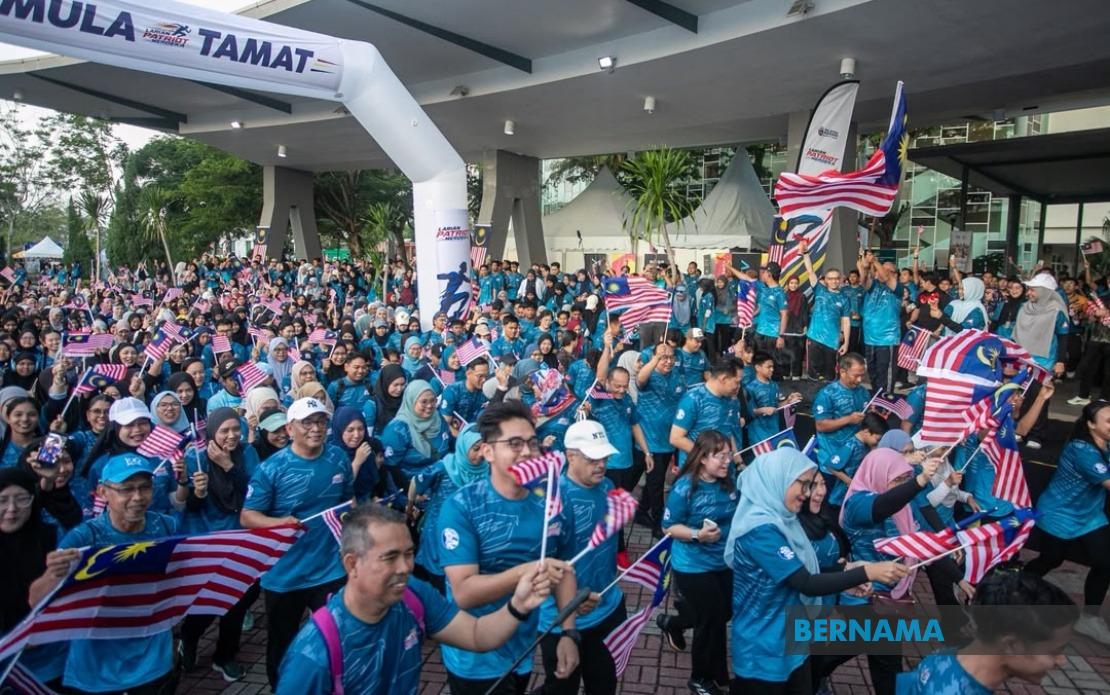
Ipoh played host on Friday morning to a festive community gathering as approximately 2,000 residents turned out for the Patriot Merdeka Run, an event designed to kindle national spirit ahead of the 2026 National Day and Malaysia Day celebrations. The Sultan Azlan Shah Ministry of Health Training Institute (ILKKM SAS) became a hub of activity from early dawn, with families of all ages arriving to participate in what organisers framed as a celebration of patriotism and national unity. The visible presence of children, elderly participants and entire family units underscored the inclusive nature of the initiative, which sought to bridge generational and social divides through a shared commitment to Malaysia's independence legacy.
The morning's proceedings began with an energetic mass aerobics session that set a buoyant tone for the occasion. Participants subsequently gathered to collectively wave the Jalur Gemilang, transforming the flag-waving gesture into a symbolic expression of national affection and cohesion. This carefully choreographed opening demonstrated how even routine civic activities could be leveraged to reinforce patriotic sentiment across diverse population groups. The organisers' decision to sequence the aerobics before the run itself appeared calculated to build momentum and foster a sense of collective participation, moving beyond passive observation toward active engagement with national symbols.
Datuk Abdul Halim Hamzah, serving as secretary-general of the Communications Ministry, formally commenced the 2.5-kilometre fun run at 7.30 am. The route itself became a visual manifestation of national pride, with the Jalur Gemilang positioned at intervals along the entire pathway, creating an immersive environment where patriotism became impossible to overlook. The choice of a 2.5-kilometre distance—neither overly demanding nor trivial—reflected careful consideration of accessibility for participants of varying fitness levels, ensuring that the event functioned genuinely as a community activity rather than an exclusive competition.
Participant attire and behaviour painted a picture of enthusiastic national engagement. Many runners donned clothing incorporating the colours of the Jalur Gemilang—red, white, blue and gold—transforming the gathering into a moving kaleidoscope of national symbolism. Parents shepherded young children through the route, often carrying them or adjusting their pace to match smaller legs. Between participants, spontaneous cheers and encouragement created an atmosphere of goodwill that transcended the formal athletic component of the event. These organic social interactions represented the genuine fabric of community cohesion that national campaigns often aspire toward but seldom achieve.
For Malaysia's government communications apparatus, the run served a dual purpose that merits consideration. On one level, it functioned as a legitimate public health initiative, addressing the chronic underactivity that plagues urban Malaysian populations. On another level, it represented a carefully orchestrated platform for cultivating patriotic sentiment at a grassroots level, leveraging popular participation in fitness activities to reinforce emotional attachment to national symbols and independence narratives. The marriage of wellness and patriotism suggested that government messaging strategies increasingly seek to embed national values within lifestyle activities rather than presenting them as abstract civic duties.
The Patriot Merdeka Run constitutes merely the opening salvo in a broader calendar of commemorative events scheduled for the 2026 National Day and Malaysia Day (HKHM 2026) celebrations. Organisers envision such activities as instruments for nurturing sustained national unity and deepening public comprehension of independence's significance—particularly important as Malaysia approaches its seventh decade since Merdeka, when historical memory may fade among younger generations. By anchoring patriotic messaging within participatory community events, programme planners attempted to make national identity a lived experience rather than merely an inherited concept.
Prime Minister Datuk Seri Anwar Ibrahim was scheduled to formally inaugurate the broader 2026 celebrations at 10 am the same morning, elevating the Ipoh run's significance within the official national calendar. His participation signalled that despite the ground-level grassroots character of the Patriot Merdeka Run, government leadership viewed it as sufficiently important to anchor their involvement. Such top-level engagement often serves to amplify media coverage and public awareness, translating localised community activities into national narratives.
The Fly the Jalur Gemilang Campaign (MPBKKJG 2026), of which Friday's run formed part, represents the government's comprehensive strategy for building patriotic momentum throughout the year preceding Malaysia Day 2026. Such long-lead campaigns acknowledge that sustained national sentiment requires more than annual moments of commemoration—they necessitate ongoing reinforcement across multiple platforms and activities. By launching initiatives twenty months in advance of the target celebration, authorities sought to maintain patriotic consciousness within public discourse throughout an extended period.
For Malaysian observers attuned to government messaging patterns, the Ipoh gathering illustrated the administration's preference for incorporating civic participation within health and wellness frameworks. This approach sidesteps the potential for patriotic campaigns to appear purely propagandistic by embedding them within activities that offer tangible personal benefits—improved fitness, family bonding, community socialisation. The strategy acknowledges public sophistication regarding government campaigns whilst simultaneously reinforcing that national values remain compatible with individual wellbeing and social enjoyment.
The participation of approximately 2,000 residents in Ipoh reflected reasonable uptake for a provincial launch event, suggesting that patriotic messaging retains genuine resonance within Malaysian communities when presented through accessible, participatory channels. The multi-generational character of attendance—spanning young children to elderly participants—indicated that independence narratives continue to matter across age cohorts, though perhaps for different reasons. Younger generations may have engaged primarily through the activity's social and health dimensions, whilst older participants likely possessed more direct historical consciousness regarding independence's meaning and achievement.

