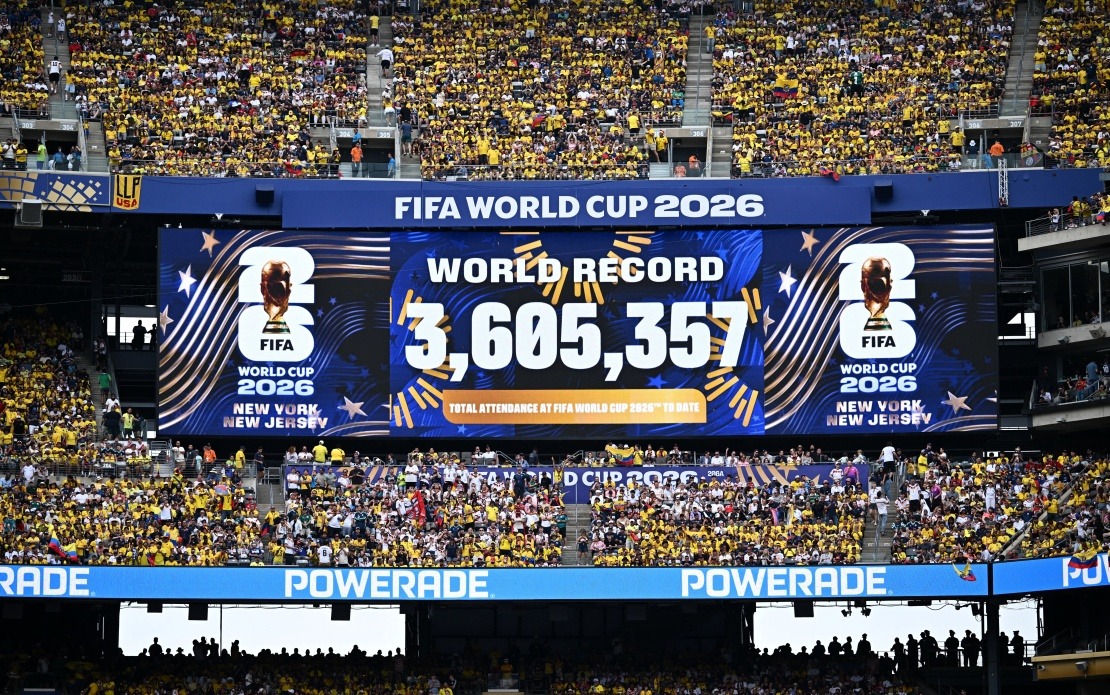
The 2026 FIFA World Cup has achieved a historic milestone by becoming the most well-attended tournament in the competition's 96-year history. During the second half of Germany's encounter with Ecuador at East Rutherford in New Jersey on Thursday, the milestone was officially announced across stadium screens, with the attendance figure reaching 3,605,357. The announcement prompted enthusiastic applause from supporters in attendance, marking a significant moment in sporting history.
This new record surpasses the previous benchmark set in 1994, when the World Cup in the United States recorded attendance figures of nearly 3.6 million across 52 matches. The timing of the announcement—midway through a major group-stage fixture—underscores the sustained level of public engagement with the tournament across its duration. The scale of this achievement becomes particularly striking when considering the tournament structure and scale of participating nations.
The 2026 edition features an expanded format with 48 teams competing across 16 host cities, a significant increase from the traditional 32-team configuration. This structural change has fundamentally transformed how the tournament distributes matches geographically and temporally. With approximately 80 matches constituting the full tournament schedule, and 48 fixtures still pending at the time of the announcement, the final attendance figures are projected to nearly double the 1994 record. Should current average attendance levels persist through the remaining matches, the tournament could accumulate somewhere in the region of 5.5 million to 6 million total spectators.
The consistency of public interest has proven remarkable. Stadiums hosting 2026 World Cup matches have maintained average occupancy exceeding 99 percent throughout the tournament's progression. This extraordinarily high capacity utilisation across such a prolonged schedule demonstrates unprecedented enthusiasm for the global football spectacle. The expansion to multiple host nations and cities has enabled broader geographic distribution of fixtures, potentially reducing travel barriers for fans and expanding the accessible audience base across North America.
FIFA President Gianni Infantino attributed the achievement to football's intrinsic capacity to galvanise global audiences and foster unity through sport. He highlighted the exceptional atmospheric conditions witnessed across the 16 host cities and their respective stadiums, characterising the tournament environment as one of celebration and collective joy. This observation reflects observations that extend beyond mere numerical metrics to encompass the qualitative experience created within sporting venues and host communities.
The 2026 World Cup's venue distribution across multiple North American cities—spanning the United States, Mexico, and Canada—has facilitated unprecedented access for continental audiences. Unlike tournaments concentrated in single nations, the distributed model enables fans across a vast geographic region to experience matches without necessarily travelling across entire continents. This logistical advantage, combined with the expansion to 48 teams, has generated multiple simultaneous matchday events, potentially distributing spectator interest more evenly across the tournament schedule.
For Malaysian and Southeast Asian football enthusiasts, the 2026 tournament's performance metrics carry implications regarding future tournament hosting and investment in sporting infrastructure. The demonstration of public appetite for international football events, even in mature markets like North America, suggests sustained global demand for World Cup experiences. The record-breaking attendance also reinforces football's commercial and cultural significance as a unifying global phenomenon, particularly relevant as Southeast Asian nations increasingly prioritise sports tourism and infrastructure development.
The expanded tournament format represents a deliberate FIFA strategy to broaden participation and accessibility. By accommodating 48 teams rather than 32, the organisation has enabled qualification for additional nations and created additional fixtures, theoretically enhancing appeal across more global regions. The attendance records validate this expansion strategy from a commercial perspective, though ongoing discussions continue regarding the format's competitive integrity and match quality implications.
The 1994 United States World Cup, which previously held the attendance record, occurred during a period when football's mainstream popularity in North America remained considerably lower than current levels. The intervening three decades have witnessed substantial growth in professional soccer's profile, investment, and viewership across the continent. The 2026 tournament has thus capitalised on this evolved sporting landscape, with developed infrastructure and substantially larger stadium capacities compared to the 1994 era.
Looking forward, the trajectory established by 2026 will likely influence future tournament planning and venue selection processes. Tournament organisers will increasingly recognise the commercial potential inherent in multi-city, multi-nation hosting arrangements, particularly when combined with expanded team participation. The record-breaking attendance figures provide compelling evidence supporting continued investment in football infrastructure and the economic viability of hosting major international tournaments in markets with substantial populations and existing sporting traditions.

