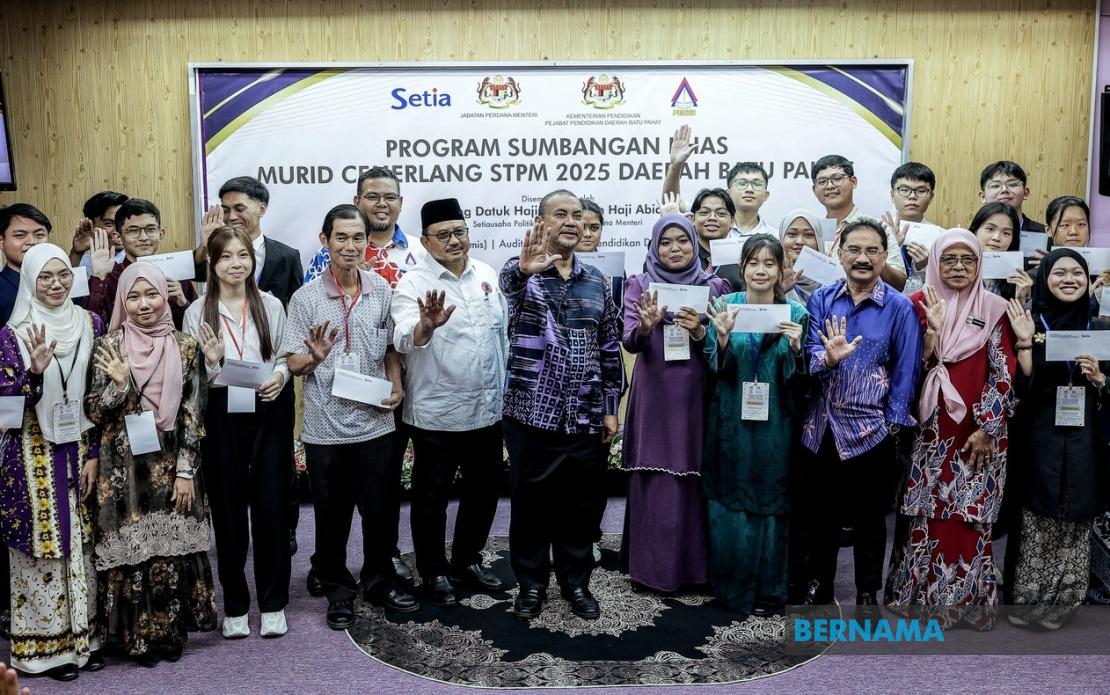
The Prime Minister's Office has distributed special recognition contributions to 214 outstanding Sijil Tinggi Persekolahan Malaysia (STPM) students in the Batu Pahat district, marking a significant gesture toward recognizing educational achievement across the region. The initiative, unveiled during the 2025 STPM Top Achievers Award Ceremony held at the Batu Pahat District Education Office, demonstrates the federal government's commitment to supporting Malaysia's brightest secondary school graduates as they prepare for the next phase of their academic journeys.
Datek Azman Abidin, Political Secretary to the Prime Minister, explained that the beneficiaries represented top performers from 16 secondary schools throughout the district. He articulated the core objective of the programme: to inspire the recipients to maintain their academic trajectory and pursue further studies at the tertiary level whilst simultaneously serving as positive role models for their peers. The recognition extends beyond symbolic acknowledgment, with tangible financial contributions intended to ease the transition from secondary to higher education.
According to Azman, the government views this initiative as part of its broader strategy to demonstrate investment in Malaysia's education sector and youth development. He underscored that the programme reflects the administration's dedication to empowering the younger generation through targeted support mechanisms. While the current distribution is geographically limited to Batu Pahat, Azman indicated that expansion to other districts remains under consideration, contingent upon budget allocation and available government resources. This conditional scaling suggests that the programme's long-term viability will depend on sustained political will and financial commitments in subsequent budget cycles.
Among the recipients was Afida Auni Airulnizam, a 20-year-old alumna of Sekolah Menengah Kebangsaan Tun Sardon in Rengit, who articulated the dual significance of the award. For her, the contribution represents both formal recognition of her academic diligence and concrete encouragement to pursue tertiary studies without excessive financial strain. As the younger of two siblings, Afida draws inspiration from her older brother's university experience and views his academic path as a blueprint for her own aspirations. She is particularly keen on pursuing sports science at the tertiary level, should she receive placement through Malaysia's university admission system.
The experiences of recipients like Afida highlight an often-overlooked dimension of educational excellence in Malaysia: the persistent concern among high-achieving students from middle-income backgrounds regarding the financial feasibility of university attendance. While these students possess the academic credentials for competitive tertiary programmes, the absence of substantial financial support can create psychological barriers or force difficult compromises in course selection. By addressing this concern directly, the Prime Minister's contribution programme potentially removes a significant obstacle to talent mobilization in the country's higher education sector.
Muhd Ammar Firdaus Mohd Fadzil, another 20-year-old recipient from SMK Tun Ismail, welcomed the initiative with particular emphasis on its practical utility. He noted that the financial assistance would materially reduce the burden of preparation and transition costs associated with university entry. These expenses, often underestimated in education policy discussions, encompass registration fees, accommodation deposits, purchasing textbooks, acquiring laboratory or studio equipment, and related costs that accumulate rapidly before students receive their first financial aid disbursements.
The recognition of STPM students is strategically significant within Malaysia's educational landscape. The STPM, serving as the traditional gateway to Malaysian public universities for many students, produces graduates with advanced foundational knowledge in specialized disciplines. However, the cohort-based distribution of university placements can create anxiety among top performers, particularly those competing for spaces in high-demand programmes. The Prime Minister's award provides not only financial relief but also symbolic affirmation that governmental institutions acknowledge and value the dedication these students have demonstrated.
From a regional perspective, Malaysia's investment in recognizing top secondary school achievers reflects broader Southeast Asian trends toward identifying and nurturing academic talent at earlier stages. Countries including Thailand, Vietnam, and Indonesia have implemented similar recognition programmes, reflecting a shared understanding that visible government support for educational excellence can positively influence national academic culture. Such initiatives, particularly when accompanied by tangible financial benefits, send clear signals to the broader student population regarding societal valuation of academic achievement.
The expansion potential mentioned by Azman warrants close examination. Limiting the current programme to Batu Pahat, a district with approximately 400,000 residents, suggests a pilot approach rather than a comprehensive national roll-out. If the scheme is extended to other districts with comparable populations, the national scope could expand to encompass thousands of students annually. However, such expansion would require substantial budget reallocation within the education ministry's portfolio, potentially creating difficult prioritization decisions between competing initiatives such as infrastructure development, teacher training programmes, and curriculum innovation.
The timing of the awards programme also carries implicit significance. Announced in June, shortly before the commencement of most Malaysian universities' intake periods, the contribution arrives at a psychologically optimal moment for students finalizing their higher education decisions. This strategic timing suggests deliberate policy coordination between the Prime Minister's Office and the Ministry of Education, indicating that such initiatives are unlikely to be entirely ad hoc or reactive.
Looking forward, the sustainability of this programme depends on several factors beyond immediate funding availability. Public perception of fairness and inclusivity will prove crucial—if the programme appears geographically concentrated or favours students from particular demographic backgrounds, it could generate counterproductive sentiment despite its positive intentions. Additionally, the long-term impact assessment will require tracking whether recipients complete their tertiary studies, achieve employment outcomes, and subsequently contribute to Malaysia's professional workforce and tax base.
The recognition of academic excellence through government-backed awards also carries implications for how Malaysia positions itself within regional competition for educational prestige. As universities across Southeast Asia increasingly market themselves on student achievement metrics and graduate outcomes, government support for top-performing secondary students signals confidence in the quality of Malaysia's educational pipeline. This positioning could strengthen Malaysia's appeal to prospective international students considering universities in the region.
Ultimately, the initiative represents a pragmatic acknowledgment that financial constraint should not determine access to quality tertiary education for Malaysia's most academically talented youth. As these 214 students progress to universities across the country, their success or challenges will provide valuable data regarding the effectiveness of targeted financial support in removing barriers to educational mobility. The programme's expansion or contraction in subsequent years will likely depend on whether government evaluators assess these outcomes as justifying continued investment.

