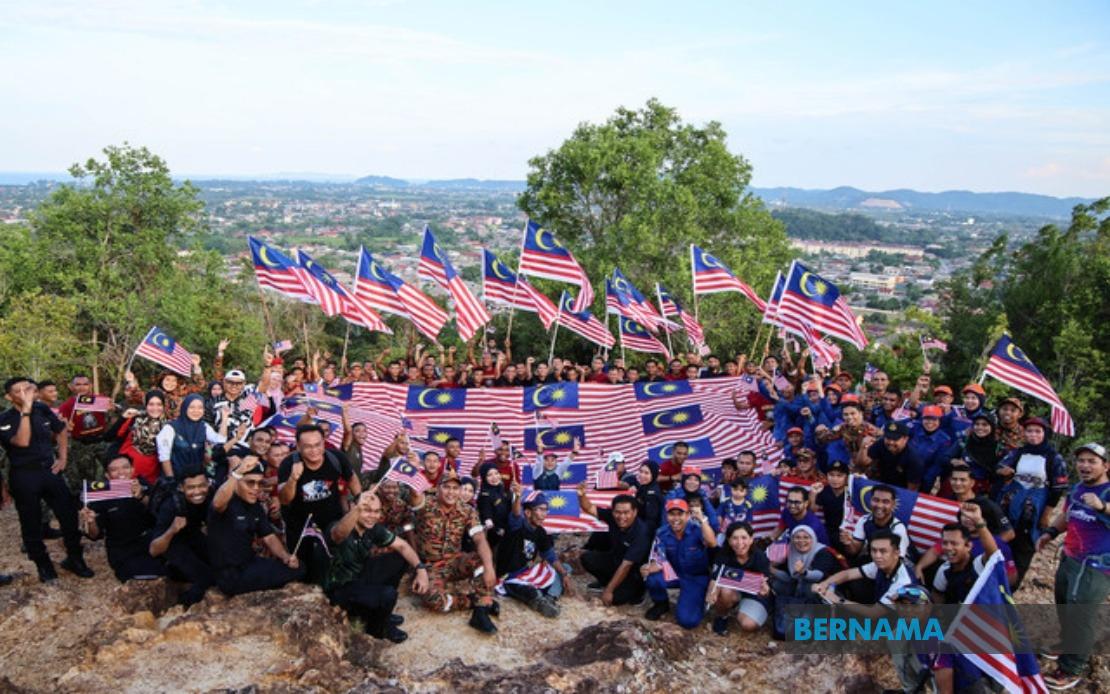
An inaugural patriotic gathering drew 300 uniformed officers, government employees and journalists to Kuala Terengganu on August 21, uniting representatives from multiple agencies in a summit hike designed to honour the nation during National Month. The collaborative climb represented an ambitious attempt to weave together institutional pride with public demonstration of national unity, bringing together personnel whose daily responsibilities span law enforcement, defence, customs, civil protection and anti-corruption work.
The Malaysia Telecommunications and Resources Association (METRA) orchestrated the event, with METRA president Mohd Zaid Mohd Noor emphasising the broader purpose behind assembling such a diverse contingent. According to Mohd Zaid, the climbing initiative served as a tangible expression of patriotic sentiment, one that would resonate beyond the immediate participants through media coverage and public awareness. The involvement of journalists underscored recognition that institutional celebrations require amplification through professional communication channels to achieve genuine national resonance.
The participating agencies reflected the breadth of Malaysia's governmental apparatus. The Terengganu Fire and Rescue Department (JBPM) and Malaysian Armed Forces (ATM) brought frontline operational personnel accustomed to high-stakes coordination. The Road Transport Department (JPJ) and Malaysian Anti-Corruption Commission (MACC) contributed regulatory and enforcement expertise. The Terengganu division of the Ministry of Domestic Trade and Cost of Living (KPDN), the Royal Malaysian Customs Department (JKDM) and the Malaysia Civil Defence Force (APM) each contributed institutional representation, creating a cross-sector assembly rarely achieved outside formal government coordination structures.
Mohd Zaid articulated a dual rationale for the exercise. First, he positioned the climb as a statement of love for Malaysia, channelling patriotic sentiment into concrete action rather than rhetoric. This framing acknowledged that National Month celebrations risk becoming repetitive ceremonial exercises unless anchored to meaningful participation. By requiring participants to physically exert themselves en route to a summit—a destination symbolically elevated above ordinary ground level—organisers created a metaphorical journey toward national aspiration.
Second, METRA explicitly recognised media's catalytic role in disseminating patriotic messaging. As Mohd Zaid noted, journalists bear institutional responsibility for communicating values beyond their newsrooms, leveraging diverse communication platforms to shape public discourse. This articulation placed media practitioners not as neutral observers but as active agents in nation-building, a positioning that reflects Southeast Asian governance traditions where press organisations are frequently expected to participate in official messaging rather than maintain distance.
The summit climb incorporated a visual centrepiece that remained only partially described in available accounts: organisers planned to unfurl a giant flag at the peak. This symbolic act would transform the climb into a staged spectacle, generating imagery suitable for broadcast and publication. The flag deployment strategy illustrates how modern patriotic demonstrations blend physical participation with media-friendly visuals, recognising that contemporary celebrations require both on-ground participation and distributed digital presence.
Beyond immediate celebratory function, Mohd Zaid identified secondary institutional benefits. The event provided what he characterised as a platform for strengthening inter-agency ties, acknowledging that collaboration among diverse government organisations often requires structured settings to develop beyond standard bureaucratic channels. By placing personnel from different agencies in shared physical challenge, organisers created informal bonding opportunities that formal meetings rarely facilitate. This capacity-building dimension carries particular relevance in Malaysia's federated structure, where coordination between federal agencies and state-level implementation bodies frequently faces institutional friction.
The promotion of healthy lifestyle constituted a tertiary messaging layer embedded within the patriotic framework. By coupling physical exertion with national celebration, event organisers reframed fitness as patriotic obligation rather than individual health choice. This rhetorical move reflects broader Southeast Asian governance approaches that frequently integrate public health messaging within nationalist narratives, positioning bodily wellness as contributory to national strength.
The timing during National Month (August) positioned the initiative within Malaysia's annual calendar of national commemoration, a period when patriotic expression becomes institutionally sanctioned and encouraged. Terengganu as venue held particular significance, representing a state with distinct cultural identity within the Malaysian federation, suggesting that coordinators intentionally chose a non-federal territory to demonstrate national unity through geographically dispersed participation.
For Malaysian readers and regional observers, this gathering exemplifies how Southeast Asian governments operationalise patriotic sentiment through institutional participation. Unlike Western democratic contexts where citizens typically encounter national celebrations through passive consumption of public ceremonies, Malaysian approaches frequently demand active participation from government workers, positioning employment within the state apparatus as carrying inherent patriotic obligations. The requirement that journalists participate alongside security forces reflects expectation that media institutions share governmental objectives rather than maintain autonomous critical distance.
The event also demonstrates how regional governance structures attempt to address persistent inter-agency coordination challenges through shared experience and informal relationship-building. Rather than establishing formal liaison committees, Malaysian authorities increasingly employ celebratory occasions as venues where institutional representatives naturally interact, building social capital that subsequently facilitates operational coordination.
For Southeast Asian media organisations and journalism practitioners, the Terengganu summit hike signals evolving expectations regarding media's role in state-sanctioned patriotic expression. The explicit inclusion of journalists among participants, rather than as external observers, reflects regional norms positioning press organisations as stakeholders in national projects rather than as detached chroniclers of governmental activity.

