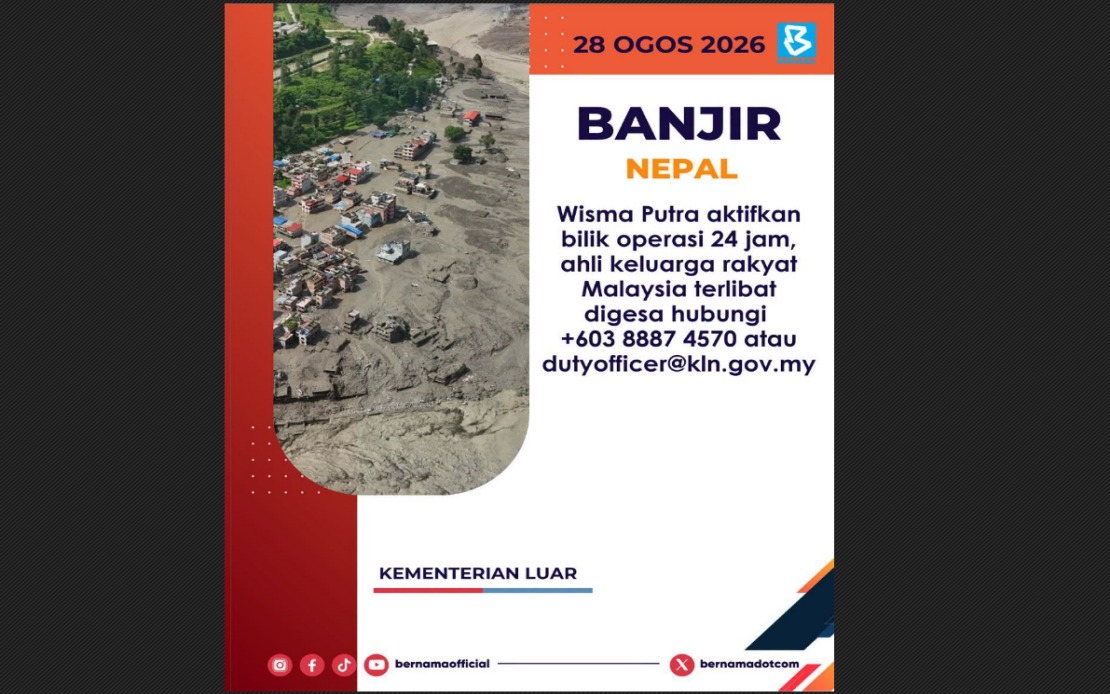
Malaysia's Foreign Ministry has intensified its emergency response following devastating floods that struck Nepal's Rasuwa district, with 57 Malaysian nationals currently unaccountable and diplomatic channels working urgently to establish their whereabouts. The crisis prompted Wisma Putra to establish a 24-hour Operations Room in Putrajaya, reflecting the gravity of the situation as the ministry coordinates with Nepalese authorities, regional diplomatic missions, and international rescue teams to verify the status of affected citizens. The unaccounted figures are based on reports submitted by family members, employers, and contacts within Malaysia as of 11 pm on 27 August, though officials acknowledge that numbers may fluctuate as additional information becomes available.
The catastrophic flooding event, which engulfed the Rasuwa region on Wednesday morning, has claimed more than 400 lives across Nepal with over 800 people—including hundreds of international tourists—still missing. The scale of the disaster presents unprecedented challenges for rescue operations, with entire communication networks severed and critical road infrastructure destroyed throughout the affected zones. This infrastructure collapse has fundamentally hampered conventional rescue methods, forcing authorities to rely extensively on helicopter operations to reach stranded individuals and evacuate those facing imminent danger from secondary flooding risks.
Wisma Putra's strategy involves comprehensive cross-verification with Nepalese counterparts, working directly with Nepal's Foreign Ministry Emergency Response Team and the Nepal Tourism Board to authenticate claims about missing nationals. The Malaysian missions are painstakingly comparing family reports against official rescue records and casualty lists maintained by Nepalese authorities. To date, local authorities have reported rescuing 31 foreign nationals, though the ministry has not yet confirmed that any of these rescued individuals are Malaysian citizens, highlighting the information vacuum that continues to characterise the emergency response.
A particular complication identified by Wisma Putra is the likelihood that some Malaysian nationals reached the disaster zone through alternative entry points via China and India rather than direct routes to Nepal. This regional mobility pattern is not uncommon for tourists exploring the broader Himalayan corridor, but it substantially complicates tracking efforts. The ministry has consequently issued urgent appeals to families of Malaysians travelling anywhere across the wider region to register their whereabouts, recognising that citizens with unconfirmed locations may inadvertently be caught in secondary effects of the disaster or may have altered their travel plans in ways their families are not yet aware of.
The operational response reflects Malaysia's established protocols for mass casualty incidents abroad. The 24-hour Operations Room serves as the coordination hub, processing incoming information, managing communication with other government agencies, and providing real-time updates to anxious families. This structure enables the ministry to respond to new developments instantly rather than operating within standard business hours, a critical necessity given the rapidly evolving situation in Nepal where secondary dangers including landslides and contaminated water pose continuing threats to both survivors and rescue personnel.
Families seeking to provide information or trace missing relatives have multiple pathways to contact Wisma Putra, reflecting the ministry's recognition that people in distress may access services through different channels depending on their circumstances. The primary telephone line at +603 8887 4570 enables immediate voice contact with duty officers, while email communication through [email protected] and the dedicated Kathmandu embassy address at [email protected] create written records and allow for documentation of specific cases. The ministry has also encouraged Malaysians to utilise the e-Konsular portal for registration, a digital system that maintains updated contact details and travel information for Malaysian citizens abroad, though specific portal details were not fully elaborated in the official advisory.
The information sought by authorities—full names, passport numbers, detailed travel itineraries, last known locations, and contact telephone numbers—enables systematic cross-referencing with rescue records and hospital admissions. This data granularity is essential because confusion over names, spelling variations across languages, and the traumatic circumstances of rescue operations can create identification bottlenecks. By gathering comprehensive identifying information from Malaysian sources, Wisma Putra can narrow search parameters considerably and avoid the frequent scenario where rescued individuals cannot be matched to missing persons lists due to information gaps.
For Malaysian citizens currently in or near the affected areas, Wisma Putra has issued explicit safety guidance emphasising the dynamic nature of the hazard environment. Beyond the immediate flooding, affected zones face secondary risks including contamination of water supplies, disease outbreak potential in displacement camps, and the possibility of renewed flooding as weather patterns stabilise unevenly across the region. The advisory urges nationals to maintain constant contact with authorities, avoid venturing into damaged zones for documentation or recovery of belongings, and comply fully with instructions from Nepalese emergency personnel who possess situational awareness that visitors inherently lack.
The response illustrates the substantial logistical challenges confronting Malaysia's diplomatic apparatus when major disasters strike popular tourist destinations in the region. Nepal receives significant Malaysian visitor traffic owing to trekking culture, mountaineering expeditions, and spiritual tourism, meaning the national diaspora in the country encompasses both temporary tourists and long-term residents. The dual nature of this presence complicates rescue prioritisation and resource allocation, particularly when rescue capacity remains severely constrained by infrastructure damage.
The Nepalese authorities themselves face unprecedented operational demands. With helicopter resources stretched across the entire disaster zone and medical facilities in Kathmandu reaching surge capacity, the coordination of international assistance becomes critical. Individuals requiring emergency medical care are being airlifted to major hospitals in the capital, a journey that in normal circumstances takes hours but may be further delayed given the volume of casualties requiring transport. Those with non-critical injuries receive treatment at field medical camps established within affected communities, though the absence of functional communication systems means that information about where injured individuals are being treated often reaches families only belatedly or incompletely.
The situation underscores Malaysia's vulnerability exposure as a source nation for outbound tourism and adventure travel. Citizens pursuing recreational activities in mountainous or geographically unstable regions face risks that are difficult to mitigate through standard pre-travel briefings or travel insurance mechanisms. The scale of this particular disaster—the second major flooding event in the Himalayan region within recent years—raises questions about whether tourism authorities and travel companies should recalibrate risk communication or seasonal travel advisories for Malaysians considering Nepal visits.
Looking forward, the ministry's priority remains locating and verifying the status of all uncontactable nationals while providing concrete support to families navigating an extraordinarily stressful situation. As rescue operations progress and casualty figures stabilise, attention will shift toward repatriation of any injured Malaysians, provision of consular services to affected citizens, and eventual diplomatic engagement regarding disaster response coordination. The 24-hour operations posture will likely persist until missing persons are either located or their fates confirmed, a process that typically requires weeks rather than days given the scale and chaos of major disasters.

