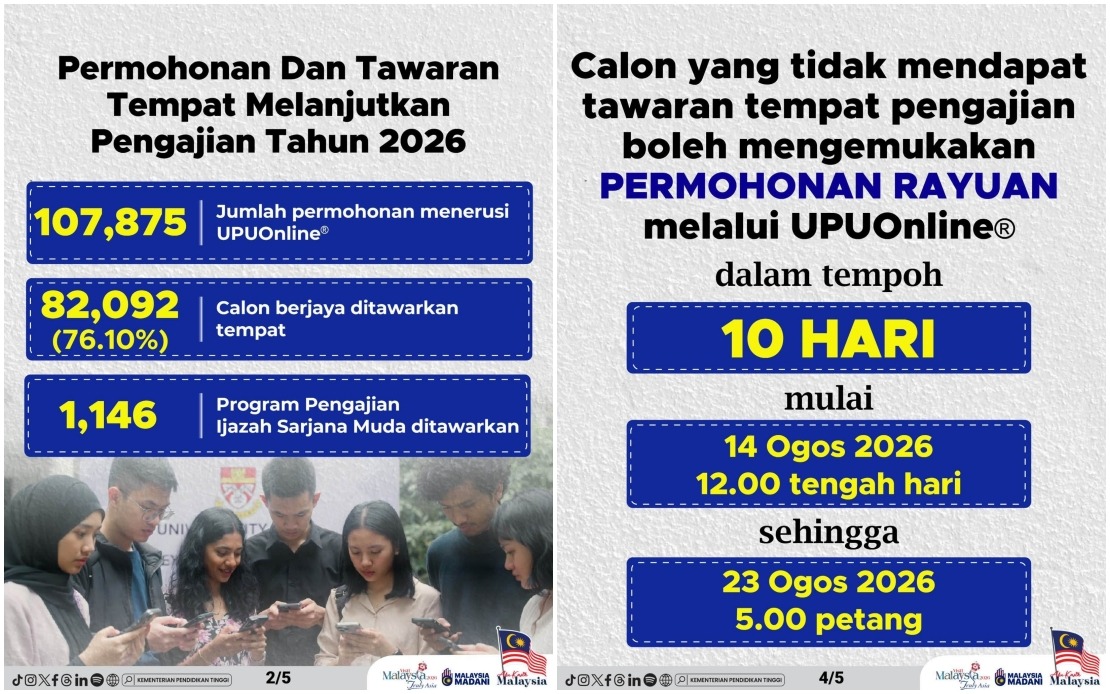
The Ministry of Higher Education (KPT) has announced that 82,092 candidates have secured undergraduate places at Malaysia's 20 public universities for the current academic year, marking a significant milestone in the nation's higher education intake process. This figure represents 76.10 per cent of the total 107,875 eligible applications submitted through the UPUOnline centralised admissions platform, indicating a substantial portion of qualified applicants gaining entry to tertiary institutions.
The offers span across 1,146 undergraduate degree programmes available this session, providing prospective students with considerable diversity in academic disciplines and specialisations. This breadth of programme offerings reflects the government's commitment to developing a well-rounded talent pool across various sectors critical to Malaysia's economic and social development. The range extends from engineering and science disciplines to humanities, business, and professional fields, catering to the varied interests and career aspirations of Malaysia's youth.
Admissions to these public universities operate strictly on a merit-based system, with the ministry implementing a transparent selection process that ranks all eligible candidates according to their merit scores in descending order. This meritocratic approach ensures that places are allocated based on academic achievement, creating a fair and objective framework that rewards excellence and maintains institutional standards. The methodology underscores KPT's commitment to upholding academic rigour while providing equal opportunity to all qualified applicants regardless of background.
For the significant cohort of candidates who have successfully secured offers, the ministry has extended congratulations and expressed optimism that recipients will make full use of this opportunity to advance their education and personal development. The statement emphasises the importance of students maximising their university years to acquire not only academic knowledge but also essential skills and professional networks that will serve them throughout their careers. This messaging reflects broader aspirations for Malaysia's graduate workforce to contribute meaningfully to the nation's competitive position in the global economy.
The result, with more than three-quarters of eligible candidates receiving offers, demonstrates the substantial capacity expansion within Malaysia's public university sector. Over recent years, these institutions have invested in infrastructure, academic staff, and digital facilities to accommodate growing student numbers while maintaining educational quality. The scale of this year's intake illustrates the continued prioritisation of accessible higher education as a pathway for social mobility and economic advancement within Malaysian society.
However, the fact that approximately 25,783 eligible candidates have not received offers in the initial round highlights ongoing constraints within the system, despite its expansion. This shortfall reflects the persistent challenge of matching university capacity with the rising demand for tertiary education in Malaysia. Competition for places remains intense, and the pressure on public universities to accommodate more students while sustaining academic standards continues to present logistical and financial challenges for institutions and policymakers alike.
To address the situation faced by unsuccessful candidates, KPT has implemented a second-chance appeal mechanism through the UPUOnline platform. This process, running for 10 days from noon on 14 August through 5 PM on 23 August, allows candidates who did not receive initial offers to lodge appeals for reconsideration. The appeals window represents a critical opportunity for students to explore additional pathways into public universities, potentially accessing alternative programmes or intake waves that may become available following initial acceptances and course transfers.
The appeal process demonstrates institutional recognition that initial placement rounds do not always represent the final distribution of places. Typically, some admitted students defer entry, withdraw to pursue alternative education routes, or change their programme preferences, creating opportunities within the system. By enabling appeals during this defined period, KPT provides candidates with a structured mechanism to advocate for reconsideration while maintaining administrative orderliness in the overall admissions cycle.
For Malaysian students and their families, this annual admissions announcement carries profound significance, as public university education represents a major milestone in educational progression and career trajectory. The affordability of public university education, combined with strong institutional reputations and established graduate networks, makes these places highly coveted. The competitive nature of the selection process reflects both the quality and limited capacity of Malaysia's public higher education institutions relative to demand.
Looking beyond this year's intake, these admission figures provide insights into demographic trends and educational aspirations within Malaysia. The large number of eligible applications suggests sustained or growing interest in pursuing degree-level qualifications, reflecting broader recognition of education's role in economic opportunity. However, the gaps between applications and available places underscore the need for continued investment in public university capacity, potentially including expansion of existing institutions and development of new academic facilities.
Regionally, Malaysia's public university system competes with higher education providers across Southeast Asia for student attention and investment. The transparent, merit-based approach to admissions positions these institutions favourably within the region's higher education landscape. The continued capacity and quality of the system influence not only domestic student outcomes but also Malaysia's ability to attract international students and maintain its standing as a regional education hub.
As the appeal period commences, unsuccessful candidates and their families will have a final opportunity to make their case for university places. Beyond this window, students not admitted through the public university system will need to explore alternative pathways including private institutions, international universities, or vocational and technical education programmes. The diversity of post-secondary options available in Malaysia ensures that not obtaining a public university place need not terminate tertiary education aspirations, though public institutions remain the preferred choice for many due to affordability and prestige.

