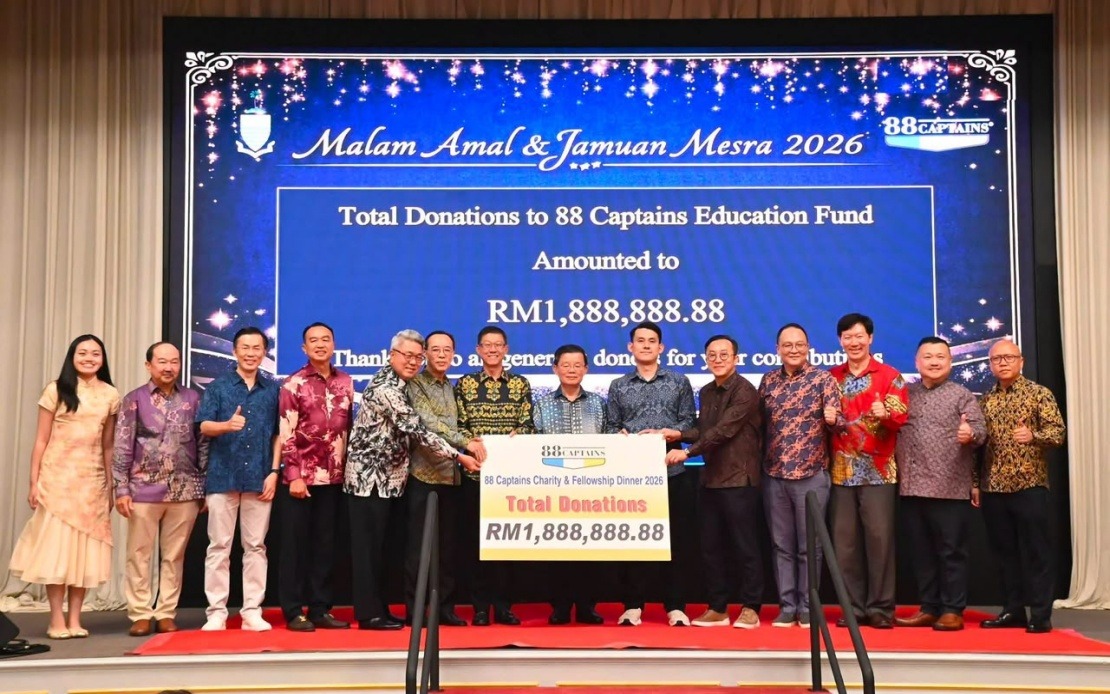
The Persatuan Kebajikan 88 Kapten Pulau Pinang has channelled over RM1 million into educational scholarships for 44 students spread across five educational institutions, underscoring a strategic push to nurture young talent in the northern region. The distribution comes as the charity organisation, established in 2022, continues expanding its footprint in education-focused interventions across Penang and surrounding areas. Speaking at the organisation's annual charity dinner in George Town, Datuk Seri Dr Ooi Eng Hock, the chairman, framed the scholarship initiative beyond mere financial relief, positioning it instead as a mechanism for cultivating ambition and instilling values that would eventually benefit the broader community.
The framing of scholarships as character-building tools reflects a broader philosophy that educational support should transcend simple subsidy. According to Ooi, the awards aim to inspire recipients to elevate their aspirations, intensify their efforts and ultimately contribute meaningfully to society as they progress. This approach aligns with emerging trends in Southeast Asian philanthropy, where donors increasingly emphasise the holistic development of beneficiaries rather than treating aid as transactional. The emphasis on attitude and values suggests recognition that Malaysia's competitive economy demands not just qualified graduates but individuals with the soft skills and ethical grounding necessary for sustainable career trajectories.
Beyond scholarships, 88 Captains has undertaken a deliberate bridge-building exercise between academic institutions and the working world through its Apprenticeship, Internship, Reskilling and Upskilling programme, launched last year at Universiti Sains Malaysia. This AIRU initiative represents a structural attempt to reduce the notorious gap between what universities teach and what employers need—a persistent challenge across Malaysia and the region. The organisation has assembled a dedicated task force composed of outstanding scholars from USM, ViTrox College, Tunku Abdul Rahman University of Management and Technology and INTI International University. These young leaders serve as intermediaries who will engage directly with corporate executives and founders to understand current industry requirements while simultaneously channelling graduate perspectives and expectations back to their institutions.
A notable dimension of this industry-education dialogue concerns salary expectations. The task force has identified RM4,000 as the baseline expectation for graduate starting salaries, a figure that reflects both aspirations and labour market realities in Malaysia's competitive sectors. This explicit articulation of salary expectations represents a pragmatic acknowledgment that financial sustainability matters for graduates, particularly in a high-cost environment like Penang where housing and living expenses continue climbing. By facilitating direct conversations between employers and student representatives, the AIRU programme creates space for these expectations to inform curriculum design and institutional planning.
The recent 88 Captains Annual Charity Dinner 2026 successfully mobilised RM1.89 million in funds, demonstrating substantial community support for the organisation's mission. The event's high-profile attendance, including Penang Governor Tun Ramli Ngah Talib and his wife, along with Chief Minister Chow Kon Yeow, underscores the alignment between 88 Captains' work and state government priorities. This political endorsement matters strategically, as it positions education-focused philanthropy as integral to Penang's broader economic development agenda rather than peripheral charity work.
Over the preceding four years, 88 Captains has substantially expanded its reach and impact, orchestrating more than 50 distinct events while pursuing diverse community initiatives. The distribution of smart televisions to primary and secondary schools represents recognition that educational equity increasingly hinges on access to technology. Similarly, the establishment of 5G Education Digital Libraries across 88 schools acknowledges that digital infrastructure constitutes a form of educational justice—schools in under-resourced areas cannot compete without reliable internet connectivity and contemporary learning platforms. Support for the Special Education Integration Programme indicates that 88 Captains views inclusive education not as a peripheral concern but as central to genuine talent development.
Penang Chief Minister Chow Kon Yeow's explicit commendation of 88 Captains' efforts signals strategic alignment between the charity and state development priorities. Chow emphasised that the scholarship, digital learning and school-university-industry partnership initiatives directly support Penang's repositioning as a leader in advanced manufacturing, semiconductors, artificial intelligence and the digital economy. This framing transforms educational scholarships from welfare measures into economic development tools—investments that supply talent pipelines for sectors driving state competitiveness. For a state heavily dependent on manufacturing and technology sectors, cultivating local talent reduces costly recruitment from overseas while building indigenous expertise.
A recent initiative warrants particular attention given its timeliness: the Joint Mental Health Development in Schools programme, incorporating AI Early Education for Responsible Adoption. Chow noted that this launch arrived opportunely following introduction of the Anti-Bullying Act 2026, suggesting that legal frameworks alone prove insufficient for addressing youth mental health and social cohesion challenges. The integration of AI education within mental health prevention demonstrates sophisticated understanding that technological literacy and psychological wellbeing represent interconnected priorities for contemporary schools. Teachers require upskilling, students need support, and responsible AI deployment demands proactive institutional planning—areas where 88 Captains' initiatives provide practical infrastructure.
The emphasis on responsible AI adoption carries particular resonance across Southeast Asia, where rapid technological adoption often outpaces policy frameworks and educational capacity. Malaysia's schools and education system have generally lagged in developing comprehensive AI literacy curricula, leaving students vulnerable to both technological disruption and the psychological impacts of poorly-managed digital environments. By prioritising responsible adoption rather than simply promoting AI exposure, 88 Captains and its partners position education as active governance rather than passive reception of technological change. This approach proves especially relevant for Penang, where aspirations for semiconductor and technology leadership demand a workforce that understands not just how to use AI, but how to deploy it ethically and sustainably.
The broader trajectory of 88 Captains since its establishment in 2022 reflects a maturation in philanthropic approaches to education across Malaysia. Rather than singular-focus charity work, the organisation has developed an integrated ecosystem addressing scholarships, digital infrastructure, industry liaison, special education inclusion and emerging mental health challenges. This systems-level thinking suggests that substantial educational progress requires coordinated interventions across multiple points rather than isolated interventions. For Malaysian policymakers and other regional organisations, the 88 Captains model demonstrates how strategic philanthropy can complement government efforts while maintaining independence and responsiveness to ground-level needs.

