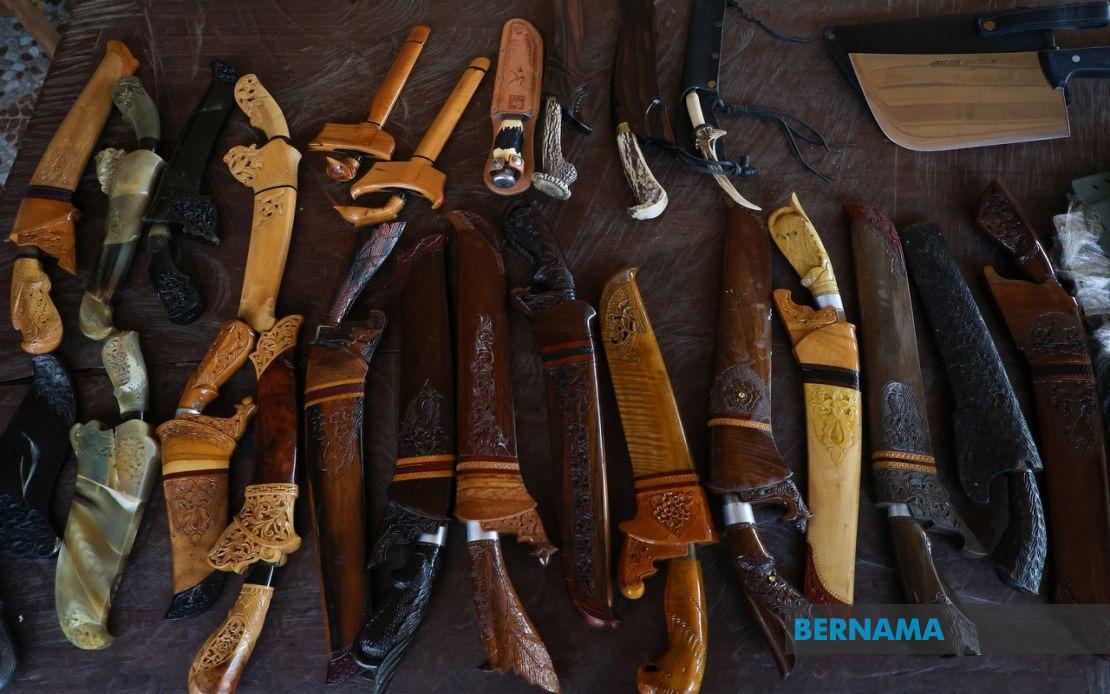
The finely carved bird-headed hilt of a traditional golok represents far more than aesthetic craftsmanship—it embodies an entire way of life that is rapidly vanishing from Kelantan. As master blacksmiths pass away with alarming frequency and few apprentices step forward to learn their secrets, one man's decades-long passion for collecting and preserving these weapons has become a quiet but crucial archive of the state's cultural patrimony.
Ahmad, 71, has become the unlikely custodian of this heritage through a collection that now exceeds 100 pieces, each representing countless hours of lost knowledge and artistic mastery. The blades and sheaths in his possession tell stories that transcend mere utility; they are biographical documents written in steel and wood, each bearing the unmistakable signature of its maker. In an era when mass production dominates the market, the value of such handcrafted pieces continues to climb precisely because they cannot be replicated. Every carving, every curve, every mark reflects the maker's unique perspective and skill set, transforming functional weapons into irreplaceable historical artifacts.
The blacksmithing tradition faces an existential crisis that extends beyond simple economic change. When a master craftsman passes away without transferring their accumulated wisdom, the loss is permanent and irreversible. Knowledge gained through decades of trial and error, experimentation with materials, and refinement of techniques vanishes as surely as the craftsman themselves. Ahmad recognised this reality two decades ago when he began his journey into the world of traditional weaponry by assisting a blacksmith friend with making hilts and scabbards. What started as a collaborative hobby evolved into a consuming mission to document and preserve the craft through acquisition and meticulous documentation.
The bird-shaped hilt that gives the golok its distinctive character serves multiple purposes that underscore why these weapons merit preservation beyond mere nostalgia. Functionally, the curved bird form provides a grip that fits naturally within the human hand, reducing fatigue during extended use and improving control. Beyond ergonomics, however, the motif carries profound historical resonance. The bird image connects directly to the Petalawali figure depicted on ancient ceremonial boats of the Kelantan Sultanate, vessels that once played central roles in maritime trade and diplomatic missions. By incorporating this symbol into weapon design, traditional blacksmiths wove together utility, artistic expression, and historical memory into each piece they forged.
Ahmad's collection has achieved remarkable geographic and chronological diversity, spanning acquisitions from Germany, Sweden, Denmark, England, the United States, Japan, China, Spain and Portugal. This international reach reveals how traditional Southeast Asian weaponry attracted collectors and traders worldwide, establishing it as a legitimate art form with global appreciation. Among his treasured possessions are particularly notable pieces: a knife featuring a Sarawakian deer-antler hilt that showcases the region's materials and aesthetic traditions, and an exquisitely crafted keris constructed from black kemuning wood with a contrasting golden kemuning hilt. The estimated value of his entire collection has reached RM20,000, though Ahmad insists that monetary worth fails to capture what these weapons truly represent.
The collector refuses all offers to sell pieces from his assemblage, viewing such transactions as fundamentally incompatible with his mission. Each item carries the fingerprints, both literal and metaphorical, of craftsmen who have since passed away and whose individual techniques died with them. To Ahmad, selling would constitute not merely a financial transaction but a profound betrayal of the blacksmiths who created these works and the cultural heritage they embodied. This philosophical stance separates Ahmad's approach from that of typical collectors motivated primarily by investment value or aesthetic accumulation. His collection functions instead as a museum without walls, a repository of knowledge that refuses commercialisation.
Preservation itself demands rigorous discipline and technical understanding. Ahmad maintains his collection in a dedicated cabinet and executes comprehensive inspections every three months without fail. During these sessions, he carefully applies protective oil to each blade, guarding against the relentless oxidation that would otherwise consume the steel. This meticulous routine reflects his comprehension that allowing deterioration and rust to progress would represent a second death for these weapons—first the craftsman passed from the world, then the artifact would follow if negligence permitted corrosion. Such dedication transcends the casual collecting hobby and reveals Ahmad's approach as custodianship in the truest sense.
The predicament facing Kelantan's blacksmithing extends beyond cultural nostalgia into questions of national identity and continuity. As globalisation accelerates and younger Malaysians pursue careers in service sectors and technology industries, the manual crafts that once defined regional cultures face existential pressure. The path to mastery in traditional blacksmithing demands years of apprenticeship, physical labour, and acceptance of modest economic returns—a proposition that struggles to attract modern youth accustomed to different expectations. Without deliberate intervention and cultural valuation, these skills will vanish entirely within a generation, taking with them not merely production methods but entire worldviews about creativity, material quality, and human relationship with craft.
Ahmad's vision encompasses both preservation and dynamism—a recognition that heritage need not mean fossilisation. He envisions Kelantan's traditional weapon-making continuing to evolve through thoughtful innovation while maintaining the artistic identity and cultural values that distinguish the craft from industrial alternatives. This balanced perspective acknowledges that cultures remain living entities requiring adaptation to survive, yet adaptation need not necessitate abandonment of core principles. Contemporary blacksmiths could employ modern tools and techniques while respecting traditional design principles and maintaining the standard of craftsmanship that earned these weapons international respect.
The tragedy inherent in Ahmad's collection lies in what it represents: a personal solution to a structural problem. A single passionate individual cannot reverse the decline of an entire craft tradition, no matter how diligently he preserves and documents existing pieces. What Ahmad has accomplished is both admirable and insufficient. His work demonstrates the urgent need for formal institutional support—apprenticeship programmes, government recognition of master craftsmen, cultural tourism infrastructure, and educational initiatives that position traditional blacksmithing as a viable career path rather than a curiosity from Malaysia's past. Without such systemic interventions, Ahmad's collection may ultimately become not a preserved legacy but a mausoleum for skills and knowledge that the nation allowed to fade.
The conversation around Kelantan's blacksmithing heritage ultimately reflects broader questions about what modern Malaysia values and wishes to preserve. Does the nation view traditional crafts as expendable relics of pre-industrial life, or as irreplaceable cultural resources worthy of investment and protection? Ahmad's quiet vigil over his collection of goloks, keris, and machetes poses this question without demanding an answer, yet the urgency becomes clearer each time another master craftsman passes away. The bird-headed hilts and meticulously forged blades in his cabinet wait patiently for the next generation to recognise their value and choose to carry forward the knowledge they represent.

