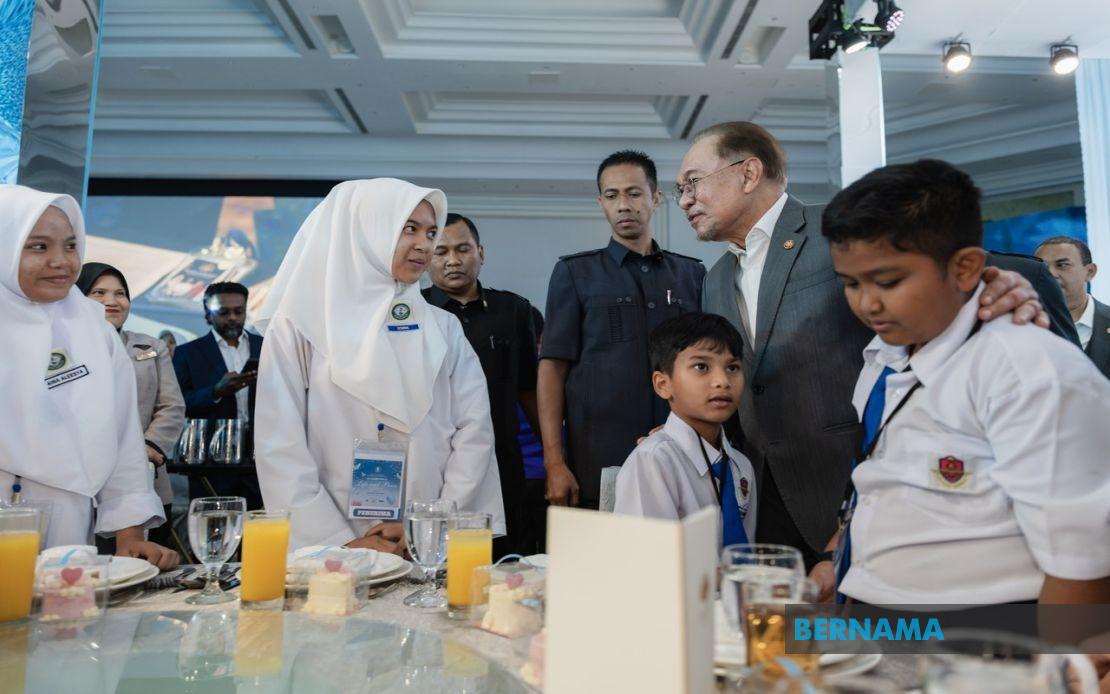
Prime Minister Datuk Seri Anwar Ibrahim has delivered a pointed message about child development, arguing that educational attainment divorced from moral character represents a fundamental failure of the schooling system. Speaking at the Celebration of Life and Peace event in Kuala Lumpur on July 15, Anwar stressed that the ultimate purpose of education extends far beyond academic metrics, encompassing the cultivation of respect, compassion, and integrity in the next generation.
Addressing approximately 700 pupils drawn from 47 schools across Kuala Lumpur and Putrajaya, the Prime Minister posed a direct challenge to young people, questioning what benefit exists in excelling academically while simultaneously engaging in bullying, disrespect, and harmful behaviour toward peers. His remarks appear designed to confront a persistent problem in Malaysian schools, where reports of student-to-student violence and harassment continue to surface despite increased awareness campaigns. Anwar framed the issue not merely as a disciplinary concern but as a matter affecting each child's future trajectory and their capacity to contribute positively to Malaysian society.
The event itself served as a platform for delivering this message within a celebratory context, organised by the ERM Foundation to commemorate the birthdays of attending schoolchildren in conjunction with the birthday of foundation founder Xin'er. This approach allowed Anwar to engage directly with students in a relaxed setting rather than through formal policy pronouncements. Notably, his wife Datuk Seri Dr Wan Azizah Wan Ismail and political secretary Datuk Azman Abidin accompanied him, suggesting institutional weight behind the messaging around child welfare and character development.
Anwar's framing of the issue carries particular resonance given Malaysia's ongoing societal conversations about youth behaviour and educational outcomes. While the country has produced students who excel internationally in mathematics, science, and other academic disciplines, concerns persist about the broader development of soft skills, emotional intelligence, and ethical decision-making. The Prime Minister's intervention suggests that the federal government views character education as central to national development strategy, not peripheral to it.
Xin'er, the foundation's founder, articulated a complementary perspective focused on inclusion and emotional wellbeing. Her emphasis on celebrating children who may lack access to birthday celebrations or who face health challenges speaks to a broader philosophy that child development occurs within contexts of vulnerability and inequality. By bringing together 700 pupils from diverse backgrounds for a shared experience, the event embodied the principle that meaningful childhood memories need not be expensive or exclusive to those with economic advantage.
The practical dimensions of the celebration reflected this commitment to inclusion and dignity. Each attending student received RM500 in cash assistance, a meaningful sum for many Malaysian families, alongside access to food, entertainment, and activities throughout the day. Such provisions remove financial barriers that might otherwise prevent full participation by less affluent schoolchildren, ensuring that the messaging around character and kindness reaches across socioeconomic divides.
Anwar's specific challenge to students—asking them to promise to study hard, respect teachers, and love their parents—translated abstract virtues into concrete commitments. The use of the grandfather metaphor, positioning himself as an elder addressing youth, invoked cultural frameworks emphasising respect for age and experience while maintaining an approachable tone. This rhetorical strategy appears designed to avoid the hectoring tone that often characterises adult-to-youth messaging, instead appealing to an imagined relationship of mutual affection and shared values.
The emphasis on bullying rejection carries particular significance for Malaysia, where documented cases of school violence have periodically prompted national soul-searching. Bullying affects not only immediate victims but creates broader school environments where fear and social fragmentation undermine learning. By positioning bullying as fundamentally incompatible with intelligence and future success, Anwar reframed the issue from a question of personal cruelty to one of rational self-interest and social responsibility.
The government's engagement with foundations like ERM on child welfare matters reflects a broader recognition that child development requires partnerships beyond the formal education sector. While schools bear responsibility for academic instruction, character formation emerges from multiple institutional and familial contexts. By partnering with civil society organisations, the government acknowledged both resource constraints within the education system and the necessity of diverse voices in shaping young people's values.
For Malaysian educators and parents, Anwar's intervention provides implicit validation for approaches that integrate character development alongside academic instruction. Schools implementing comprehensive programmes addressing bullying, emotional literacy, and ethical reasoning can point to top-level political endorsement for their efforts. Conversely, the message may pressure educational institutions to demonstrate tangible outcomes in character development, potentially leading to expanded curricula or assessment mechanisms.
The timing of this public emphasis on child character and wellbeing occurs within a broader national context of economic challenges and generational anxiety about employment prospects. Young Malaysians face competitive job markets where academic credentials alone provide insufficient competitive advantage. Anwar's insistence that intelligence without kindness fails ultimately speaks to employers' increasing emphasis on teamwork, emotional intelligence, and ethical conduct as essential professional capacities. In this reading, character development becomes not merely a moral imperative but an economic necessity.
Looking forward, the intersection of character education and academic excellence will likely remain central to Malaysian educational policy discussions. Anwar's public commitment to this framework suggests that future government initiatives may increasingly link funding, assessment, or recognition of schools to demonstrated outcomes in reducing bullying, building inclusive environments, and developing student character. The celebration event itself, while celebratory in tone, functioned as both symbolic commitment and practical demonstration of how such messaging can be delivered in inclusive, non-coercive ways.

