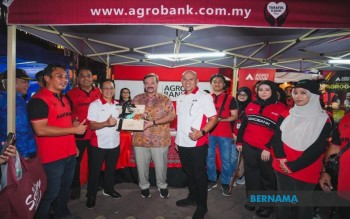
Agrobank has channelled more than RM8 million in financing applications through a series of direct engagement sessions designed to connect capital with hawkers and micro-entrepreneurs operating across Malaysia. The initiative, which extends into Sabah for the first time, represents a deliberate pivot towards bringing financial services closer to small business operators in their own operating environments rather than expecting them to navigate formal banking channels.
The expansion into Borneo came through two major engagement events: one at the Api-Api Night Market along Jalan Gaya in Kota Kinabalu, and another at the Papar Tamu Farmers' Market. These locations were chosen specifically because night markets and farmers' markets function as economic anchors within their communities, generating significant trade activity and employment while serving as informal hubs for small business operators. The Api-Api session alone engaged 153 hawkers and small business proprietors, while the Papar market event drew 95 traders seeking to understand financing options available to them.
The financing discussions centred on identifying capital needs aligned with immediate business priorities—particularly working capital requirements for day-to-day operations and expansion funding for traders looking to scale their activities. Rather than applying standardised lending criteria, Agrobank's field teams sought to understand the specific operational challenges and growth aspirations unique to Sabah's trading community, an approach that acknowledges the distinct economic dynamics of East Malaysia compared to Peninsula Malaysia's more developed financial infrastructure.
Agrobank Group president and chief executive officer Datuk Tengku Ahmad Badli Shah Raja Hussin framed the Sabah expansion as recognition that small business ecosystems operate under fundamentally different constraints and opportunities depending on geography and local conditions. The on-the-ground methodology allows the bank to provide context-specific guidance rather than generic product explanations, addressing the reality that a hawker in Kota Kinabalu faces different market conditions, supply chain complexities, and growth trajectories than a trader in the Klang Valley.
The initiative aligns with an emerging strategic consensus within Malaysia's financial sector and government that traditional banking access mechanisms exclude significant portions of the small business community. By positioning loan officers within actual trading environments—night markets and farmers' markets where transactions occur daily—Agrobank removes geographical and information barriers that often prevent micro-entrepreneurs from even initiating financing conversations. For traders accustomed to cash-based operations, the presence of bank representatives offering explanations of loan products, eligibility criteria, and application processes in their own business spaces fundamentally alters accessibility.
Finance Minister II Datuk Seri Amir Hamzah Azizan's attendance at the Api-Api session signals government endorsement of this direct engagement model, positioning it as aligned with broader policy objectives around financial inclusion and small business support. The visibility of high-level political involvement underscores the administration's commitment to ensuring that financing initiatives reach intended beneficiaries and demonstrates accountability for the effectiveness of targeted lending programmes.
The RM8 million in applications generated to date suggests meaningful uptake, though the conversion rate from application to approved and disbursed financing remains an open question. The volume of expressions of interest indicates substantial unmet demand for accessible capital within Malaysia's trading community—a cohort that typically operates outside formal employment structures and thus struggles to meet conventional lending requirements around salary documentation and employment history.
Agrobank's expansion of these engagement sessions beyond the Klang Valley's farmers' markets into Sabah's night markets and tamus reflects recognition that Malaysia's small business ecosystem is geographically dispersed and requires regionally tailored approaches. East Malaysia's distinct economic geography, smaller business scale, and different supply chain structures demand financing solutions adapted to local realities rather than Peninsula-centric models.
The initiative sits within the context of Prime Minister Datuk Seri Anwar Ibrahim's directive for financial agencies to accelerate disbursement of RM5 billion earmarked for small trader financing. This government-level push for capital acceleration creates institutional pressure for banks to innovate in outreach and approval processes, transforming what might otherwise be marketing exercises into genuine attempts at expanding the financing pipeline for underbanked populations.
Beyond immediate financing applications, these engagement sessions generate valuable data about small business financing needs, repayment capacity, and growth potential that extends beyond what traditional loan applications reveal. The informal conversations occurring within market environments allow loan officers to assess business viability and operator capability through direct observation and dialogue rather than relying solely on documentation that many small traders cannot easily produce.
For Malaysian policymakers focused on inclusive economic growth and small business development, Agrobank's ground-level approach offers a replicable model that other financial institutions might adopt. The evidence that direct engagement generates substantial financing interest suggests that accessibility barriers rather than capital demand constitute the primary challenge limiting small business financing in Malaysia.
Looking forward, the success of these Sabah sessions will likely determine whether Agrobank extends engagement operations to other regions outside the Peninsula, potentially including East Coast states and rural areas where small trading communities remain underserved by conventional banking infrastructure. The RM8 million in applications represents a starting point for understanding how expanded geographic reach and direct engagement methodologies can reshape financing access across Malaysia's heterogeneous small business landscape.

