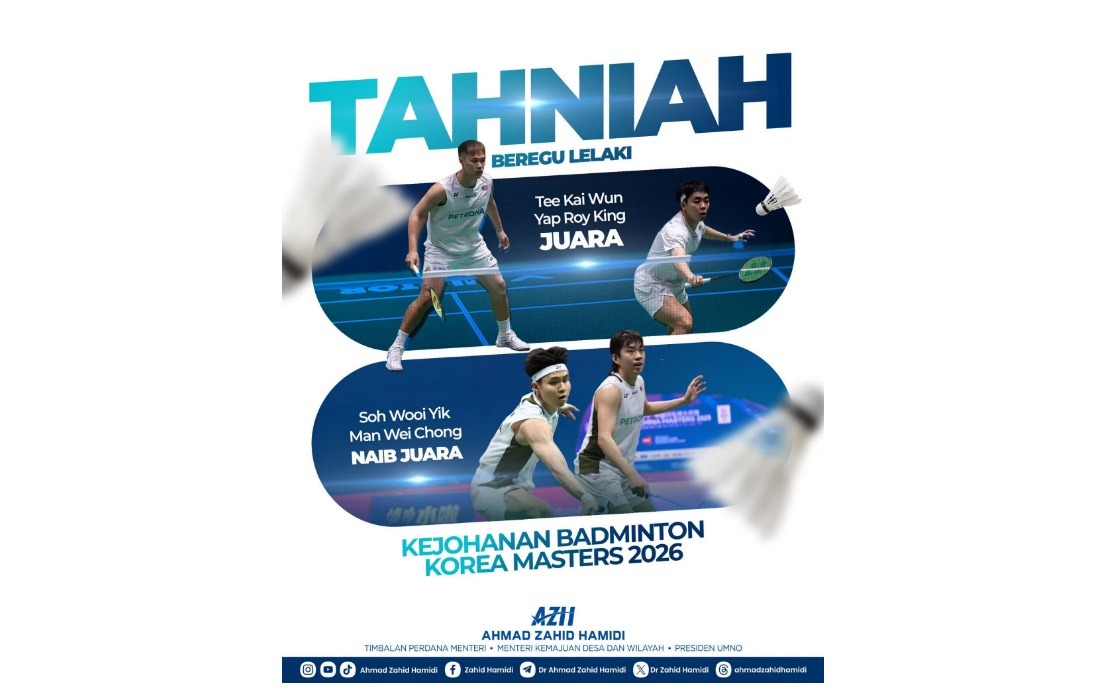
Deputy Prime Minister Datuk Seri Dr Ahmad Zahid Hamidi has extended his congratulations to Malaysia's badminton contingent following an impressive showing at the 2026 Korea Masters Badminton Championships, where homegrown talent claimed both the championship and runner-up positions in the men's doubles competition. The twin success, achieved at the Yi Sun-sin Gymnasium in Asan, underscores Malaysia's continuing prowess in a discipline where the nation has historically maintained a strong international standing.
Tee Kai Wun and Yap Roy King secured the Korea Masters title in what marked their debut appearance at the tournament, overcoming fellow Malaysians Soh Wooi Yik and Man Wei Chong in a thrilling final. The championship pair dominated the match, claiming a decisive 21-13, 21-18 victory in just 31 minutes, demonstrating the level of competitive intensity that exists within Malaysia's elite badminton ranks. The decisive nature of the scoreline, combined with the brevity of the encounter, suggests that Kai Wun and Roy King delivered a composed and tactically astute performance under pressure.
The runners-up finish for Wooi Yik and Wei Chong, while falling short of the ultimate prize, nevertheless represents a significant achievement in its own right. Both pairs' presence in the final exemplifies the depth of talent within Malaysia's badminton system, where multiple combinations can compete at the highest international level. Ahmad Zahid, in his official capacity, took the opportunity to recognise the collective effort invested by the athletes, coaching staff, and support personnel who contributed to this outcome.
Malaysia's success at the Korea Masters carries particular resonance given the tournament's standing within the badminton world. The championship represents one of the sport's prestigious stops on the international circuit, and securing victories at such venues elevates Malaysia's profile among the world's badminton-playing nations. Ahmad Zahid's public endorsement, delivered through a Facebook statement, reflects the government's investment in sports development and its commitment to maintaining Malaysia's competitive edge in badminton, a sport deeply embedded in the nation's sporting identity.
The victory also extends Malaysia's recent trajectory of success at the Korea Masters. Wooi Yik previously claimed the men's doubles title in 2024, when partnering Aaron Chia, making Malaysia a two-time champion at the event. This consistency demonstrates that the nation's success is not merely circumstantial but rather reflects systematic development and sustained competitive excellence. The opportunity for Malaysian pairs to dominate the podium speaks to the quality of preparation and the effectiveness of Malaysia's selection and training protocols.
Ahmad Zahid's message emphasised the importance of channelling this momentum into future international competitions, framing the Korea Masters victory as validation for continued pursuit of glory on the global stage. His remarks carried an implicit recognition that individual tournament victories, while valuable, must serve as stepping stones toward broader competitive objectives. For athletes like Kai Wun and Roy King, breaking through at an international tournament in their debut appearance carries psychological significance that may enhance their confidence in pursuing additional titles.
The closeness of the final match—both sets decided by eight-point margins—indicates that the gap between Malaysia's top pairings remains marginal. Such competitive equilibrium within a national team structure generally produces positive outcomes, as athletes elevate their performance standards through regular exposure to world-class domestic opposition. The fact that Wooi Yik and Wei Chong pushed the eventual champions suggests that Malaysian men's doubles possesses multiple combinations capable of contending for major titles.
From a regional perspective, Malaysia's performance at the Korea Masters contributes to Southeast Asia's overall badminton standing. The region has historically produced world-class players across multiple disciplines, and continued success at prestigious tournaments reinforces Southeast Asia's position as a badminton powerhouse. Malaysian victories at international events carry significance beyond national pride, as they elevate the competitive standards that athletes from neighbouring countries must meet.
Looking forward, Ahmad Zahid's public recognition of the achievement signals government support for continued investment in badminton infrastructure and athlete development programmes. Such political endorsement can translate into sustained funding for training facilities, coaching expertise, and competition opportunities. For Malaysian badminton, maintaining momentum from tournaments like the Korea Masters requires consistent access to high-quality preparation environments and international competition schedules that keep athletes sharp and competitive.
The men's doubles competition in badminton remains fiercely contested globally, with established powers including China, Indonesia, and Thailand consistently producing championship-calibre pairs. Malaysia's ability to claim titles and reach finals in this context demonstrates technical proficiency and tactical sophistication among its athletes. As the international badminton calendar progresses, eyes will turn toward Malaysia's performance at subsequent tournaments, where Kai Wun and Roy King, alongside Wooi Yik and Wei Chong, will face opportunities to consolidate their credentials and pursue additional honours.

