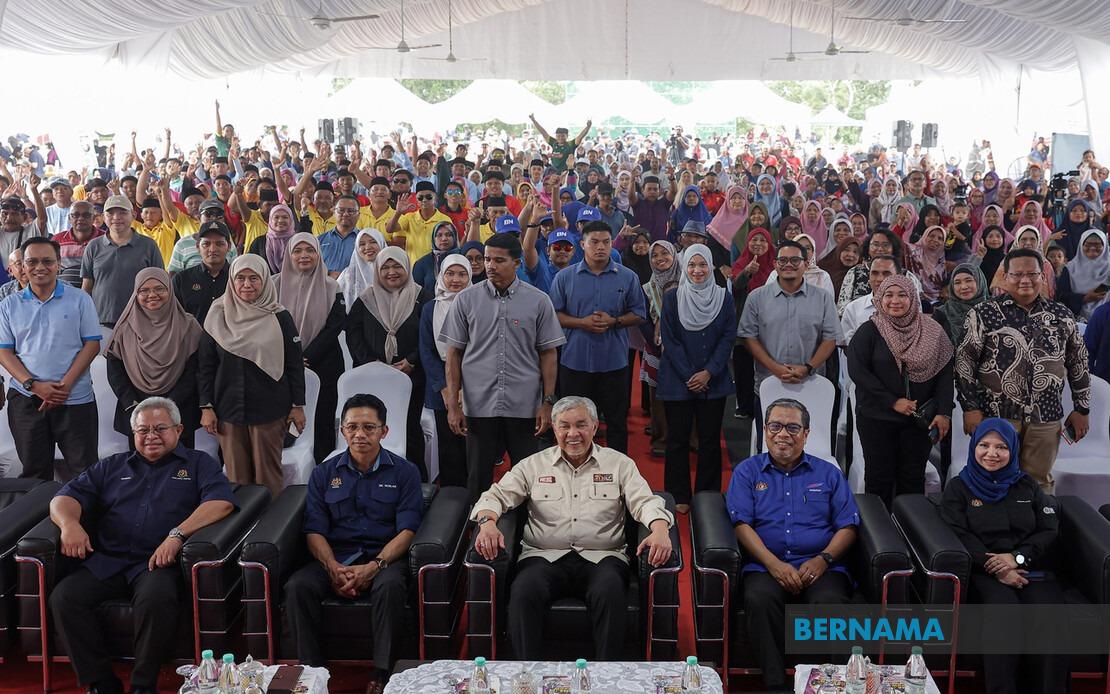
The intensifying complexity of Malaysia's political arena demands that established coalitions rethink their strategic positioning and forge new alliances to safeguard national stability, according to Barisan Nasional chairman Datuk Seri Dr Ahmad Zahid Hamidi. Speaking at an event in Jempol on July 18, the BN leader underscored that the constant shifts in electoral dynamics and party alignments require proactive repositioning rather than adherence to historical blueprints. His comments reflect growing recognition among Malaysia's political establishment that the post-2018 era has fundamentally altered how coalitions must operate to remain competitive and relevant.
The immediate testing ground for BN's evolving approach is the forthcoming 16th Negeri Sembilan state election, where the coalition has brokered an understanding with Perikatan Nasional to prevent candidate duplication. Ahmad Zahid characterised this arrangement as a pilot initiative that will inform whether similar cooperative mechanisms should be extended to the upcoming Melaka state election and ultimately shape strategy for GE16. The significance of this pilot cannot be overstated: successful coordination in Negeri Sembilan could establish a precedent for resource-efficient coalition management across multiple electoral contests, whilst failure might necessitate a return to more adversarial positioning between the two blocs.
Crucially, Ahmad Zahid clarified that the BN-PN understanding does not constitute a formal merger or binding political alliance. Instead, it represents a tactical arrangement specifically designed to eliminate vote-splitting scenarios where both coalitions field candidates in identical constituencies. This distinction carries considerable weight in Malaysian politics, where formal coalitions trigger constitutional implications, require binding governance documents, and impose constraints on constituent parties' operational autonomy. By framing the accord as a temporary, issue-specific understanding rather than a consolidated partnership, BN preserves flexibility to pivot its strategies independently based on results and changing electoral arithmetic.
The timing of this development arrives amid broader uncertainty about Malaysia's political direction following successive state-level contests that have demonstrated voters' willingness to shift support across traditional lines. Negeri Sembilan presents a particularly instructive case study given its status as a swing state where BN has struggled to maintain dominance in recent years. An understanding with PN, which commands substantial support in certain Negeri Sembilan constituencies, potentially allows BN to recapture ground through strategic consolidation rather than outright confrontation. However, it also signals BN's acknowledgment that its traditional machinery alone may be insufficient to withstand electoral headwinds in competitive terrain.
For PN, the Negeri Sembilan arrangement offers a different calculus. The coalition gains credibility through demonstrated willingness to cooperate at state level whilst maintaining its separate identity and independence of action. This arrangement allows PN to demonstrate maturity and pragmatism to electorate segments that might view the coalition as perpetually oppositional. Additionally, successful coordination in a state election provides PN with negotiating leverage should discussions about federal-level cooperation or a potential post-GE16 government formation emerge in future months.
Ahmad Zahid's emphasis on assessing performance before extending the model to Melaka and GE16 reflects caution born from Malaysia's recent political volatility. The failure of previous coalition experiments, most notably the brief Perikatan Nasional government and subsequent realignments, has instilled wariness about overcommitting to arrangements that lack adequate institutional foundations. By proposing a graduated rollout of the BN-PN understanding, Ahmad Zahid positions BN as a stabilising force capable of learning from experience rather than rigidly adhering to predetermined templates.
For Malaysian voters and observers, this evolution carries several implications. The absence of overlapping contests in Negeri Sembilan means that in certain constituencies, voters will effectively face a choice between a BN or PN candidate unopposed by the other coalition. This arrangement could alter voter behaviour by removing strategic voting incentives in some contests whilst intensifying competition in others where both coalitions field separate candidates. The resulting electoral environment will provide valuable data about whether such coordinated approaches genuinely enhance stability or merely shift competition to different battlegrounds.
The broader context shaping Ahmad Zahid's statements involves GE16, expected within the next 18 months. Federal-level politics remains fractious, with PAS-led PN and UMNO-anchored BN pursuing divergent governance philosophies and competing for overlapping voter constituencies. The Negeri Sembilan arrangement represents an attempt to demonstrate that cooperation is feasible without requiring ideological convergence or institutional subordination. Should the state election yields positive results for both coalitions under this framework, Ahmad Zahid's proposal to expand the model gains credibility and momentum heading into general election preparations.
However, significant obstacles remain. DAP and other opposition components view any BN-PN coordination with suspicion, perceiving it as a move toward federal-level realignment that could marginalise Pakatan Harapan entirely. Malaysian civil society remains divided about whether such arrangements enhance democratic functioning or concentrate power among established players. Additionally, grassroots party members in both BN and PN may resist cooperative arrangements that limit their candidates' opportunities in constituencies viewed as winnable.
Ahmad Zahid's emphasis on "highly dynamic" politics acknowledges a fundamental reality: Malaysian electoral coalitions have become fluid instruments responsive to shifting demographics, economic conditions, and voter sentiment rather than enduring organisational structures. This fluidity demands constant strategic recalibration from leadership. The BN-PN understanding in Negeri Sembilan exemplifies this adaptive approach, serving simultaneously as a pragmatic response to immediate electoral challenges and a test case for coalition management methodologies that could define Malaysian politics throughout the remainder of this decade.

