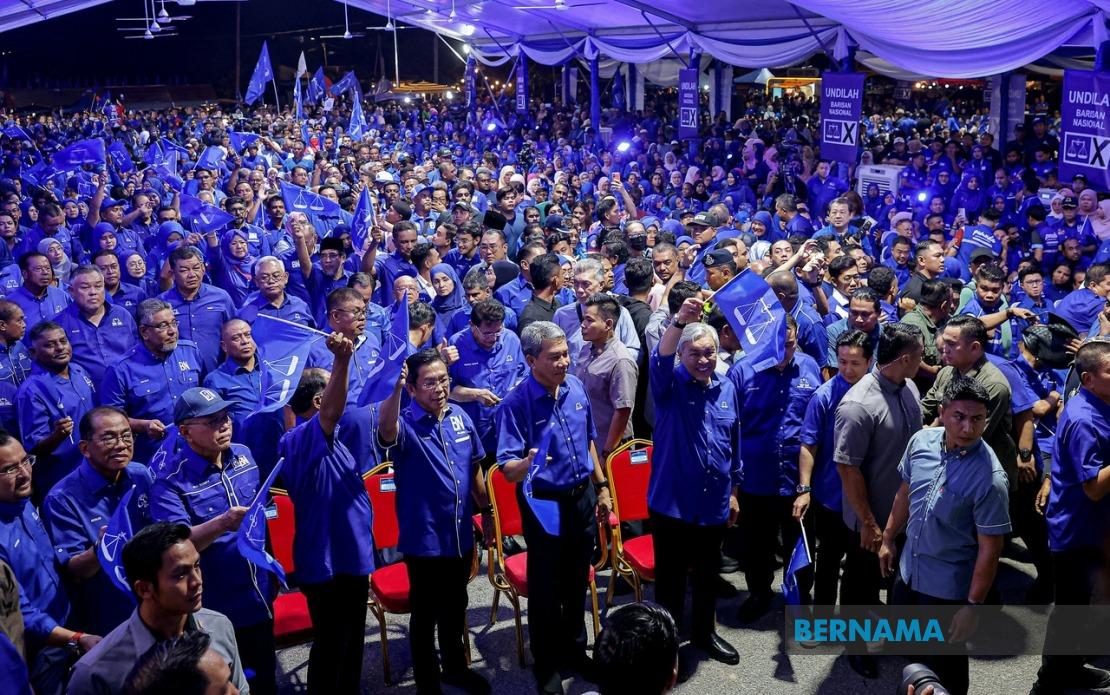
Barisan Nasional's decisive victory in Johor should provide the blueprint and momentum for the coalition to triumph in the 16th Negeri Sembilan state election, according to BN chairman Datuk Seri Dr Ahmad Zahid Hamidi. Speaking at the launch of the coalition's election machinery at Tuanku Abdul Rahman Stadium in Paroi on July 15, Ahmad Zahid framed the Johor success as evidence that voters reward political stability, economic stewardship, and responsible governance—qualities he asserted BN can deliver across the country.
The Johor outcome was indeed historic for the coalition. BN captured 48 of 56 state seats and accumulated nearly 60 per cent of the popular vote, marking the coalition's strongest performance in the state's electoral history. For observers tracking BN's trajectory since its 2022 federal election loss, the Johor result signalled a substantial recovery in public confidence and organizational capability. Ahmad Zahid presented this achievement not merely as a one-state anomaly but as validation of a broader national strategy centred on demonstrating competent administration and political predictability.
Central to Ahmad Zahid's message was the critical importance of internal unity within the BN coalition structure. He attributed Johor's success specifically to the cohesion exhibited by BN component parties, which he characterized as working seamlessly as a single unit despite their distinct identities and interests. This emphasis on solidarity carries particular weight in Malaysian politics, where coalition governments routinely face tensions between major and minor partners over seat allocations, ministerial portfolios, and policy direction. The Johor machinery functioned as an integrated force, avoiding the public recriminations and factional displays that can undermine voter confidence. Ahmad Zahid explicitly instructed Negeri Sembilan party members to replicate this formula by setting aside candidacy grievances and ideological disagreements in service of the larger electoral objective.
The Deputy Prime Minister and UMNO president directed the party machinery to immediately intensify grassroots engagement through house-to-house canvassing and direct voter contact. This directive reflects the reality that while national-level messaging and leadership appeals matter, state elections in Malaysia are ultimately decided through localized mobilization. The instruction to mobilize the ground machinery without delay indicates concern that electoral momentum, though strong following Johor, can dissipate if activation lags. The timeline reinforced this urgency: nomination day fell on July 20, early voting on July 28, and polling on August 1, leaving only weeks for the machinery to build campaign infrastructure and consolidate voter support across Negeri Sembilan's constituencies.
Ahmad Zahid also addressed what might be termed the candidacy distraction problem endemic to Malaysian electoral politics. Party members and aspiring candidates frequently become preoccupied with selection processes, factional negotiations, and disputes over which individual or faction receives preference for parliamentary or state assembly seats. These internal competitions, while often necessary for democratic selection, can fracture party unity and divert resources from external voter outreach. Ahmad Zahid's warning acknowledged this hazard directly, instructing activists that regardless of who emerges as the Menteri Besar candidate or individual state assembly hopefuls, the machinery's core responsibility remained unchanged: consolidating voter support and translating that support into wins. This framing attempted to subordinate individual ambitions to collective electoral success.
The performance benchmark Ahmad Zahid referenced was BN's showing in the 2023 Negeri Sembilan state election, when the coalition secured 14 seats. Improvement from that baseline seemed realistic given the coalition's demonstrable recovery in public confidence and the apparent decline in voter appetite for opposition governance in certain states. However, the absolute number of seats required to form government and Negeri Sembilan's total seat count would determine what constituted genuine victory. The reference to the 2023 result served to anchor expectations: BN was not targeting merely maintenance of its existing position but substantial advancement beyond it.
The presence of BN deputy chairman Datuk Seri Mohamad Hasan and other coalition leaders at the Paroi event underscored the campaign's high-level importance. In Malaysian politics, attendance by senior figures signals party commitment and provides visual confirmation to rank-and-file members that leadership takes the particular contest seriously. The event functioned simultaneously as an aspirational messaging platform—promoting the notion that BN momentum was unstoppable—and as an operational launch point where candidates would be formally announced and the machinery given marching orders.
For Negeri Sembilan specifically, the stakes extended beyond the particular state. The sultanate has been a contested terrain between BN and opposition coalitions in recent electoral cycles. A decisive BN victory would signal continued national momentum and potentially create positive spillover effects toward any subsequent federal elections. Conversely, an opposition gain or narrow BN victory would suggest limits to the coalition's recovery and provide opposition leaders with evidence that Johor represented a regional anomaly rather than the beginning of a broader BN resurgence.
Ahmad Zahid's emphasis on confidence and leadership capability touched on fundamental voter concerns in post-pandemic Malaysia. Economic growth pressures, employment uncertainty, cost-of-living anxieties, and unresolved questions about institutional integrity and governance quality weighed on voters across the country. BN's argument—that the coalition offers experienced, competent administration—resonated in Johor and Ahmad Zahid sought to replicate that messaging in Negeri Sembilan. However, opposition parties would certainly counter that alternative governance models offered fresher approaches and greater accountability.
The explicit invocation of faith—"Insya Allah, victory will belong to Barisan Nasional"—reflected the religious dimensions often present in Malaysian political discourse, where Islam holds constitutional significance and religious rhetoric carries weight among certain voter segments. This linguistic choice situated BN's electoral aspirations within a framework of divine favor conditional upon human effort and righteousness, a rhetorical strategy designed to motivate the machinery while appealing to spiritually-inclined voters.
As the Negeri Sembilan campaign unfolded, the coalition's capacity to maintain Johor-level discipline, prevent internal faction conflicts from becoming public, and translate national messaging into localized voter contact would determine outcomes. Ahmad Zahid's instructions provided the strategic direction; whether the machinery could execute that vision while managing the inevitable pressures of state-level politics remained to be seen. The Johor template existed, but translating templates into electoral victories consistently proved challenging for all Malaysian parties.

