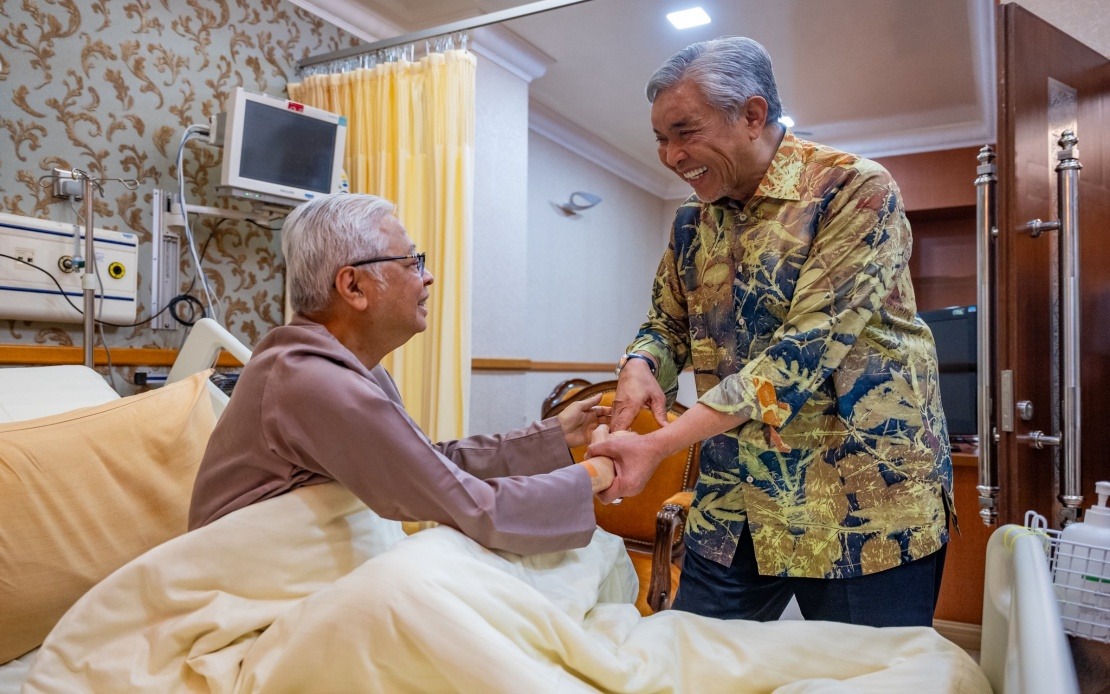
Deputy Prime Minister Datuk Seri Dr Ahmad Zahid Hamidi visited former Prime Minister Datuk Seri Ismail Sabri Yaakob at the National Heart Institute (IJN) in Kuala Lumpur on August 10, offering his support as the senior politician continues his recovery from recent cardiac intervention. The visit underscores the continued bonds within Malaysia's political leadership during challenging personal circumstances, with Ahmad Zahid publicly expressing his hopes for Ismail Sabri's swift restoration to full health and regular duties.
The former premier's health crisis emerged unexpectedly on August 6 when he experienced acute cardiac symptoms while attending the Malaysian Anti-Corruption Commission (MACC) office for a scheduled statement recording. The incident prompted his immediate admission to IJN, where medical specialists determined that intervention was necessary to address an underlying heart rhythm abnormality. Subsequent to his hospitalisation, Ismail Sabri underwent a procedure to implant a wireless pacemaker, a modern cardiac device designed to regulate irregular heartbeats and prevent potentially serious complications.
Following the hospital visit, Ahmad Zahid took to social media to convey his well-wishes, sharing a personal message reflecting both his concern for his predecessor and his belief in positive outcomes. In his X post, the Deputy Prime Minister articulated a prayer for Ismail Sabri, requesting divine intervention to grant him continued vitality, fortitude during recovery, resolution of his medical challenges, and eventual return to his accustomed roles. The public nature of Ahmad Zahid's gesture highlights the significance placed on demonstrating unity and solidarity among the nation's political elite during matters affecting individual wellness.
Ismail Sabri's health event carries implications for Malaysia's political landscape, particularly given his recent institutional prominence and ongoing parliamentary responsibilities as the Bera Member of Parliament. His position in the legislative chamber and his influence within the broader political establishment make his recovery a matter of general national concern beyond mere personal interest. The timing of his medical emergency, coinciding with his presence at MACC, adds complexity to the narrative, though immediate attention focused appropriately on his acute cardiac needs rather than the broader context of his visit to the anti-corruption body.
Wireless pacemakers represent a significant advancement in cardiac treatment technology, offering patients reduced infection risk compared to traditional devices and improved convenience through wireless charging capabilities. The decision to implant such a device indicates that Ismail Sabri's condition was serious enough to warrant permanent intervention, though specialists determined the procedure offered the optimal pathway toward recovery and sustained health management. Modern pacemaker technology has enabled numerous individuals across diverse age groups and professional backgrounds to return to active, productive lives following implantation.
The National Heart Institute, where Ismail Sabri received treatment, stands as Malaysia's premier cardiac care facility, equipped with advanced diagnostic and therapeutic capabilities. The institution's reputation and resources ensured that the former Prime Minister received optimal medical attention from experienced specialists familiar with complex cardiac cases. IJN's role as the country's leading heart care centre underscores the seriousness with which the medical establishment approached Ismail Sabri's presentation and recovery requirements.
From a broader governance perspective, Ismail Sabri's temporary absence from parliament and reduced capacity for official duties during recovery raises questions about continuity in legislative functions and representation for his Bera constituency. While such absences are anticipated and accommodated within parliamentary procedures, the duration and extent of his recovery period remain to be observed. His previous tenure as Prime Minister, though relatively brief, positioned him as a significant figure in Malaysian political discourse, and his ongoing contributions to parliamentary debates remain valued by his political coalition.
The incident also serves as a reminder of the physical demands placed upon senior political figures, whose schedules frequently involve high-stress environments, extensive travel, and demanding institutional commitments. Malaysia's political leadership, like that in other nations, must balance public service obligations against personal health maintenance, a challenge that becomes increasingly acute with advancing age. Ismail Sabri's situation may prompt broader conversations within political circles regarding wellness support systems and workload management for senior office holders.
Ahmad Zahid's visible engagement through his hospital visit and public prayer request demonstrates the personal relationships that persist among Malaysia's political leadership despite competing partisan interests. Such gestures, when extended across political boundaries or involving former adversaries, carry symbolic weight in reinforcing the notion of shared national purpose transcending electoral cycles. The Deputy Prime Minister's actions reflected not merely protocol but genuine concern for a colleague's wellbeing, a message that resonates particularly in Southeast Asian political cultures where personal relationships and hierarchical respect remain significant factors in governance dynamics.

