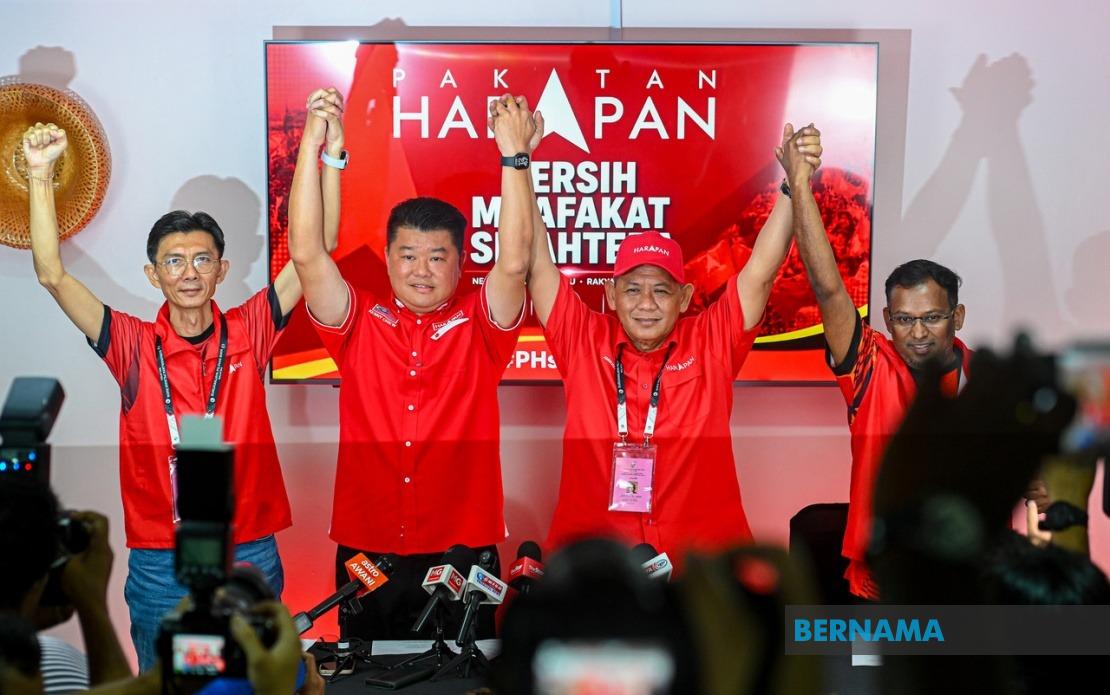
In a bid to steady nerves within Pakatan Harapan's ranks ahead of Negeri Sembilan's closely watched state election, coalition leaders have publicly brushed aside mounting speculation about tensions that had surfaced among senior party figures. Datuk Seri Aminuddin Harun, who heads the PH machinery in the state and chairs the Port Dickson parliamentary seat's campaign efforts, moved swiftly to contain the narrative during a Port Dickson press conference, characterising social media chatter about internal friction as a deliberate distraction orchestrated by political opponents intent on undermining the coalition's momentum.
The controversy centred on the renomination of Datuk Yew Boon Lye to represent the Chuah constituency, an issue that had drawn the public attention of Port Dickson's PKR deputy division chief, Datuk Kenny Chiew Chi Kin. The deputy division chief's position on the matter had circulated across digital platforms, prompting questions about whether cracks were forming within the PH structure as candidates were finalised for the contest. Aminuddin's intervention sought to reframe this as a non-issue, insisting that the question of candidate selection had been addressed through internal party mechanisms and that unity had been restored.
According to Aminuddin's statement, Chiew has formally committed to mobilising resources behind all five PH candidates vying for positions across the Port Dickson electoral area. The five constituencies in question—Chuah, Lukut, Sri Tanjung, Bagan Pinang, and Linggi—form a crucial battleground where the coalition believes it can consolidate support. Aminuddin, who is also Negeri Sembilan's menteri besar and PKR state chairman, emphasised that party hierarchies and campaign teams had functioned cohesively in recent weeks, with no substantive disagreements over strategy or resource allocation emerging to derail preparations.
The state PKR chairman's characterisation of Chiew as a dedicated party worker who had contributed meaningfully to organisational development despite missing out on a candidacy appeared designed to neutralise any suggestion that the deputy division chief harboured grievances. By publicly crediting Chiew with commitment to strengthening the Port Dickson division and validating his party service record, Aminuddin sought to underscore that disappointment over candidate selection did not translate into fractious behaviour or reluctance to campaign. This framing suggested that internal processes, while sometimes involving disagreement, ultimately produced alignment behind campaign objectives.
The timing of these reassurances carries weight given the competitive environment surrounding the Negeri Sembilan election. The state represents contested terrain where Pakatan Harapan, Barisan Nasional, and Perikatan Nasional are each mobilising significant resources. Port Dickson itself holds symbolic importance—it is currently represented by Aminuddin in Parliament, and the five state constituencies nestled within this federal seat constitute a microcosm of broader electoral dynamics affecting the state. Any perception of internal discord, particularly at mid-level party structures, risks translating into voter hesitation or reduced campaign energy during the critical fortnight before polling.
Yew Boon Lye's situation in the Chuah seat illustrates the broader complexities of candidate selection in multi-party coalitions. In the 2023 state election, Yew secured the constituency with a comfortable 6,298-vote majority over Perikatan Nasional's Tang Jay Son, establishing credibility as a vote-getter. His renomination this time positions him against Barisan Nasional's Pau Jeou Ching, suggesting a realignment of opposition forces in the state. The decision to retain Yew despite whatever internal discussions occurred reflects PH's confidence in his personal vote-earning capacity, yet the visibility of those deliberations had created an opening for critical commentary.
The compressed timeline intensifies scrutiny of coalition management. With early voting scheduled for July 28 and main polling on August 1, the window for damage control and campaign acceleration is narrow. Any unresolved tensions, whether genuine or merely perceived, could materialise as reduced volunteer turnout, fractured ground-level coordination, or depressed voter enthusiasm in target constituencies. Aminuddin's forceful dismissal of rift claims thus serves a practical function beyond public relations—it signals to party workers and allied organisations that leadership remains unified and committed to an aggressive push in the final weeks.
The invocation of external manipulation as an explanation for rumours circulating on social media reflects a wider pattern in Malaysian politics. By attributing critical narratives to deliberate sabotage by rivals rather than acknowledging genuine internal processing, Aminuddin frames the coalition as under siege from external forces rather than grappling with normal organisational tensions. This rhetorical move can prove effective in rallying supporters around a siege mentality, yet it also carries risk if subsequent events suggest that internal coherence was indeed fragile.
For Malaysian political observers, the Port Dickson situation encapsulates challenges facing coalition governance in a fragmented electoral landscape. When three major political blocs compete for dominance—as is increasingly the case in state-level contests—candidate selection becomes more fraught because each position carries implications for vote distribution and coalition viability. The Negeri Sembilan election will test whether Pakatan Harapan can maintain internal discipline while defending ground against both Barisan Nasional and the resurgent Perikatan Nasional machinery across the state's multiple constituencies.
Aminuddin's positioning of himself as Pakatan Harapan's candidate in Linggi adds another dimension to his role as chief coalition architect in the state. His stakes in the election outcome are personal as well as organisational, a fact that likely informed his swift and assertive response to speculation about internal fractures. Should the coalition perform strongly across the five Port Dickson constituencies, his leadership credentials would be substantially reinforced; conversely, underperformance would invite questions about management effectiveness.
The broader context of Negeri Sembilan's electoral trajectory suggests that coalition stability will prove pivotal. The state has experienced significant political turbulence in recent years, with shifting alliances and changing voter preferences creating unpredictable outcomes. Pakatan Harapan's capacity to present itself as a cohesive force while managing the legitimate interests of constituent parties and their members will likely determine whether it can consolidate recent gains or cede ground to competitors. In this light, Aminuddin's intervention, while seeking to downplay internal complexities, inadvertently highlights just how delicate the balance has become.

