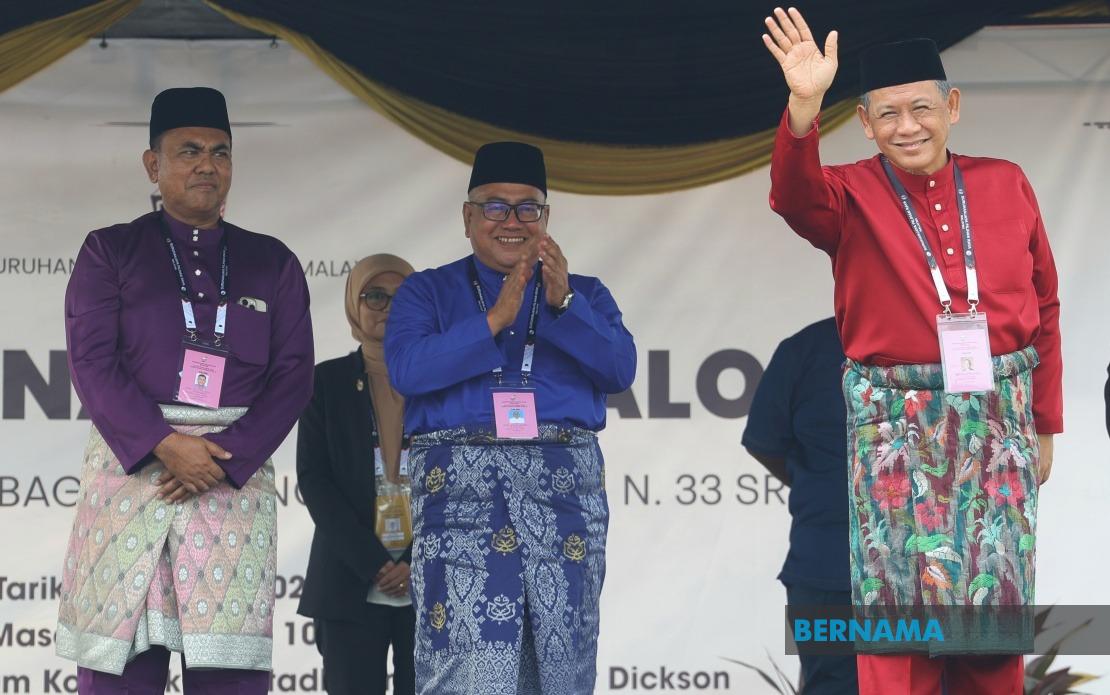
The Negeri Sembilan state election campaign has taken shape with the nomination of candidates across all constituencies, setting up several intriguing political matchups that will test the region's political alignments on August 1. At the forefront is the battle for Linggi, where Pakatan Harapan's Menteri Besar Datuk Seri Aminuddin Harun will seek to wrest the seat from incumbent Datuk Mohd Faizal Ramli of Barisan Nasional while simultaneously contending with Bersatu candidate Datuk Zamri Md Said. The announcement of the candidate list at the Port Dickson District Administration Complex on July 18 confirmed what analysts had anticipated: a fragmented political landscape where the traditional two-bloc contest has been complicated by the emergence of Bersatu as a spoiler force in multiple constituencies.
The three-way contest in Linggi exemplifies the evolving dynamics in Malaysian state politics, particularly as Bersatu, despite its split from Umno and subsequent repositioning, continues to field candidates against both established coalitions. This development carries significant implications for how votes will be distributed, potentially benefiting whichever coalition can consolidate its voter base most effectively. Aminuddin, who led Pakatan Harapan to form the state government, faces the dual challenge of defending his personal seat while maintaining the broader coalition's dominance across the state. His vulnerability in Linggi—demonstrated by the need to directly contest the seat himself—suggests that the political ground may have shifted since the previous election, or that Barisan Nasional has mounted an aggressive local campaign to reclaim lost territory.
Beyond the Linggi constituency, the broader canvas of the Negeri Sembilan election reveals a state experiencing significant political competition. In Sri Tanjung, the incumbent from Pakatan Harapan, Dr G. Rajassekaran, must defend his position against Barisan Nasional's A. Achutan and Bersatu's Leevineshwaraan Murugan, repeating the three-way pattern that characterises multiple contests in this election cycle. This consistency suggests a deliberate strategy by Bersatu to contest broadly across the state, either to establish itself as a credible third force or to maximise its leverage in post-election negotiations. The Lukut constituency presents a different configuration, with Pakatan Harapan's Choo Ken Hwa facing Perikatan Nasional's Sathes Kumar Nilameham and independent candidate Teo Seng Lee, indicating that opposition to the current government is splintered across multiple political vehicles.
The Bagan Pinang contest takes on particular significance given that the incumbent is Abd Fatah Zakaria of PAS, a key component of Perikatan Nasional. His defence against Pakatan Harapan's Nasir Raman and Bersatu's Sheikh Junaidy Jamaludin demonstrates how even seemingly secure seats are now contested by multiple challengers. The presence of Bersatu in this race, potentially splitting the opposition vote, could inadvertently benefit the PAS incumbent if voters seeking to challenge the state government divide their preferences. Conversely, in Chuah, the contest remains a straight fight between Pakatan Harapan's Yew Boon Lye and Barisan Nasional's Pau Jeou Ching, suggesting that not all constituencies have attracted Bersatu's intervention or that the coalition's resources are being selectively deployed in targeted seats.
The Election Commission's administrative preparations underscore the scale of this state election. With 889,490 eligible voters registered to participate—comprising 867,151 ordinary voters alongside 16,884 military personnel and their spouses and 5,455 police officers and their families—the electoral base is substantial enough that even modest shifts in voter behaviour could produce significant changes in the composition of the state assembly. Early voting has been scheduled for July 28, providing a mechanism for those unable to vote on polling day to exercise their franchise, while the main vote count occurs on August 1. These logistical arrangements, while routine, highlight the complexity of conducting democratic elections across multiple constituencies with diverse voter populations.
For Malaysian observers and political analysts across Southeast Asia, the Negeri Sembilan election carries broader significance beyond state-level governance. The performance of Pakatan Harapan in maintaining or expanding its representation will be closely watched as an indicator of the coalition's strength following internal tensions and leadership transitions at the national level. Similarly, Barisan Nasional's ability to recapture seats will signal whether the traditional ruling coalition retains organisational capacity and voter support in key constituencies. The Bersatu factor introduces an additional variable, as the party's positioning between national coalitions creates unpredictability in state-level politics. Should Bersatu perform strongly, it may demonstrate that despite internal challenges nationally, the party maintains grassroots support in specific regions.
The electoral contest in Negeri Sembilan also reflects broader trends in Malaysian democratic politics, where voters increasingly engage with multiple political options rather than remaining locked into traditional bloc voting. The proliferation of three-way and multi-candidate contests suggests that party loyalty has become more conditional and that local issues may play a determining role in electoral outcomes. For parties and candidates, this fragmentation requires sophisticated ground campaigns capable of persuading voters to choose them over multiple competitors rather than simply mobilising their existing base. The stakes are particularly high for Aminuddin in Linggi, where his personal political future is intertwined with the broader question of whether Pakatan Harapan can consolidate its gains in a state where it assumed power with considerable ambitions for transformation.
The road to August 1 will undoubtedly witness intensified campaigning, with all three major political forces seeking to frame the election narrative in ways favourable to their candidacies. Aminuddin and his coalition colleagues will likely emphasise developmental achievements and policy implementation, while opposition forces will highlight any perceived shortcomings or unfulfilled promises. For Malaysian voters in Negeri Sembilan and observers across the region, this state election provides a crucial test of contemporary political preferences and the durability of the coalition arrangements that have dominated Malaysian politics in recent years.

