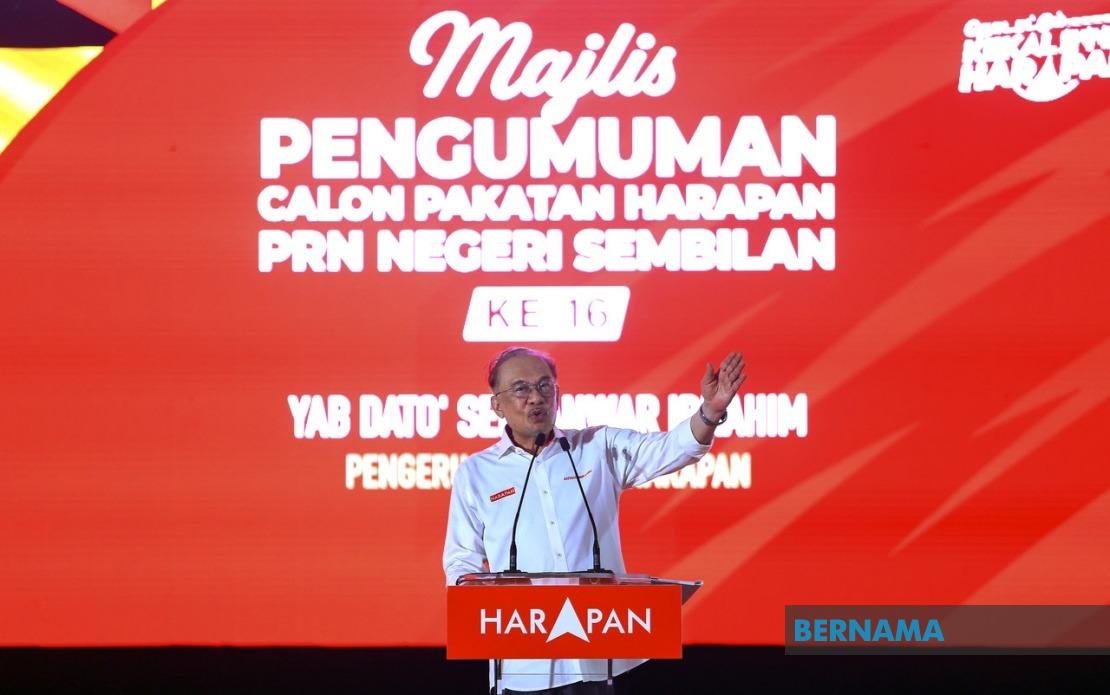
Prime Minister Datuk Seri Anwar Ibrahim unveiled Pakatan Harapan's candidate slate for the 16th Negeri Sembilan State Election at a coalition rally in Kuala Pilah on Monday, signalling the opposition's determination to maintain its grip on the strategically important state. The announcement spotlighted two heavyweight political figures tasked with anchoring the coalition's campaign: Negeri Sembilan Menteri Besar Datuk Seri Aminuddin Harun, who will contest the Linggi seat, and DAP secretary-general Anthony Loke, who will seek re-election in Chennah.
Aminuddin's candidacy in Linggi represents a calculated political maneuver by Pakatan Harapan, moving the state leader to a new constituency after holding Sikamat for four consecutive electoral cycles spanning 16 years since 2008. This transition reflects the coalition's confidence in its grassroots organization in the Linggi area, even as it relinquishes Aminuddin's long-held seat. As both Menteri Besar and PH chairman for Negeri Sembilan, Aminuddin carries significant symbolic weight in a state where Pakatan Harapan has successfully consolidated power following the 2018 federal election upheaval.
Loke's decision to defend Chennah underscores the DAP's continued centrality within the coalition structure in Negeri Sembilan. The veteran politician has held this seat since 2013, building substantial personal support and parliamentary gravitas over more than a decade. His retention as a candidate signals that the coalition views Chennah as a secure stronghold worth preserving through an established, high-profile incumbent rather than risking the seat with a newcomer.
The ceremony itself served as a show of force for Pakatan Harapan, drawing thousands of supporters to the Kuala Pilah venue and showcasing the coalition's top-tier political machinery. The presence of Amanah president Datuk Seri Mohamad Sabu, PH communications director Datuk Seri Fahmi Fadzil, and election director Datuk Seri Amirudin Shari underscored the campaign's centralized coordination and the coalition's determination to execute a disciplined, unified strategy across multiple fronts.
For Malaysian observers, the Negeri Sembilan contest carries broader implications beyond the state's boundaries. As one of the few states where Pakatan Harapan maintains strong control, the election serves as a litmus test for the coalition's ability to retain power amid shifting political dynamics nationally. The outcome will provide insight into whether the coalition can consolidate support or whether recent governance challenges at federal and state levels have eroded voter confidence.
Aminuddin's transition from Sikamat to Linggi also raises questions about succession planning within Pakatan Harapan's Negeri Sembilan apparatus. The move suggests the coalition has identified Linggi as potentially more strategically valuable or more defensible than Sikamat, or conversely, that party strategists believe Aminuddin's profile can help recapture or solidify a seat that may have slipped or become contested in previous elections. This tactical flexibility demonstrates the coalition's willingness to redeploy its senior figures where they can generate maximum electoral advantage.
The timing of the candidate announcement reflects standard pre-election procedures, allowing the selected candidates adequate opportunity to campaign and embed themselves with constituents before polling day. For Loke, the unopposed confirmation as the Chennah candidate potentially signals that other internal contenders either deferred to his seniority or that party leadership viewed him as the only viable option to retain the seat against opposition challengers.
Pakatan Harapan's strategic posture in Negeri Sembilan must also be understood in the context of larger national politics. The coalition has sought to rebuild credibility and recover from voter defection following the 2020-2022 political turmoil and the federal government's mixed record on key manifesto commitments. Retaining control of Negeri Sembilan would provide important momentum and demonstrate that the coalition retains sufficient support base to govern effectively at the state level.
The announcement ceremony's scale and the involvement of multiple coalition parties underscores that Negeri Sembilan represents a genuine battleground where the opposition cannot afford complacency. Opposition parties and Barisan Nasional will certainly view the state as an opportunity to erode Pakatan Harapan's majority, making the choice of experienced, high-profile candidates a prudent investment of political capital. Both Aminuddin and Loke bring track records of electoral success and constituency management that should serve the coalition well in what is shaping to be a keenly contested contest.

