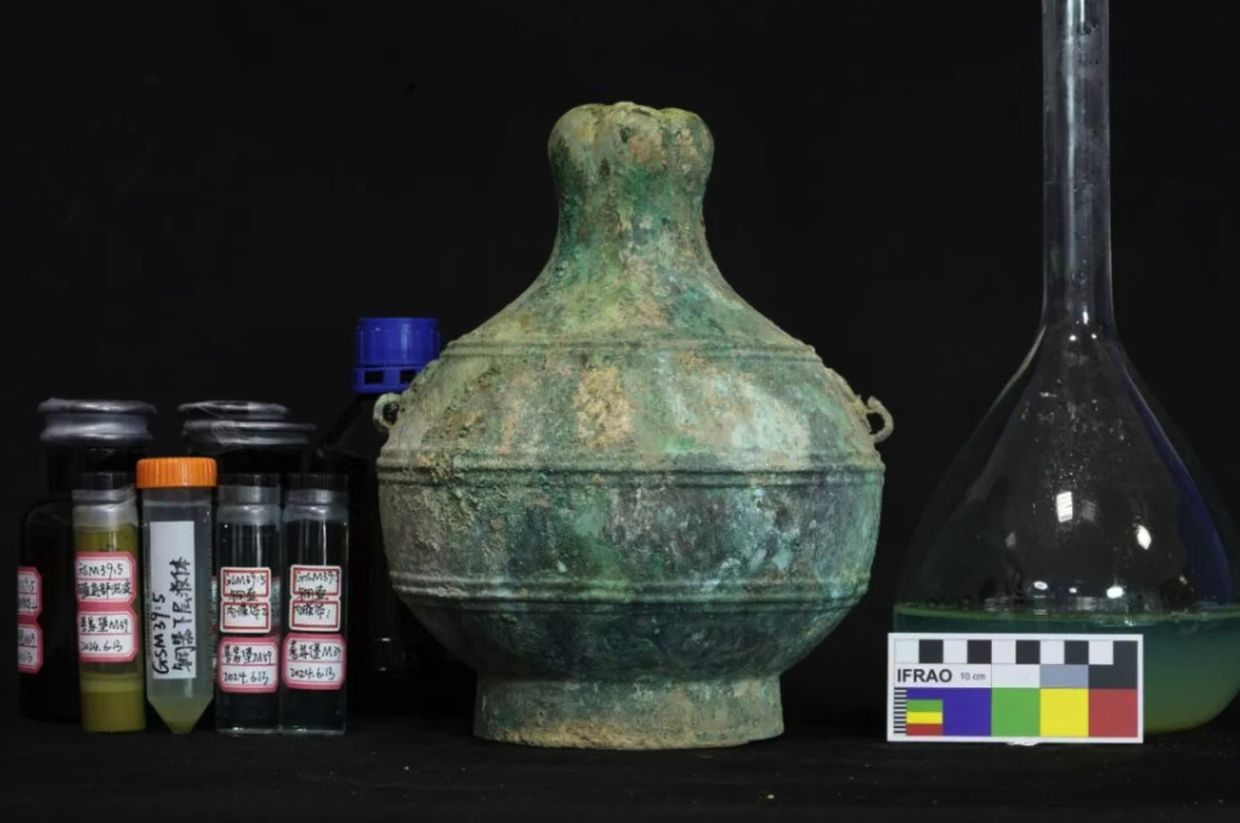
A remarkable archaeological find near China's ancient fortifications is shedding light on the sophisticated brewing traditions of the Qin dynasty. Researchers discovered a bronze wine vessel in the Shanjiabao cemetery, located just two kilometres from the remains of the Warring States-era Qin Great Wall, containing liquid that has survived intact for more than 2,300 years. The discovery, detailed in the Journal of Archaeological Science, represents one of the most complete and informative wine artefacts from the Qin period ever recovered in China.
The excavation site itself tells a story of life along the ancient frontier. The 170-kilometre stretch of the Qin Great Wall was dotted with numerous fortifications, including forts, castles, and defensive outposts of varying sizes. Soldiers stationed at these posts and their families lived within these fortified settlements, creating permanent communities in one of China's most strategically important regions. When archaeologists systematically excavated the Shanjiabao cemetery, they uncovered 183 tombs from the Warring States period, with 179 definitively identified as belonging to the Qin culture. The scale and consistency of these burials suggest the site functioned as a public cemetery specifically for garrison personnel and their families attached to the Great Wall installations.
The wine itself was discovered in Tomb No 39, contained within a distinctive bronze vessel shaped like a garlic head—a characteristic design feature of Qin culture. Researchers extracted 3,740 millilitres of ancient liquid residue from the pot, which laboratory analysis confirmed was indeed wine. What makes this discovery extraordinary is not merely the volume of liquid preserved, but the remarkable condition in which it was found. The bronze vessel employed an ingenious double-layer sealing mechanism that combined a textile inner lining with an outer coating of organic clay. This ancient engineering approach created an almost hermetic seal that allowed the wine to remain largely uncontaminated through two millennia.
Wang Xiaoyang, head of the Shanjiabao cemetery archaeological project at the Ningxia Institute of Cultural Relics and Archaeology, emphasised the significance of the find in an interview. The vessel represents "the most well-preserved and information-rich wine relic from the period of the Qin state that has been publicly reported in China." To unlock the secrets of the ancient recipe and production methods, researchers collaborated with Northwest University to conduct comprehensive chemical and biological analysis of the preserved liquid.
China's position as one of humanity's earliest regions to develop alcoholic beverages makes such discoveries particularly valuable for understanding the evolution of fermentation technology. Archaeological evidence of ancient alcoholic beverages continues to emerge throughout the country, generating considerable scholarly interest in tracing the origins of brewing and the development of distinctive techniques across different regions. However, the brewing traditions in China varied significantly between regions, reflecting local agricultural resources and climatic conditions. Southern China predominantly used rice as the fermentation base, while northern regions relied on cereal grains including millet and foxtail millet. These geographical distinctions created fundamentally different flavour profiles and nutritional content in the resulting beverages.
The chemical composition of the Shanjiabao wine reveals the sophistication of Qin-era brewing science. Researchers detected twenty-four distinct types of chemical compounds within the preserved liquid, encompassing organic acids and their derivatives, amino acids and their derivatives, and various carbohydrates. This complex biochemical profile indicates intentional fermentation processes rather than simple accidental alcohol production. Particularly telling was the distribution pattern of the organic acids, which matched that of artificially aged yellow wine—demonstrating that these ancient producers understood ageing processes and could deliberately manipulate conditions to achieve desired characteristics in their final product.
Starch residue analysis provided crucial insight into the specific grains employed in production. Laboratory work confirmed that more than ninety-two per cent of the starch in the wine originated from broomcorn millet, a hardy grain well-suited to the semi-arid climate of the Ningxia region. This finding definitively established the liquid as a grain-based alcoholic beverage rather than a fruit wine such as those made from grapes, confirming the northern Chinese brewing tradition. The reliance on millet speaks to both the environmental constraints of the Great Wall frontier and the expertise Qin producers had developed in utilising locally available resources to create a distinctive product.
This discovery fills an important gap in archaeological understanding of winemaking practices in the Ningxia region during the Warring States period. While scholars have long recognised that the Qin dynasty possessed sophisticated administrative and military capabilities, direct evidence of their culinary and fermentation technologies has been limited. The Shanjiabao find provides tangible proof of the knowledge and skill embedded in everyday life along the border fortifications. The presence of such a finely crafted and carefully sealed vessel filled with wine in a tomb suggests not mere subsistence production, but rather a valued commodity worthy of inclusion in funeral goods.
The broader implications of the discovery extend beyond pure archaeological interest. For those studying the development of Chinese civilisation, the wine vessel and its contents illustrate how technological sophistication permeated all levels of society—not only military infrastructure and administrative systems, but also food production and preservation. The care taken to seal the vessel with advanced techniques demonstrates that even two thousand years ago, producers understood principles of preservation that would not be formally codified in Western science for centuries. The tomb itself, containing this cherished bronze vessel filled with wine, hints at a poignant human narrative: a Qin soldier or official who valued fine wine, whose family ensured he would carry that love into the afterlife by filling his most treasured possession with their finest vintage to accompany him for eternity.

