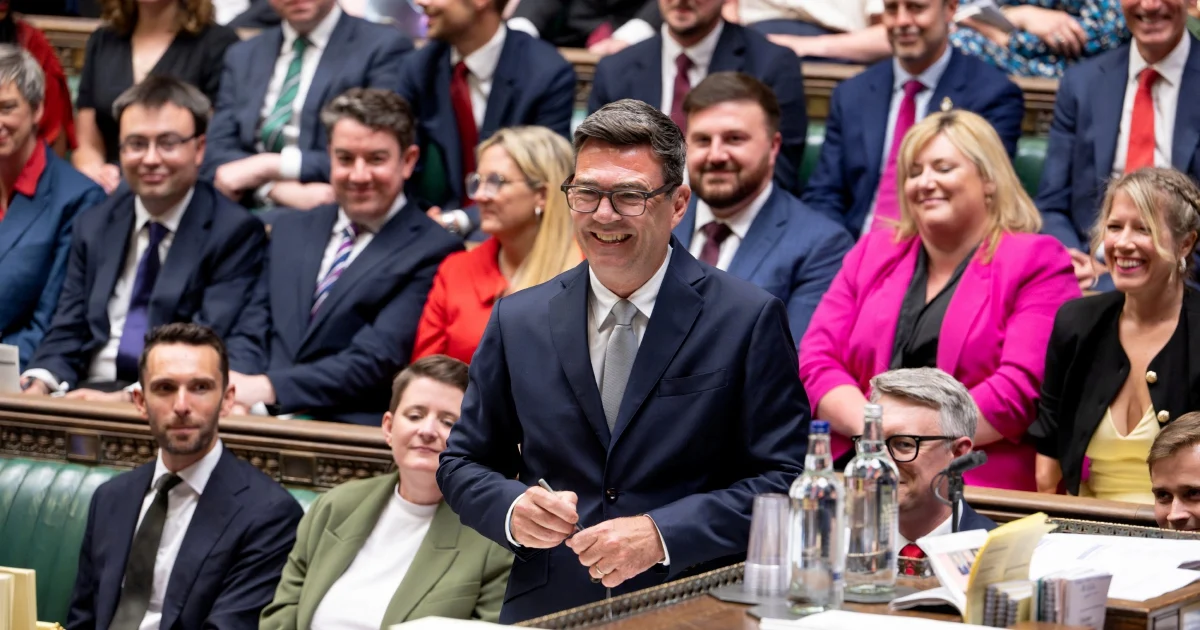
Andy Burnham, the Mayor of Greater Manchester, stepped into the spotlight on Monday as a leading contender to become Britain's next prime minister after Keir Starmer announced his resignation to Labour members of parliament. The former health secretary received a considerable reception in Westminster, signalling strong backing from within the party's parliamentary ranks at a moment of significant uncertainty for the governing Labour administration.
Burnham's ascendancy reflects a broader pattern in recent British politics where regional leaders have leveraged their local credibility to mount national campaigns. His elevation represents a shift in Labour's internal dynamics, moving the party's centre of gravity away from the London-based establishment that has dominated its recent history. As the elected leader of Greater Manchester since 2017, he has cultivated an image as a pragmatic politician responsive to working-class concerns, a positioning that resonates with traditional Labour constituencies.
The timing of Starmer's exit has created an unexpected opportunity for Burnham to translate his provincial power base into national influence. His tenure in Manchester has focused on devolution, negotiating greater autonomy and funding from Westminster for the metropolitan region. This track record of engaging directly with government while advocating fiercely for regional interests positions him distinctly within Labour's current landscape, where frustration with centralized decision-making has been mounting among elected officials in England's industrial heartlands.
Burnham's previous ministerial experience provides ballast to his candidacy. His time as health secretary during the 2010-2015 Conservative government gave him substantial experience in high-level government, though he served under that administration as part of the coalition arrangement. However, his career trajectory has been marked by significant personal setbacks. He lost the Labour leadership election in 2015 to Jeremy Corbyn, an outcome that might have derailed many political careers but instead led him toward the regional prominence he now enjoys.
The reception he received in parliament underscores the fragmentation within Labour following Starmer's departure. Rather than a unified party rallying around a single successor, parliamentary Labour appears fractured, with various factions and interest groups positioning preferred candidates. Burnham's resonance with backbenchers suggests he appeals to MPs concerned about Labour's electoral viability in northern constituencies, where the party's recent polling has proven troubling.
For Malaysian and Southeast Asian observers, Burnham's rise illustrates broader patterns visible in global politics regarding the interaction between regional and national power. His success in Manchester created a credible alternative platform from which to contest national leadership, much as regional governors in Southeast Asian systems sometimes parlay provincial achievements into higher office. The dynamics of devolved governance creating stepping stones to national power apply across different democratic systems.
Burnham's potential ascendancy also highlights how centrist parties across the Western world are reassessing their appeal to working-class voters. Labour's struggles with its traditional electoral base in northern England mirror challenges faced by centre-left parties throughout Europe and beyond. A Burnham-led Labour Party would likely signal strategic repositioning toward these constituencies, emphasizing economic development, infrastructure investment, and renewed engagement with former manufacturing heartlands.
The question of whether Burnham can consolidate support among Labour's diverse wings remains unresolved. The party contains competing ideological factions, from social democrats to democratic socialists, along with strong representation from metropolitan progressives who may view a northern, working-class focused leadership with ambivalence. His appeal to traditional Labour voters in industrial regions must be weighed against potential resistance from urban liberal sections of the party membership.
Starmer's resignation itself reflects deeper exhaustion within Labour's ranks following years of internal turmoil and, more recently, governance challenges despite electoral success. The party that won a substantial majority in 2024 nonetheless found itself navigating significant public and internal dissatisfaction by 2025, suggesting structural problems beyond any individual leader's capacity to resolve immediately. Burnham inherits not merely a party transition but a genuine crisis of direction.
Burnham's emergence as a serious contender also signals Labour's acknowledgment that its next phase requires reconnection with constituencies the party had begun losing. The symbolic power of elevating the Mayor of Manchester, a region synonymous with Labour's working-class heritage and post-industrial transformation challenges, represents a conscious choice about the party's future identity and electoral strategy.
The coming weeks will reveal whether the parliamentary enthusiasm evident on Monday translates into broader support among Labour's membership and across the party's various organized factions. Burnham faces the formidable challenge of unifying a party fractured by ideology, regional interest, and differing visions of Labour's purpose. His mayoral success in one region, however impressive, differs substantially from commanding a national party organization and leading a government facing substantial economic and social pressures. The reception he received was encouraging, but his path to Number 10 remains contingent on navigating Labour's internal complexities while rebuilding public confidence in the party's capacity to govern effectively.

