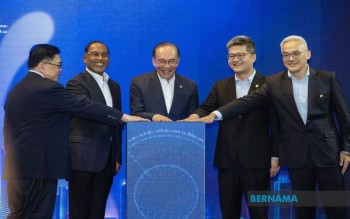
Prime Minister Datuk Seri Anwar Ibrahim has formally inaugurated Ant International's Global Operations Centre in Kuala Lumpur, marking a significant milestone in Malaysia's strategic push to establish itself as a leading destination for digital innovation and artificial intelligence development in Southeast Asia. Speaking at the launch ceremony on Wednesday, Anwar framed the investment not merely as a corporate achievement but as a catalyst for inclusive economic progress that promises to benefit local communities and strengthen Malaysia's technological capabilities on the global stage.
The establishment of the centre reflects a broader vision for how Malaysia intends to leverage digital transformation to create tangible opportunities for its workforce. Anwar articulated a philosophy centred on ensuring that technological advancement translates into tangible benefits distributed equitably across society, rather than concentrating wealth and opportunity among a privileged minority. He stressed that innovation must serve people-centric objectives, where progress is measured not solely by financial metrics but by the extent to which communities gain access to digital tools, skills, and economic participation. This framing positions the Ant International investment within Malaysia's larger aspirations to democratise digital opportunities across its population.
The scale of employment generation underscores the practical impact of this investment. Ant International has already created approximately 1,500 fintech positions in Malaysia, with more than half of these roles concentrated in technology-focused divisions. These positions span critical areas including artificial intelligence development, digital payment systems, small and medium enterprise digitalisation, and broader fintech infrastructure. The geographical and sectoral diversity of these roles suggests that the centre is not confined to executive functions but encompasses substantive technical work that anchors regional operations.
A particularly noteworthy aspect of Ant International's workforce strategy involves its recruitment of fresh university graduates, with more than fifty per cent of its technology team drawn from graduates across more than thirty Malaysian institutions. This approach directly contributes to translating academic training into practical employment, creating a bridge between higher education institutions and industry demand for digital specialists. The collaboration between Ant International and the Malaysia Digital Economy Corporation (MDEC) to develop Malaysia's digital talent pipeline further institutionalises this skills development trajectory, potentially creating long-term competitive advantages for Malaysia's tech sector.
Anwar's remarks extended to the broader challenges within the global financial system, which he characterised as inadequately serving less privileged populations, particularly in the Global South. The prime minister identified structural inequalities in how capital is allocated and how financial infrastructure privileges large multinational enterprises at the expense of smaller operators and underserved communities. He cited the continued dominance of the United States dollar in international transactions and the systematic disadvantages faced by countries and businesses lacking access to capital markets as exemplars of these systemic imbalances. This diagnosis reflects Malaysia's emerging critique of global financial architecture and its search for alternative mechanisms to facilitate economic participation.
Malaysia's bilateral currency initiatives with China provide concrete expression to these concerns. Anwar highlighted that the proportion of Malaysia-China bilateral trade conducted in local currencies—the yuan and Malaysian ringgit—has increased to eighteen per cent of total trade from a previous five per cent baseline. While the US dollar remains the dominant currency in financial transactions globally, this shift signifies a deliberate policy reorientation toward reducing reliance on external currency systems. Such moves carry implications for Malaysia's monetary autonomy and its capacity to shape financial relationships within the region according to its strategic interests rather than defaulting to established international frameworks.
Artificial intelligence emerged as a central focus in Anwar's remarks, reflecting the technology's outsized importance in Malaysia's digital future. The prime minister acknowledged both the transformative potential of large language models and the risks associated with unchecked concentration of AI capabilities in the hands of corporate or state actors. He advocated for maintaining human judgment at the centre of consequential decision-making processes, ensuring that technological sophistication does not displace human oversight of outcomes affecting populations. This position reflects growing global anxieties about AI governance and mirrors concerns articulated across Asia regarding the need for guardrails preventing algorithmic systems from operating without meaningful human accountability.
Cyril Han, chief executive officer of Ant Group, projected that Malaysia stands positioned to emerge as a prominent regional and global innovation hub for digital technologies and artificial intelligence. Han forecasted that agentic artificial intelligence—systems capable of autonomous action within defined parameters—will reach widespread deployment within the next six to twelve months, potentially reshaping commercial practices across multiple sectors. He positioned Ant International's presence in Malaysia and the broader region as essential infrastructure for navigating this transformation, framing the company's role as instrumental in supporting Malaysia's articulated AI Nation 2030 vision and broader digitalisation objectives.
The convergence of Ant International's operational expansion, Malaysia's digital ambitions, and regional technological competition underscores the stakes involved in attracting major technology infrastructure investments. For Malaysia, securing a global operations centre for a leading fintech company signifies international confidence in the country's regulatory environment, workforce capabilities, and strategic positioning within Asia-Pacific digital ecosystems. However, the investment also reflects dependencies on foreign corporate decision-making, whereby Malaysia's digital future partly rests on continuing commitments from international technology companies to maintain and expand their regional operations.
The emphasis on SME digitalisation within Ant International's operational focus carries particular relevance for Malaysia's broader economic development strategy. Small and medium enterprises constitute a substantial proportion of Malaysia's business landscape, yet many operate with limited digital infrastructure or sophisticated financial management tools. By integrating SME digitalisation into its core regional operations, Ant International positions itself to influence how Malaysia's smaller businesses integrate into digital economies, potentially reshaping competitive dynamics within domestic markets and Malaysia's integration into regional supply chains.
Anwar's broader commentary on inclusive growth and equitable benefit distribution reflects evolving political priorities within Malaysia's leadership. The emphasis on ensuring that technological advancement does not exacerbate existing inequalities or create new stratifications within society suggests awareness of potential backlash against digitalisation policies perceived as benefiting corporations and elite segments disproportionately. By articulating a vision wherein innovation serves broad-based prosperity, the government attempts to frame technological investments as serving national interests rather than narrow corporate interests, potentially building political consensus for policies facilitating further digital transformation.
The inauguration event represents convergence between Malaysia's technological ambitions, international corporate investment flows, and shifting patterns of regional cooperation. As Southeast Asian economies compete for digital infrastructure investments and technological capabilities, Malaysia's success in attracting Ant International's global operations centre positions it among frontrunners in the region's digital transformation race. Whether this investment translates into the inclusive growth and widespread capability development that Anwar emphasises will depend substantially on how Malaysia governs the transition, manages technological change, and ensures that digital opportunities genuinely permeate diverse segments of its economy and society.

