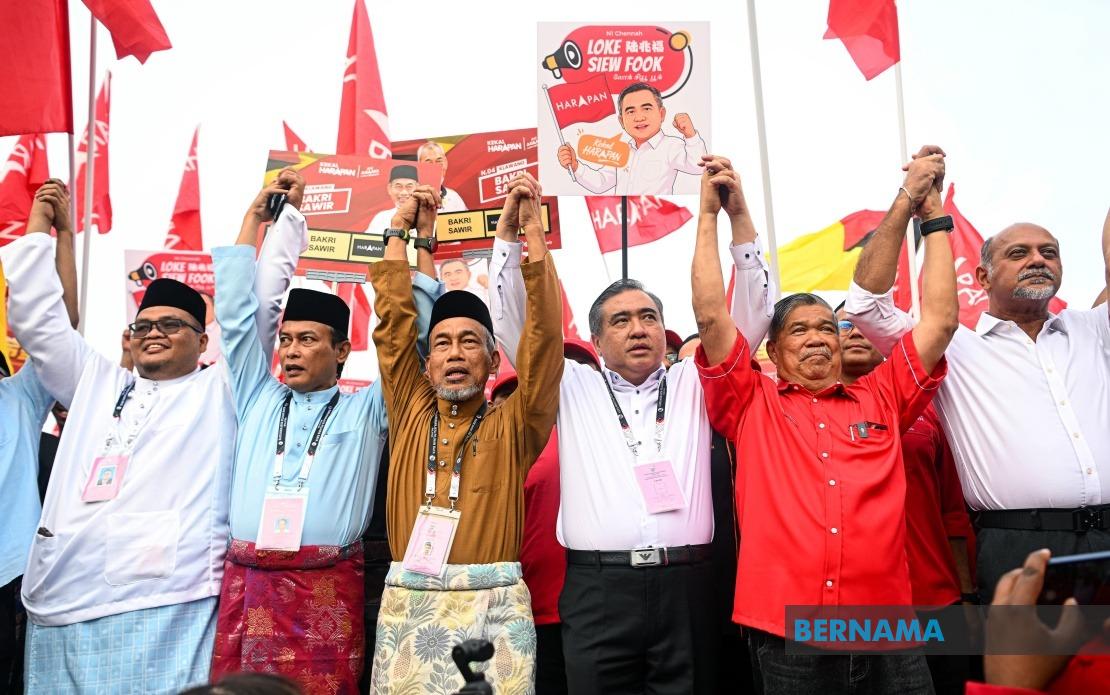
Anthony Loke, the DAP secretary-general and Transport Minister, enters the Negeri Sembilan state election today with his political standing on the line in Chennah, where he has served as the assemblyman for the past eleven years. The straight contest will pit him against Siow Kong Choon, an MCA Youth leader representing the Barisan Nasional coalition, marking a direct two-way battle in one of the state's most closely watched contests. Jelebu Parliamentary returning officer Abdul Rahim A Aziz formally announced the matchup following the close of nominations at the Dewan Besar Kuala Klawang in Jelebu, confirming that both candidates had successfully filed their nomination papers this morning.
Loke, who simultaneously represents Seremban in Parliament, submitted his candidacy at 9.05 am, with Siow following nine minutes later to complete the nomination process. The announcement marks the culmination of a carefully orchestrated electoral procedure that reflects the tight scheduling of the 16th Negeri Sembilan state election. The Electoral Commission has organised early voting for July 28, with the principal polling day set for August 1, giving both contenders less than two weeks to mount their campaigns and secure voter support across the diverse Chennah constituency.
The contest carries particular significance given Loke's trajectory within DAP and his prominence within the federal government structure. As Transport Minister, he commands a platform and profile that extends well beyond state-level politics, yet his hold on Chennah cannot be taken for granted in an increasingly competitive electoral landscape. The decision by BN to field Siow, rather than recontesting with an incumbent or candidate from another party, suggests a calculated strategy to challenge DAP's grip on this seat through an organised, well-resourced campaign backed by the coalition's machinery and resources.
History provides context for the battle ahead. In the 2023 Negeri Sembilan state election, Loke secured 5,888 votes, defeating Perikatan Nasional candidate Rosmadi Arif by a comfortable margin of 2,200 votes. That victory demonstrated substantial support within the constituency, yet the emergence of a BN challenger rather than another PN candidate may reshape the electoral dynamics. The shift in opposition positioning could indicate recalibrated political calculations, with BN viewing Chennah as winnable terrain where it can recover ground lost to DAP in recent contests. The presence of MCA, a component party within BN with traditional Chinese voter bases, adds another layer to the contest, as both DAP and MCA compete for support among similar demographic groups.
Siow Kong Choon brings youth and organisational credentials from his role as MCA Youth chief, positioning himself as a dynamic challenger within the broader BN framework. However, Loke's incumbency, ministerial office, and demonstrated electoral success in 2023 provide substantial advantages heading into the campaign. The asymmetry in resources and experience between the two candidates will likely influence how the contest unfolds over the coming weeks, with Loke capable of leveraging both state and federal platforms to address constituent concerns and promote his track record.
For Malaysian political observers, the Chennah contest exemplifies broader trends shaping the Negeri Sembilan election. The state has emerged as a genuine battleground where no single coalition can assume automatic victory, contrasting with earlier periods when electoral outcomes appeared more predetermined. The involvement of multiple coalitions—DAP within the federal government, BN seeking revival, and PN attempting to consolidate its presence—reflects the fragmentation that has characterised Malaysian politics since 2018. Within this environment, individual contests become crucial indicators of shifting voter preferences and coalition strength in specific constituencies.
The electoral calendar presents both opportunities and constraints for both campaigns. The compressed timeline between nominations closing and polling day means that both Loke and Siow must rapidly mobilise their respective party machinery, identify undecided voters, and address local issues that resonate with Chennah residents. For Loke, emphasising his ministerial achievements, developmental projects, and long-standing presence in the constituency will form the core strategy. Siow, conversely, may highlight BN's resources, new ideas, or criticisms of the incumbent's performance in addressing specific local grievances.
The broader Negeri Sembilan election context adds weight to individual contests like Chennah. The state, often overlooked in discussions of major electoral battlegrounds, actually provides a microcosm of Malaysian political competition. The results will signal whether DAP's positioning within the federal government translates to maintained or enhanced support at state level, whether BN can recover seats lost in previous elections, and whether PN retains its status as a significant electoral force. Early voting on July 28 may provide preliminary signals of voter sentiment before the main polling day, offering campaigns opportunities to adjust messaging or targeting based on early turnout patterns and demographic participation.
Loke's dual role as both federal Transport Minister and state assemblyman represents an interesting dynamic in Malaysian politics, where senior federal office-holders often contest state elections simultaneously. This arrangement allows for resource-sharing and cross-promotion of achievements but also creates potential vulnerabilities if federal performance becomes entangled with state-level expectations. Voters in Chennah will weigh Loke's transport portfolio record against his local representation, creating a multifaceted evaluation that extends beyond traditional constituency issues.
The nomination of Siow as the BN challenger reflects broader coalition strategy in states where DAP holds significant ground. Rather than allowing PN to consolidate opposition support through repeated candidacy, BN appears committed to contesting vigorously across Negeri Sembilan. This approach risks splitting the non-DAP vote but also positions BN as the primary governmental alternative, particularly appealing to voters seeking continuity with Malaysia's longest-serving ruling coalition. The MCA nomination specifically targets Chinese-majority constituencies where party dynamics have historically been competitive.

