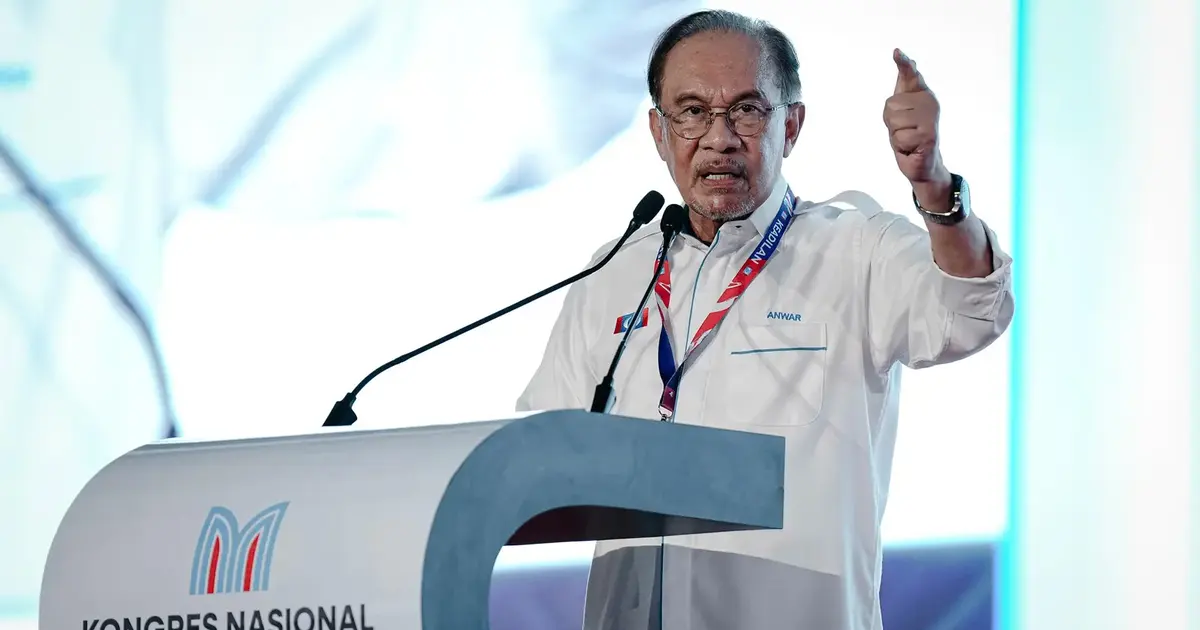
Prime Minister Anwar Ibrahim has declared a fresh round of development funding, directing an additional RM1 million to every parliamentary constituency across Malaysia in what officials characterize as a nationwide development initiative. The announcement comes as the premier moves to counter persistent allegations from opposition figures that his government has been selectively channelling resources away from states governed by opposition coalitions, a charge he firmly rejected during recent public remarks.
The distribution of RM1 million to each of Malaysia's 222 parliamentary constituencies represents a significant commitment totalling RM222 million in aggregate spending. This move signals Anwar's determination to maintain the federal government's presence and developmental footprint across the entire country, regardless of the political complexion of state administrations or local representatives. The across-the-board nature of the allocation deliberately undercuts opposition narratives suggesting partisan resource allocation, a persistent tension point in Malaysian politics where development funding has frequently become entangled with party affiliation rather than purely merit-based criteria.
The timing of this announcement carries particular significance within the context of Malaysian political dynamics. Since Anwar assumed office, his coalition government has faced recurring criticism from opposition camps claiming that constituencies represented by opposition parliamentarians receive diminished allocations compared to those held by government-aligned representatives. Such accusations reflect deeper anxieties about the relationship between electoral performance and resource distribution, a concern that resonates across multiple levels of Malaysian governance from federal to local authorities.
Anwar's categorical rejection of these allegations suggests the government recognizes the political damage such perceptions can inflict on public confidence in equitable governance. By implementing a uniform allocation formula rather than differentiated funding based on parliamentary representation or state governance structures, the administration seeks to establish a baseline commitment to development that transcends conventional partisan calculations. This approach potentially signals a broader philosophical shift toward insulating developmental programming from electoral mathematics.
The mechanism through which these funds will be deployed remains a matter for further clarification, though constituency-level development allocations typically channel resources through Member of Parliament discretionary funds or direct allocations to local authorities serving parliamentary areas. The actual implementation will reveal whether this represents genuinely equitable distribution or merely a cosmetic gesture masking continued preferential treatment through secondary allocation mechanisms and project selection processes.
For opposition-led states like Selangor, Penang, and Terengganu, this announcement potentially alleviates what their respective administrations have consistently characterized as funding starvation at the state development level. However, the constituency-based approach also creates parallel funding streams that can bypass state governments entirely, directing resources through federal channels that opposition chief ministers cannot control. This structural arrangement has become increasingly common in Malaysian federal arrangements where coalition governments at the centre and opposition administrations at state level exist in tense equilibrium.
The broader context involves Malaysia's complex multi-layered governance structure where central government, state governments, and local authorities maintain distinct fiscal authorities and spending priorities. Federal constituency-level allocations effectively create a third funding channel alongside state-level resources and conventional parliamentary grant mechanisms, potentially enabling the central government to maintain political presence and influence at the grassroots level even where state-level control eludes the ruling coalition.
From a Malaysian economic perspective, injecting RM222 million into dispersed development projects across all constituencies represents incremental stimulus distributed geographically across the nation. Whether such funds translate into meaningful infrastructure improvements, economic activity, or genuine development impact depends substantially on project identification, procurement efficiency, and implementation capacity within individual constituencies. Poorly designed or executed projects risk becoming mere political theatre that consumes resources without generating sustainable developmental returns.
The announcement also reflects Anwar's political strategy of emphasizing inclusion and national unity amid persistent parliamentary arithmetic challenges. With a slender coalition majority, demonstrating equitable treatment across political boundaries serves both immediate political objectives and longer-term legitimacy-building imperatives. Opposition parties opposing the government cannot credibly claim absolute exclusion from development resources when each of their constituencies receives identical allocations alongside government-held seats.
Regional observers of Malaysian politics will note that such announcements occur within the specific historical context of allegations regarding development discrimination, particularly following the 2022 general election when the current coalition assumed power. Similar controversies have surfaced periodically throughout Malaysian democratic history, suggesting that resolving tensions between partisan politics and ostensibly neutral resource allocation remains perpetually challenging within Malaysia's institutional frameworks.
The practical implications for Malaysian constituents hinge on whether this RM1 million per constituency truly reaches ground level as productive development initiatives or accumulates within bureaucratic pipelines subject to discretionary deployment. Transparency regarding allocation criteria, project selection processes, and spending accountability will substantially influence whether this initiative rebuilds public confidence in equitable governance or merely perpetuates the perception that partisan considerations continue dominating federal resource distribution despite rhetorical commitments to evenhandedness.

