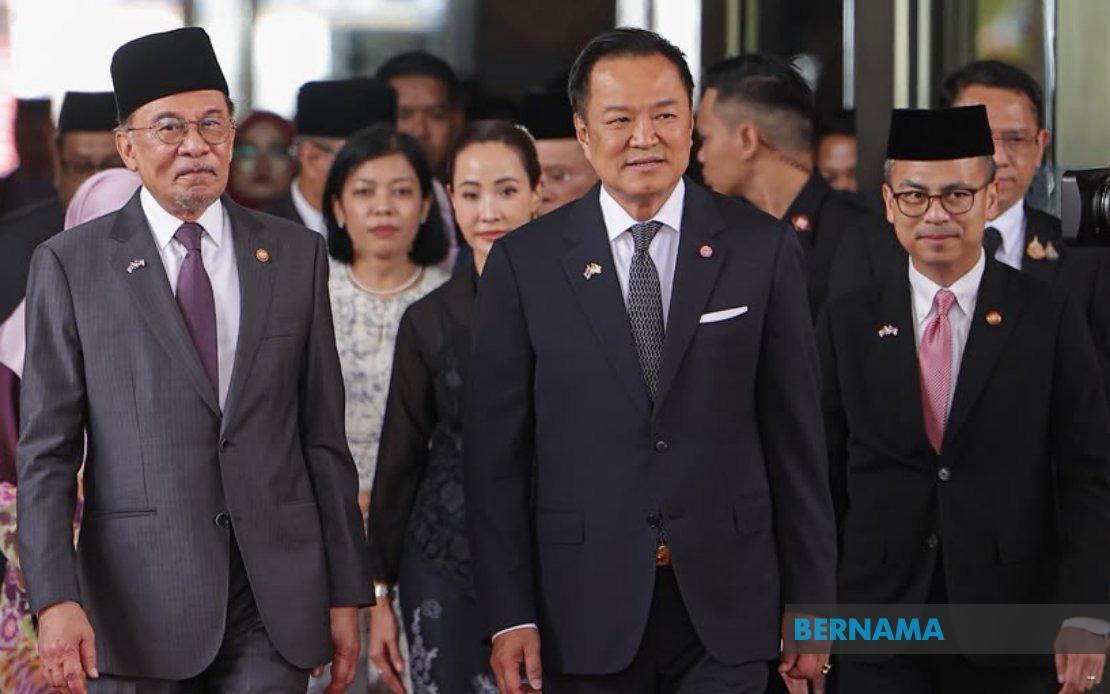
Malaysia and Thailand are moving to deepen their strategic partnership following bilateral talks between Prime Minister Datuk Seri Anwar Ibrahim and his Thai counterpart Anutin Charnvirakul at the Perdana Putra Complex in Putrajaya. The high-level engagement, part of Anutin's two-day official visit, signals renewed commitment from both nations to strengthen cooperation across multiple sectors critical to regional stability and economic growth.
The Thai Premier arrived at Kuala Lumpur International Airport at 11.11 am, where he was greeted by Anwar before the delegations proceeded to the capital for substantive discussions. The timing of the visit reflects the importance both governments attach to their relationship, particularly as the region navigates complex geopolitical challenges and seeks to harness economic opportunities through regional integration frameworks.
At the heart of the bilateral agenda lies trade and investment cooperation, an area where both nations see considerable potential for mutual benefit. Malaysia and Thailand are among Southeast Asia's more developed economies, and closer commercial ties could unlock efficiencies in supply chains, particularly in manufacturing and services. Border connectivity emerges as another critical focus area, with improved transportation and logistical links potentially reducing trade costs and facilitating faster movement of goods between the two nations. Enhanced people-to-people exchanges through education and tourism partnerships would further cement social bonds and cultural understanding.
Security cooperation represents a strategic pillar of the discussion, underscoring shared concerns about transnational threats, maritime safety and regional stability. Both countries face common challenges ranging from human trafficking to cybersecurity, making coordinated approaches essential. Agricultural collaboration, to be formalised through a Memorandum of Understanding signed during the visit, addresses food security imperatives that resonate across Southeast Asia. Thailand's agricultural prowess combined with Malaysia's agro-technology capabilities could yield innovations beneficial to both nations and the broader region.
The composition of delegations on both sides underscores the comprehensive nature of the engagement. Malaysia fielded key economic and security figures including Deputy Prime Minister Fadillah Yusof, Foreign Minister Mohamad Hasan, and sectoral ministers covering transport, agriculture, investment and labour. Thailand's representation was equally substantial, with multiple deputy prime ministers and sector-specific ministers present, indicating Bangkok's serious investment in the bilateral relationship. This institutional depth suggests these talks will produce concrete outcomes rather than symbolic gestures.
Within the ASEAN framework, Malaysia-Thailand cooperation takes on added significance. Both nations are pillars of the regional bloc, and their alignment on key issues influences broader Southeast Asian positions on trade, security and diplomacy. The discussions on regional and international developments reflect awareness that bilateral partnerships operate within a larger strategic context shaped by great power competition, supply chain restructuring and climate imperatives. Coordinated positions between Bangkok and Kuala Lumpur strengthen ASEAN's collective voice in international forums.
The agricultural cooperation agreement carries particular weight given food security pressures intensifying across Asia. Thailand remains a global agricultural heavyweight, while Malaysia has invested substantially in agro-technology and sustainable farming practices. Joint initiatives could include knowledge transfer, research collaboration and market access arrangements that benefit producers in both countries. Such cooperation also addresses consumer interests in both nations, where food affordability remains a political priority.
Tourism presents another dimension where complementary strengths exist. Thailand draws millions of international visitors annually, while Malaysia offers distinctive attractions across cultural, natural and urban tourism segments. Coordinated tourism promotion, simplified visa procedures and joint destination marketing could increase visitor flows and generate employment across both economies. Regional tourism integration remains underdeveloped compared to other sectors, suggesting significant untapped potential.
Education and human resource development feature prominently in bilateral exchanges, reflecting long-term nation-building ambitions. Student exchange programmes, research partnerships between universities and vocational training collaboration create pipelines of informed citizens with direct experience of their neighbour's society. Such personal connections historically produce dividends in understanding and cooperation that transcend political cycles.
The bilateral meeting demonstrates how Malaysia and Thailand, despite occasional tensions over maritime boundaries and irregular migration, prioritise sustained engagement and constructive problem-solving. This pragmatic approach contrasts sharply with more confrontational regional dynamics and underscores both governments' preference for dialogue-based cooperation. The official luncheon concluding the formal discussions provides informal space for relationship-building beyond structured agendas.
For Malaysian readers and businesses, these developments offer concrete opportunities. Enhanced trade frameworks could benefit Malaysian exporters accessing Thai markets, while Thai investments in Malaysia might accelerate development in special economic zones and industrial corridors. Reduced border friction through improved connectivity translates into tangible benefits for communities in border states like Perlis, Kedah and Kelantan.
The talks also reflect evolving Southeast Asian dynamics as the region seeks to balance relationships with major powers through strengthened intra-regional partnerships. Malaysia and Thailand's deepened cooperation provides a stabilising force, demonstrating that regional nations can drive their own agenda through serious bilateral engagement. This model of sustained diplomatic effort, supported by institutional mechanisms and clear sectoral priorities, offers a template for how other ASEAN members might strengthen partnerships.
As both nations chart courses through economic transitions and geopolitical uncertainties, their bilateral relationship anchors each in a network of trusted partners with shared interests. The visit of Anutin to Putrajaya thus represents more than ceremonial diplomacy, but rather a deliberate investment in the partnership architecture that will shape Southeast Asian prospects over coming years.

