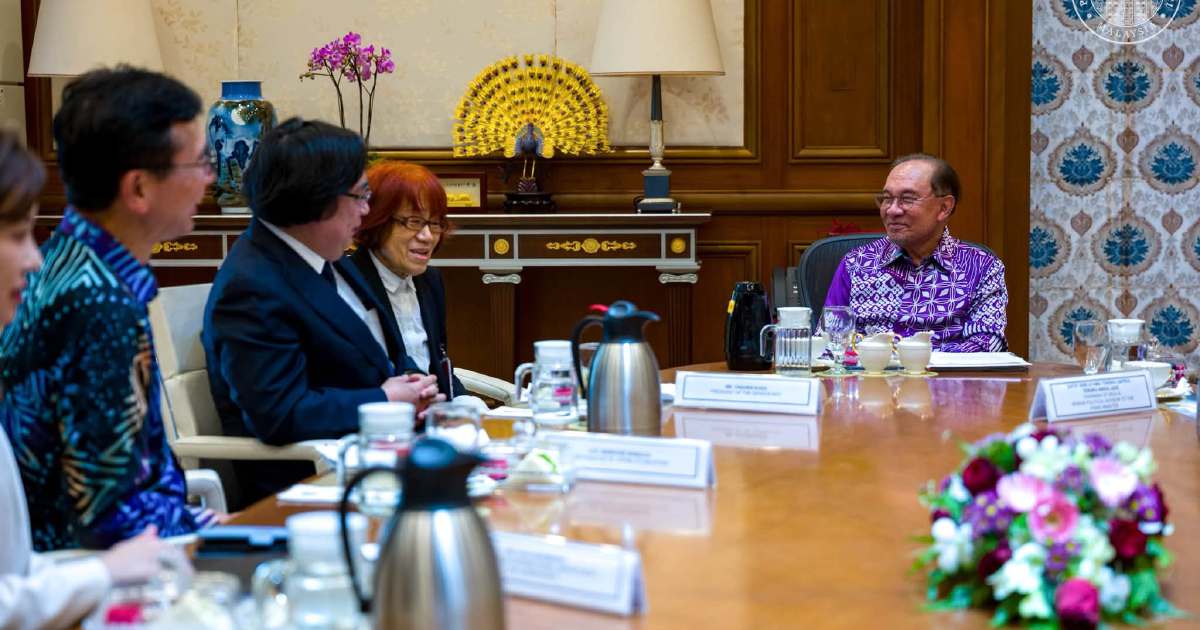
Prime Minister Datuk Seri Anwar Ibrahim welcomed Genron NPO president Yasushi Kudo to Kuala Lumpur today, with both leaders zeroing in on mechanisms to fortify the foundational partnership between Malaysia and Japan. The courtesy visit provided a platform for substantive conversations around how the two nations can strengthen their diplomatic architecture and advance shared interests across multiple domains.
Genron NPO, Japan's premier independent policy think tank, has positioned itself as a bridge between governmental bodies and civil society on crucial policy questions. Kudo's presence in Kuala Lumpur signals the organisation's commitment to deepening analytical ties with Southeast Asian partners. The platform created by such engagements allows for candid exchanges that can inform both national strategies and public discourse on regional matters of common concern.
Malaysia and Japan maintain a longstanding relationship rooted in colonial-era connections, but contemporary ties have evolved significantly to encompass economic integration, technology transfer, and security cooperation. Japan remains one of Malaysia's largest foreign direct investors, with substantial commitments in manufacturing, automotive assembly, and semiconductor production. The bilateral economic footprint extends across multiple sectors, making Japan a key player in Malaysia's industrialisation agenda and critical to achieving broader Vision 2050 objectives.
The timing of this diplomatic engagement carries strategic importance given the evolving geopolitical landscape in the Indo-Pacific region. Japan faces mounting pressures regarding regional security challenges, including territorial disputes and the assertiveness of major powers in contested maritime zones. Malaysia, as a maritime nation with its own territorial concerns and a non-aligned foreign policy tradition, brings a distinct perspective to regional stability discussions. Think tank-level dialogue such as this creates space for exploring commonalities without the formal constraints of government-to-government negotiations.
Think tanks play a pivotal yet often underestimated role in shaping bilateral relations. Genron NPO's engagement with Malaysian leadership reflects a broader Japanese strategy to cultivate networks of influence and understanding across the region. These organisations can pioneer ideas, test policy proposals, and build intellectual consensus before governments formally commit to initiatives. For Anwar's administration, such exchanges provide windows into evolving Japanese strategic thinking on regional priorities.
The discussion between Anwar and Kudo likely touched on economic dimensions of the partnership. Japanese firms have invested heavily in Malaysia's semiconductor ecosystem, a sector deemed critical by both nations. Supply chain resilience and technological cooperation have become paramount as both countries navigate a world increasingly characterised by industrial competition and economic security concerns. Malaysia's positioning as a technology hub makes it valuable to Japan's diversification strategies away from China-dependent production networks.
Defence and security cooperation represents another substantive area of Malaysia-Japan engagement. Japan's expanding security role in Southeast Asia, underscored by its Quad partnership and increased naval presence, intersects with Malaysia's own security calculations. While Malaysia maintains strategic autonomy and has not formally aligned with any bloc, productive dialogue with Japanese policymakers enables clearer communication about respective security concerns and potential collaborative opportunities in maritime domain awareness and anti-piracy efforts.
Cultural and educational dimensions should not be overlooked in assessing Malaysia-Japan relations. Japanese language programmes, student exchanges, and cultural initiatives have created constituencies across Malaysia favourably disposed toward deepening ties. These soft power elements provide foundations upon which deeper strategic cooperation can be constructed. Think tanks often champion such people-to-people engagement as essential infrastructure for long-term relationship building.
Regional stability concerns undoubtedly featured in today's discussions. The South China Sea remains a focal point for Malaysian security strategy, with overlapping claims and competing strategic interests creating constant tension. Japan, while not a claimant state, maintains substantial interests in freedom of navigation and the preservation of rules-based maritime order. Malaysian and Japanese analysts share concerns about unilateral actions that could destabilise the region or constrain legitimate economic activity through vital shipping lanes.
Genron NPO's track record suggests Kudo may have raised questions about the multilateral architecture in Southeast Asia, including the relevance and effectiveness of mechanisms like the ASEAN Regional Forum and the East Asia Summit. These platforms remain important for managing regional tensions, but questions persist about whether they adequately address contemporary security challenges. Malaysia's role within ASEAN as a middle-power broker makes its perspectives on regional institutionalisation particularly valuable to Japanese strategic planners.
Investment flows and human capital mobility merit continued attention in Malaysia-Japan relations. Japanese educational institutions attract Malaysian students, fostering connections that yield dividends across decades. Similarly, Malaysian professionals working within Japanese firms or joint ventures create networks that facilitate business expansion and knowledge transfer. These practical dimensions of bilateral ties deserve sustained policy support from both governments.
The courtesy call itself exemplifies how Malaysia has positioned itself as a destination for international engagement. Anwar's administration has signalled openness to deepening partnerships across ideological and geographical divides. Japan, seeking to strengthen ties with non-aligned nations as a counterbalance to Great Power competition, finds Malaysia an attractive partner. The results of such conversations, channelled through think tank networks and government channels, will shape regional dynamics for years ahead.
Moving forward, the challenge for both Malaysia and Japan lies in translating diplomatic warmth into concrete cooperation that delivers tangible benefits for their citizens. Whether through expanded trade arrangements, enhanced technological collaboration, or improved security coordination, the foundations laid through conversations like today's create potential pathways forward. As the region navigates unprecedented strategic competition and economic interdependence, Malaysia-Japan cooperation becomes increasingly relevant to broader Asian stability and prosperity.

