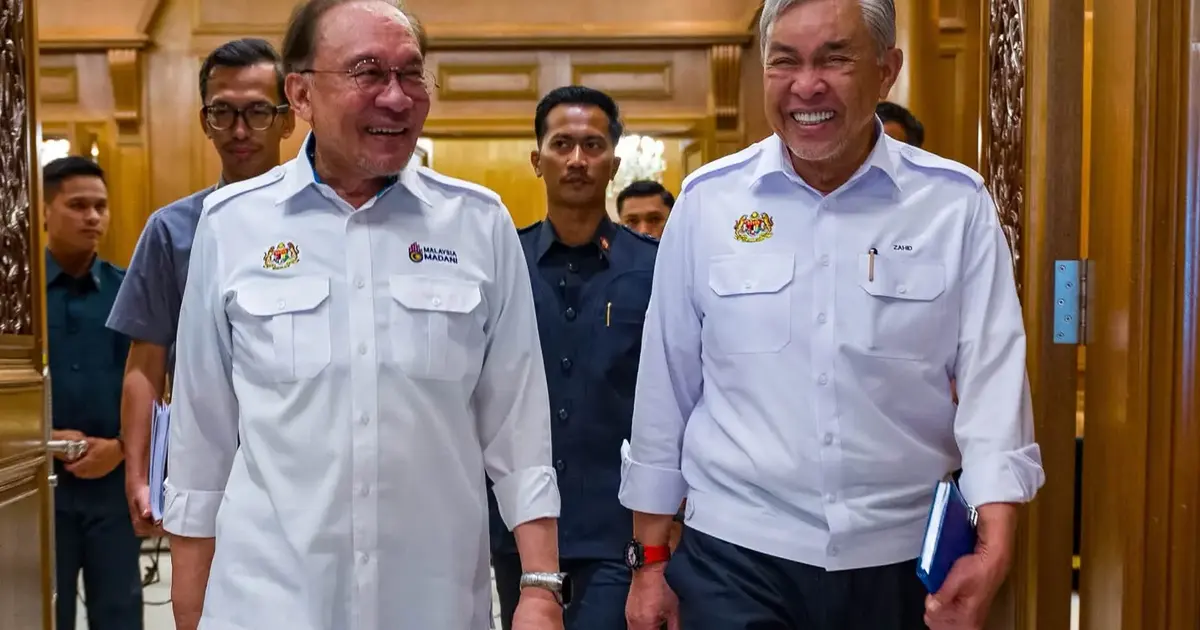
The visible warmth between Prime Minister Anwar Ibrahim and Barisan Nasional chairman Ahmad Zahid Hamidi on Tuesday suggested that tensions simmering within Malaysia's ruling coalition have been smoothed over, at least for public consumption. The two leaders presented a unified front after days of pointed rhetoric that exposed fractures in the government alliance between Anwar's PKR and the BN component parties.
The diplomatic display comes immediately following Zahid's provocative statement on Monday, in which he openly challenged Anwar's authority by suggesting that the prime minister retain the freedom to remove the eight BN ministers currently occupying positions within the cabinet if their presence no longer suited him. The comment, while framed as a matter of principle and parliamentary prerogative, represented a thinly veiled rebuke of Anwar's governance and carried implicit questions about the stability of the coalition arrangement.
Zahid's remarks had injected considerable uncertainty into coalition politics at a particularly delicate moment. The statement appeared designed to reassert BN's independence and prevent any perception that the party had become subordinate to PKR-led decision-making. By publicly declaring that Anwar possessed the constitutional authority to dismiss his ministers, Zahid was simultaneously emphasising that BN's participation in government remained conditional rather than permanent.
The underlying tensions reflected deeper structural challenges within Malaysia's current governing arrangement. The coalition between PKR and BN represents a marriage of political convenience rather than ideological alignment, born from electoral necessity following the 2022 general election. Both parties maintain distinct organisational interests, and disagreements over ministerial allocation, policy direction, and the distribution of resources and political credit inevitably surface.
For Malaysian observers, the back-and-forth between Anwar and Zahid underscores the inherent instability of coalition governments that lack overwhelming parliamentary majorities. When individual parties possess significant leverage—as BN does with eight cabinet ministers—they can weaponise ministerial appointments and dismissals to extract concessions or assert their influence over government direction. This dynamic has historically characterised Malaysian politics but remains particularly pronounced during periods of coalition strain.
The personal relationship between Anwar and Zahid carries additional historical weight. Both men have experienced significant reversals in their political fortunes, and their ability to maintain effective working relations despite personal differences has proven crucial to coalition stability. Public displays of cordiality serve important signalling functions to their respective party bases, financial markets, and international observers who monitor Malaysia's political weather closely.
Zahid's veiled challenge had also potentially reflected frustration over specific policy decisions or resource allocation questions that were not publicly articulated. BN ministers typically advocate for positions that favour their parties' interests and regional constituencies. When prime ministerial decisions run counter to these expectations, coalition tensions inevitably emerge. The timing of Zahid's statement suggested that some grievance—whether related to economic policy, administrative appointments, or development priorities—had triggered his more combative posture.
The rapid transition from confrontational language to smiling partnership photos illustrates the pragmatic nature of Malaysian coalition politics. Both leaders appeared to recognise that extended public bickering served neither party's interests. For Anwar, maintaining coalition discipline remained essential to passing legislation and implementing his government's agenda. For Zahid and BN, the threat of ministerial dismissal—however implicitly communicated—needed to be absorbed without escalating into a full coalition crisis that might trigger early elections neither party necessarily wanted.
Regionally, Malaysia's coalition stability matters beyond domestic politics. Neighbouring countries and international investors monitor whether the government can maintain coherent policy direction and predictable governance. Visible conflict between coalition partners generates uncertainty that can affect investment decisions, currency stability, and diplomatic relations. The quick resolution of the public dispute, therefore, served broader national interests beyond the immediate political calculation.
Looking forward, the underlying issues that provoked Zahid's challenge remain unresolved. BN's eight ministers and their supporting political structures will continue advocating for their interests within cabinet proceedings. How effectively Anwar manages these expectations, balances competing demands from coalition partners, and exercises his prerogatives as prime minister will largely determine whether the governing arrangement survives intact through the next general election cycle. The smiling photographs may signal renewed cooperation, but they do not eliminate the structural tensions inherent in Malaysia's fractious coalition government.

