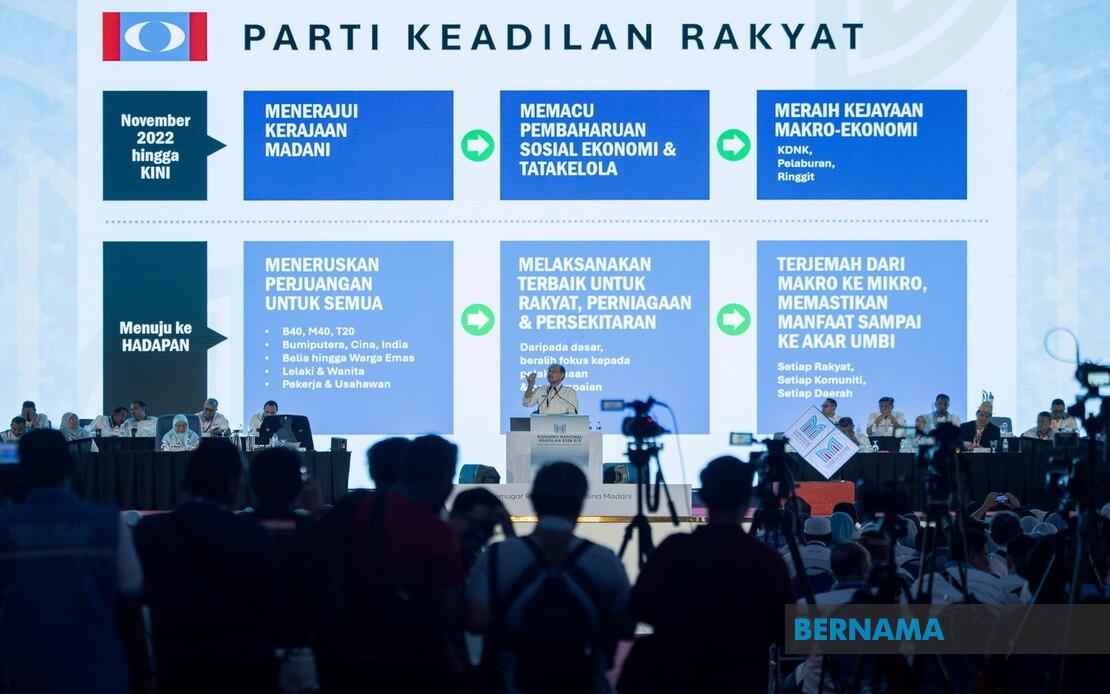
Prime Minister Datuk Seri Anwar Ibrahim has entrusted Home Minister Datuk Seri Saifuddin Nasution Ismail with a full mandate to execute the duties of PKR's deputy president, a decision unveiled during the party's National Congress 2026 proceedings at the Melaka International Trade Centre in Ayer Keroh on August 16. The appointment comes as Nurul Izzah Anwar, the sitting deputy president, steps back temporarily from her position, necessitating the interim arrangement that sees Saifuddin Nasution assume additional responsibilities alongside his ministerial portfolio.
During his winding-up address to PKR delegates, the Prime Minister framed the transition as both a recognition of Saifuddin Nasution's capabilities and a pragmatic response to party requirements during this transitional period. Anwar underscored the depth of his relationship with the Home Minister, describing him as a trusted confidant of considerable loyalty whose understanding of the Prime Minister's operational approach made him the appropriate choice for this temporary stewardship. The language employed suggested continuity rather than rupture, with Anwar's public endorsement serving to legitimise the arrangement to the broader party membership.
The PKR Central Leadership Council had formalised this arrangement on August 6, with party information chief Datuk Seri Fahmi Fadzil announcing that the council had unanimously approved Saifuddin Nasution's interim appointment following a decision to grant Nurul Izzah a temporary absence. This layered approval process—first through the council, then through formal party congress acknowledgement—reflects PKR's institutional mechanisms for managing leadership transitions and demonstrates the party's effort to present the change as orderly and consensual rather than sudden or contentious.
Simultaneously, Anwar announced a broader realignment of senior party positions. Datuk Seri Amirudin Shari, another vice-president, has been assigned responsibility as the party's election director, a role that carries significant weight given Malaysia's evolving electoral landscape and the importance of coordinating campaign machinery. Tengku Datuk Seri Zafrul Tengku Abdul Aziz has been designated as coordinator within the Prime Minister's Office, positioning him as a crucial liaison between PKR's organisational apparatus and the administrative machinery of government.
The leadership announcements must be understood within the context of PKR's recent electoral disappointment in Negeri Sembilan. On August 1, the party suffered a setback in the state election, an outcome that prompted considerable internal pressure and calls for accountability. Datuk Seri Aminuddin Harun, former Negeri Sembilan Menteri Besar and party vice-president, found himself particularly scrutinised, with six divisional chiefs in the state formally demanding a review of his position as chairman of the Negeri Sembilan PKR State Leadership Council.
Anwar's response to this brewing intra-party tension demonstrated a nuanced approach to managing dissent while protecting senior leaders from becoming scapegoats. Rather than accepting the divisional chiefs' call for Aminuddin's removal or dramatic repositioning, Anwar articulated a vision emphasising collective responsibility for electoral failure and reframing Aminuddin's future contributions toward party development rather than state-level political management. The Prime Minister redirected Aminuddin's energies toward a vice-presidential portfolio focused on cadre training and member empowerment, effectively elevating the rhetoric around his role while removing him from the immediate pressures of managing state party affairs.
Anwar's personal commitment to addressing Negeri Sembilan concerns signals his intention to manage the aftermath of the state election as a party president, not merely delegate the matter to subordinates. By pledging to personally engage with the grievances articulated by divisional chiefs, he positioned himself as directly invested in party cohesion and responsive governance. This approach contrasts with a top-down dismissal of internal critiques and instead frames dissent as something worthy of presidential-level engagement.
The appointment of Saifuddin Nasution as interim deputy president carries implications beyond PKR's internal organisational chart. As Home Minister, Saifuddin Nasution already carries substantial administrative burdens, and the additional party responsibility represents a genuine expansion of his portfolio. However, the timing and manner of the announcement suggest that Anwar views this consolidation as manageable and perhaps even strategically advantageous, allowing the Home Minister to maintain close contact with party developments while simultaneously fulfilling his cabinet obligations.
For Malaysian observers accustomed to watching coalition dynamics, these leadership adjustments underline PKR's position as the dominant component within Pakatan Harapan. The party's ability to navigate internal disagreements and implement significant leadership changes at its National Congress reflects the organisational maturity that comes from being the formation's leading force. The Negeri Sembilan election loss, while notable, has not destabilised PKR's broader governance capacity or triggered the kind of leadership crisis that might emerge in smaller or more fragile political formations.
The interim nature of Saifuddin Nasution's appointment raises questions about the medium-term trajectory of PKR's senior leadership structure. Whether this arrangement remains temporary or hardens into a permanent repositioning will likely depend on how Nurul Izzah's leave progresses and how the party's electoral performance evolves over coming months. The decision to publicly commit to an interim arrangement rather than announce an outright leadership change suggests flexibility in Anwar's approach, preserving options for recalibration based on circumstances.
From a Southeast Asian perspective, PKR's management of this transition demonstrates how coalition partners in Malaysia's evolving political ecosystem navigate leadership changes without generating the kind of public ruptures or institutional paralysis that sometimes characterise such moments in neighbouring democracies. The party's mechanisms for consensus-building, even around contentious issues like Aminuddin's position, reflect the institutional sophistication required to sustain multiparty coalitions in Malaysia's increasingly competitive political environment.

