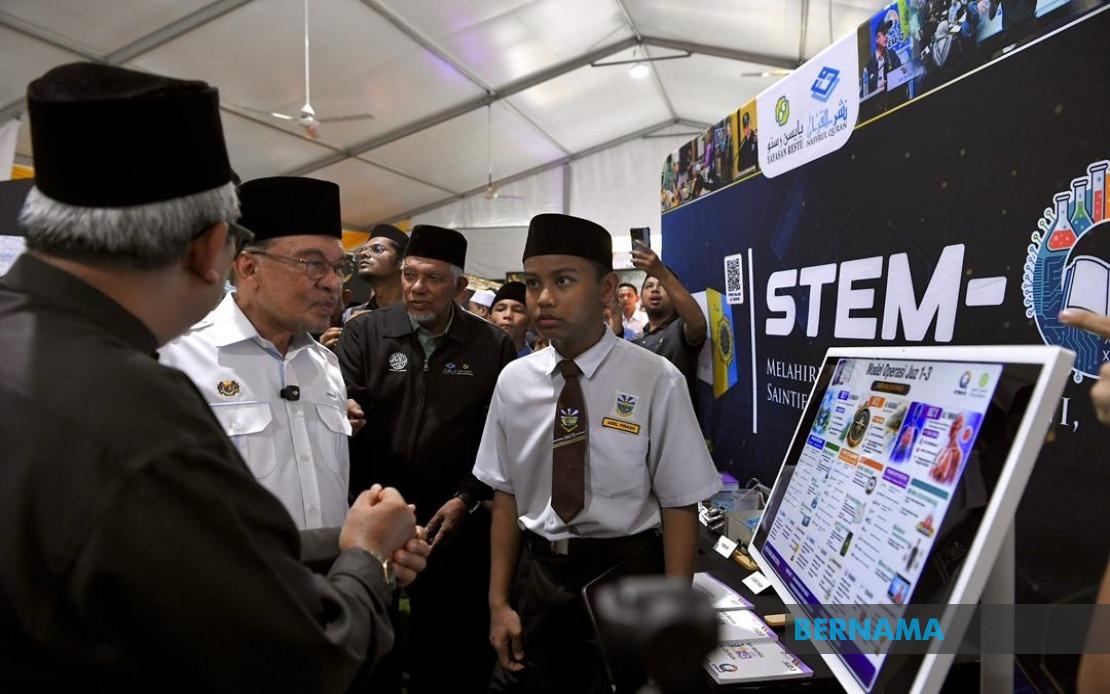
Prime Minister Datuk Seri Anwar Ibrahim has greenlit an additional RM4.6 million in developmental funding for 27 Islamic educational institutions throughout Penang this financial year, significantly expanding the government's investment in religious education infrastructure in the state. The announcement, made during the National Tadabbur Perdana and Maidah Wanita MADANI Permatang Pauh programmes at Masjid Muhajirin in Butterworth, signals a sustained commitment to strengthening Islamic schooling facilities across Malaysia's northern regions.
The doubling of expenditure represents a notable acceleration in federal support for Islamic education in Penang. Last year, the government had channelled RM2.11 million to rehabilitate facilities at 11 Islamic institutions across the state. This year's expansion to RM4.6 million covers a significantly broader network of 27 establishments, demonstrating both the growing recognition of infrastructure deficiencies and the administration's prioritisation of religious education as a strategic national concern.
As Prime Minister and concurrent Finance Minister, Anwar emphasised that the funds would address critical physical infrastructure needs at these institutions. The allocation encompasses comprehensive upgrading works including structural repairs to perimeter walls and fencing, renovation and expansion of madrasah facilities, improvements to primary school buildings, construction of new kindergarten blocks, and development of tahfiz academy spaces. This multifaceted approach acknowledges that quality Islamic education requires not merely curriculum content but also proper learning environments that are safe, functional, and conducive to academic achievement.
For Malaysian policymakers and stakeholders tracking federal spending priorities, this budgetary decision reflects a deliberate pivot toward reinforcing the religious education ecosystem. The scale of the increase—more than doubling from the previous year—suggests the government views Penang as a priority location for such investment, likely responding to documented infrastructure gaps and community petitions from Islamic education stakeholders in the state. This regional focus offers insights into how federal resources are being allocated across Malaysia's states, with coastal and urban areas receiving elevated attention.
Beyond bricks and mortar, Anwar framed the initiative within a broader vision of modernising Islamic education to remain relevant in contemporary Malaysia. He emphasised that upgrades to physical infrastructure must accompany efforts to keep Islamic pedagogy aligned with technological advancement. Specifically, he highlighted the potential role of artificial intelligence in enhancing teaching and learning within Islamic studies and Quranic education, suggesting that technological integration should be viewed as complementary to, rather than at odds with, religious instruction.
However, the Prime Minister attached a critical caveat to technological adoption, stressing that artificial intelligence and digital tools must be deployed within a framework of moral and ethical governance. His assertion that "AI must have values" and "must be rooted in morality" reflects a widespread concern among Muslim-majority societies regarding the ethical dimensions of emerging technologies. This position resonates particularly in Malaysia, where religious authorities and educators frequently voice concerns about technology's potential to dilute traditional values or facilitate harmful content. Anwar's framing positions the government as guardian of moral guardrails even as it embraces innovation.
The Prime Minister's remarks underscore a recurring theme in contemporary Islamic education policy across Southeast Asia: the necessity of balancing tradition with progress. By endorsing infrastructure investment alongside technological modernisation, while insisting on ethical foundations, Anwar articulates a developmental model that permits advancement without abandonment of core values. This approach appeals to conservative constituencies concerned about cultural erosion while also engaging progressive stakeholders who recognise that Islamic education must prepare students for a digitally mediated world.
An equally significant dimension of Anwar's statement involved mobilising civil society and community organisations to expand religious programming beyond formal educational institutions. He encouraged the public to leverage existing freedoms to organise Quranic recitation classes, tadabbur interpretive sessions, and religious lectures designed to deepen mass understanding of Islamic teachings. This invitation to grassroots religious organising represents an implicit acknowledgment that formal schooling alone cannot sustain Islamic literacy and spiritual formation in an increasingly secular public sphere.
The emphasis on continuous, community-led religious programming also reflects pragmatic recognition that religious education competes for attention with secular entertainment, digital distraction, and alternative worldviews. By encouraging structured but non-institutional venues for Quranic study and Islamic discourse, the government attempts to weave religious learning into the fabric of everyday social life. For the broader Southeast Asian context, where religious plurality and secular pressures increasingly shape educational environments, this dual strategy of state investment in formal institutions combined with facilitation of grassroots religious activity offers a model of how governments can support Islamic education without monopolising its delivery.
Penang's prominence in this funding initiative reflects its particular demographic and political character. As a state with substantial Muslim and non-Muslim populations, investment in Islamic institutions carries both religious and political significance. The allocation demonstrates federal responsiveness to Penang's religious education constituency, potentially bolstering government standing among Islamic voters and institutions that often wield considerable influence in local and national elections. From a political economy perspective, the announcement functions simultaneously as infrastructure development, religious patronage, and electoral positioning.
For Islamic education administrators and planners in other Malaysian states, Penang's experience offers both an encouraging precedent and a potential benchmark for advocating additional federal support. The willingness to expand allocations year-over-year, coupled with the breadth of institutions covered, suggests federal appetite for scaling similar programmes. Educational institutions in other states may cite Penang's example when petitioning for comparable investment, potentially generating competitive federalism in religious education funding across Malaysia.
Looking forward, the sustainability of this funding trajectory remains uncertain. Budgetary pressures, competing development priorities, and potential shifts in political leadership could constrain future allocations. Nevertheless, by publicly committing to infrastructure investment in Islamic education while simultaneously articulating a vision of value-guided technological integration, Anwar has signalled that religious education development will remain a government priority. For Malaysian Islamic educators and their constituencies, this represents a significant affirmation even as questions persist regarding the adequacy of total investment and the equitable distribution of resources across Malaysia's 13 states.

