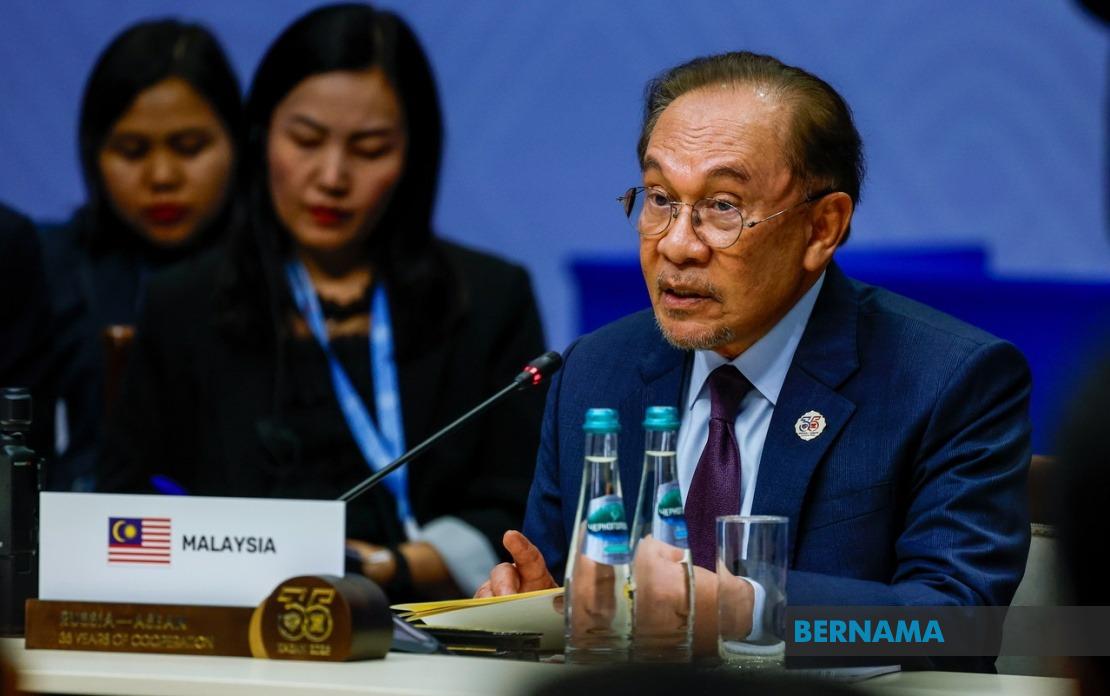
Prime Minister Datuk Seri Anwar Ibrahim has urged ASEAN and Russia to forge closer strategic partnerships across multiple sectors while reaffirming that diplomatic engagement and dialogue remain essential tools for resolving global conflicts and geopolitical tensions. Speaking during the ASEAN-Russia Commemorative Summit in Kazan on June 18, Anwar positioned the gathering as a critical platform for advancing cooperation in an increasingly volatile and unpredictable international landscape.
The timing of the summit carries particular significance, coinciding with the 35th anniversary of ASEAN-Russia diplomatic relations, which were formally established in 1991 in Kuala Lumpur. This milestone underscores three and a half decades of engagement between the 10-member Southeast Asian bloc and Moscow, a relationship that has evolved through various phases of regional and global change. The highest-level gathering brought together Philippines President Ferdinand Marcos Jr, who holds this year's ASEAN chair, alongside leaders and delegations from other ASEAN member states, elevating the discussions to a platform where strategic decisions affecting regional architecture can be forged.
Anwar articulated Malaysia's vision for expanded cooperation across diverse domains that reflect contemporary global priorities. Trade and investment channels merit strengthening to facilitate greater economic integration between the two partners. The digital economy and technological advancement present fresh opportunities, particularly as both ASEAN and Russia seek to enhance their technological capabilities and digital infrastructure. Artificial intelligence development emerged as a specific area warranting collaborative effort, acknowledging that neither bloc can afford to lag in this transformative technology. Energy cooperation remains foundational given Russia's vast hydrocarbon resources and ASEAN's substantial energy demands as rapidly industrializing economies. Food security, an increasingly pressing concern for Southeast Asia's growing population, offers grounds for agricultural collaboration and supply chain diversification. The halal industry represents a distinctive opportunity reflecting ASEAN's Muslim-majority character and Russia's growing interest in serving halal-certified markets. Beyond formal partnerships, people-to-people exchanges were emphasized as essential for building mutual understanding and cultural ties that transcend government-to-government relations.
Central to Malaysia's diplomatic message was the reaffirmation that durable peace emerges exclusively through dialogue, mutual comprehension, and adherence to international law. This principled stance reflects Malaysia's consistent positioning as a voice for multilateralism and rules-based international order within ASEAN. Anwar's emphasis on these foundations addresses broader concerns about great power competition and the potential for conflict escalation in regions where ASEAN maintains strategic interests.
The summit also provided a platform for Malaysia to reinforce its position on Middle Eastern conflicts, particularly the Israeli-Palestinian dispute. Anwar reiterated demands for an immediate halt to violence in Gaza, unobstructed delivery of humanitarian assistance to affected civilian populations, and international recognition of Palestinian self-determination rights. Malaysia's condemnation extended to Israel's military expansion into Lebanese territory and any attacks against UNIFIL, the United Nations peacekeeping force operating in southern Lebanon. These statements reflect Malaysia's longstanding solidarity with Palestinian causes and its concern about regional destabilization that could have ramifications for ASEAN's security environment.
The commemorative summit is expected to produce four substantial outcome documents that will guide future bilateral engagement. The Kazan Declaration marking the 35th anniversary milestone establishes the political framework for continued relations. Separate joint statements on energy cooperation and cultural cooperation delineate specific sectoral priorities. Most significantly, a comprehensive plan of action spanning 2026 to 2030 will provide a strategic roadmap for implementing the ASEAN-Russia Strategic Partnership, offering concrete mechanisms and timelines for advancing agreed initiatives. These documents represent more than ceremonial outputs; they constitute binding commitments that will shape resource allocation and diplomatic priorities for both blocs over the coming years.
For Malaysian readers and Southeast Asian observers, the summit demonstrates how ASEAN maintains strategic autonomy in navigating great power dynamics. The bloc deliberately cultivates partnerships with multiple powers, including Russia, even as tensions between Russia and Western states persist. This non-aligned approach reflects ASEAN's core principle of centrality and the organization's refusal to be drawn into bipolar competition frameworks. Malaysia, as a key ASEAN voice, uses such forums to advance its developmental priorities and reinforce positions on critical issues like the Middle East while building practical cooperation in areas benefiting Southeast Asian economies and societies.
The emphasis on dialogue and diplomacy carries additional weight given current global polarization. ASEAN's efforts to maintain constructive engagement with Russia, while simultaneously engaging with Western powers, underscores the bloc's commitment to avoiding forced choices in international affairs. For ASEAN economies dependent on diversified trade relationships and investment sources, maintaining viable partnerships across geopolitical divides remains essential for sustained growth and stability.
The outcome documents, particularly the 2026-2030 action plan, will likely focus on practical cooperation mechanisms rather than rhetorical commitments. Energy sector engagement could involve Russian liquefied natural gas supplies, technology transfer in hydrocarbon extraction, and renewable energy partnerships. Digital and AI cooperation might include capacity building, research collaboration, and talent exchanges. Trade facilitation measures could reduce barriers affecting Southeast Asian exports to Russian markets and vice versa. These concrete initiatives demonstrate how ASEAN-Russia relations transcend geopolitical posturing to generate tangible benefits for participating nations and their populations, reinforcing the diplomatic principle that sustained engagement serves mutual interests far more effectively than isolation or confrontation.

