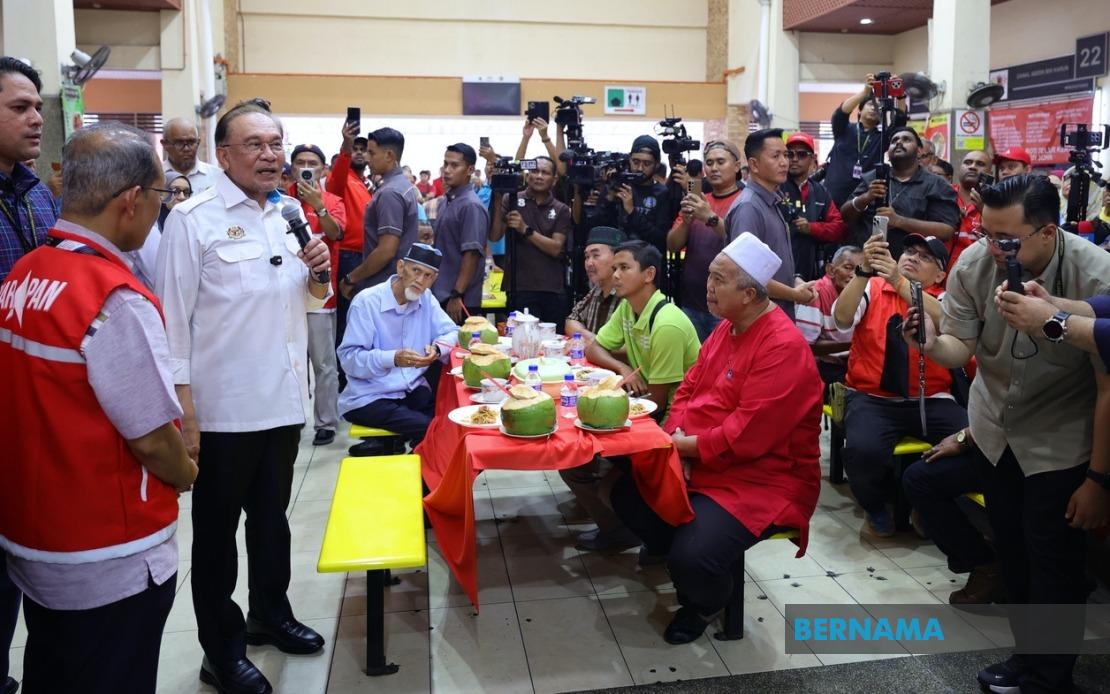
Prime Minister Datuk Seri Anwar Ibrahim has appealed to Negeri Sembilan voters to maintain their confidence in Pakatan Harapan, arguing that a strengthened electoral mandate is essential for preserving the state's political equilibrium. Speaking during a series of campaign stops in Seremban on behalf of the coalition ahead of the August 1 poll, Anwar stressed that voter support would translate into enhanced capacity for the state administration to collaborate seamlessly with federal authorities in delivering development projects and welfare initiatives to residents.
Anwar's emphasis on continuity reflects a broader PH strategy of projecting itself as a stabilising force in Malaysian politics. As both Prime Minister and PH chairman, he underscored the interconnection between state and federal governance, suggesting that fragmented political arrangements could compromise policy implementation and public service delivery. His framing of the election centres on the notion that a decisive majority for the coalition would eliminate friction between state and national administrations, thereby creating conditions for more efficient resource deployment and coordinated planning across the federation.
The Prime Minister credited Menteri Besar Datuk Seri Aminuddin Harun with maintaining Negeri Sembilan's political environment over the preceding three years, attributing this achievement to cross-party cooperation and institutional resilience. This acknowledgement is significant as it positions the state's recent record as a model for how coalitional governance can function without frequent instability or standoffs. By invoking Aminuddin's tenure as evidence of PH's administrative competence, Anwar attempted to build confidence among undecided voters that the coalition merits another term.
Yet Anwar also adopted a disarming tone regarding governance performance, conceding that PH's policies and programmes are not flawless. Rather than deflecting criticism, he invited voters to provide feedback on shortcomings and pledged that party candidates would act on such input to refine future initiatives. This rhetorical posture attempts to counter perceptions of arrogance or complacency while preserving the coalition's credibility. The implicit message—that PH is responsive to public concerns and willing to iterate on its approach—seeks to differentiate the coalition from opposition parties and reinforce its claim to voter support.
The Negeri Sembilan state election will determine control of 36 seats, with Pakatan Harapan fielding a full slate of candidates across all constituencies. The coalition's deployment comprises 16 candidates from PKR, eleven from DAP, and nine from Amanah, reflecting the established power-sharing arrangement within the alliance. This distribution underscores PH's internal dynamics and the relative weight each component party holds in the coalition's electoral calculations. For Malaysian observers, the state election serves as a barometer of whether the federal coalition's popularity has translated into sustained grassroots support or whether voters have developed reservations about PH's record in office since the 2022 general election.
The Electoral Commission has scheduled polling for August 1, with early voting permitted on July 28. This timeline provides candidates and parties a compressed campaign window of roughly two weeks to mobilise supporters and conduct outreach. For Negeri Sembilan, the election represents an opportunity for the coalition to reinforce its territorial control or, conversely, a potential vulnerability if opposition parties have made electoral inroads in the state. Given Malaysia's trajectory of competitive multi-party politics, the state contest will likely attract national attention as an indicator of whether PH retains the political momentum that secured it the largest bloc of federal parliamentary seats in 2022.
Anwar's personal participation in Negeri Sembilan's campaign highlights the election's importance to PH's national narrative. As Prime Minister and coalition chief, his presence signals that party leadership views the state outcome as consequential for the coalition's standing and morale. Conversely, his campaign visits may also reflect concern that the state is not a guaranteed PH stronghold and requires reinforced messaging from top-tier leadership to secure victory. The concentration of high-level party attention on a single state election, while standard during competitive contests, suggests PH strategists perceive the race as more competitive than public polling might initially indicate.
For Negeri Sembilan residents, the election presents a choice about governance direction and administrative priorities over the next five years. PH's campaign message emphasises continuity, stability, and responsiveness to public feedback, while implicitly contrasting its record against opposition platforms. Voters will weigh factors including economic performance, delivery of promised infrastructure projects, public safety, and administrative efficiency. The state's economic reliance on manufacturing and services, combined with its location between the Klang Valley and southern regions, makes it vulnerable to broader macroeconomic trends that may influence voter sentiment independent of local political messaging.
The broader Southeast Asian context adds another dimension to Negeri Sembilan's significance. Malaysia's experience with coalition governance and electoral competition provides a model—both positive and cautionary—for other regional democracies grappling with multi-party systems and power-sharing arrangements. The viability of PH as a durable political force depends partly on its ability to retain voter confidence through consistent electoral performance across multiple contests. A decisive PH victory in Negeri Sembilan would reinforce the coalition's narrative of electoral resilience, whereas a narrower margin or unexpected opposition gains could prompt questions about whether PH's 2022 federal victory reflected enduring structural support or a temporary electoral realignment.
As campaign efforts intensify over the coming fortnight, Anwar's core argument—that voter trust in PH translates into stable, effective governance—will be tested against opposition messaging and voter sentiment regarding economic conditions, service delivery, and political trust. The August 1 outcome will provide analysts with empirical evidence about PH's standing in a non-metropolitan, non-peninsula peripheral state, offering insights into whether the coalition's political coalition extends uniformly across Malaysia's diverse electoral geography or concentrates in particular constituencies and regions. For Malaysian observers and regional democracy watchers, Negeri Sembilan's election outcome carries implications extending well beyond the state's administrative boundaries.

