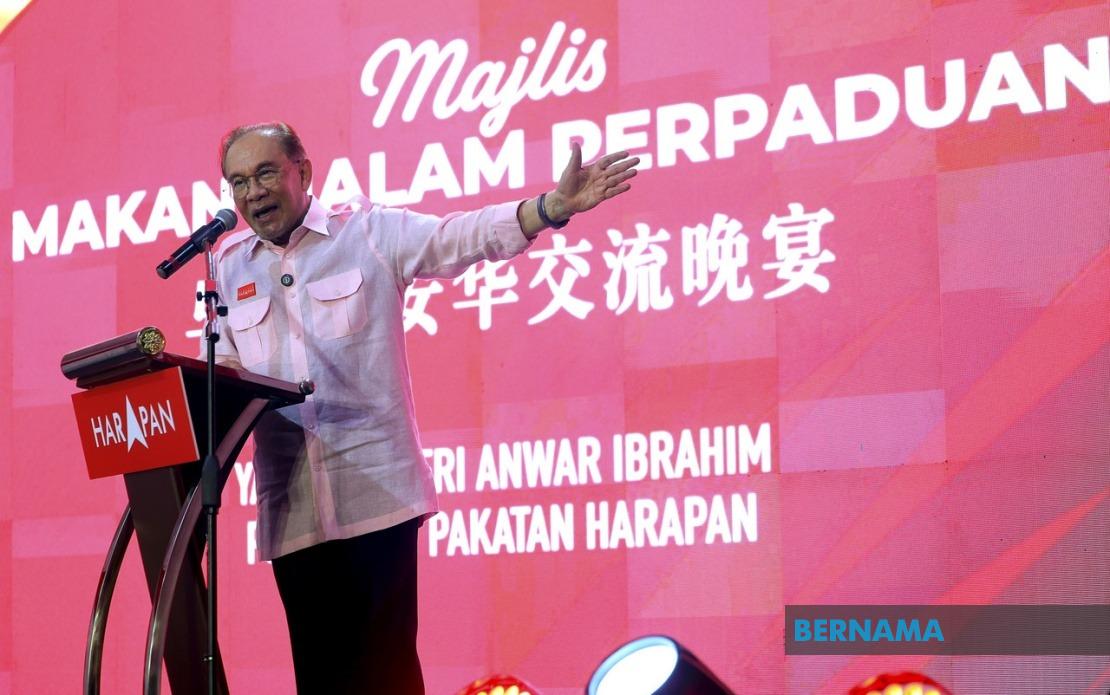
Prime Minister Datuk Seri Anwar Ibrahim has cast the upcoming Negeri Sembilan state election as a choice between proven, unified leadership and opposition infighting, using a campaign dinner in Sikamat to highlight what he views as the fractious nature of his rivals' candidacies. Speaking at the 'Perpaduan' Dinner in Taman Sri Penaga on July 22, the Pakatan Harapan chairman drew sharp contrasts between PH's track record of stable governance and what he characterised as the opposition's preoccupation with internal power struggles, even before voting takes place on August 1.
Anwar's remarks zeroed in on the apparent competition among opposition figures to claim the menteri besar's prize, a phenomenon he suggested would undermine effective state administration. His core argument rested on the principle that electoral victory should hinge on capability and public service rather than on which faction or individual secures the top job. By framing the opposition's jockeying as symptomatic of a wider malaise—prioritising personal advancement over governance—he attempted to position PH as the more serious, responsible alternative for voters concerned about stable administration.
The prime minister specifically appealed to Negeri Sembilan voters to retain Datuk Seri Aminuddin Harun, the incumbent menteri besar and PH Linggi candidate, spotlighting his tenure as evidence of clean, corruption-free governance. Aminuddin's presence at the campaign event underscored PH's confidence in continuity; his administration has been presented to the electorate as a model of integrity and effective resource management, qualities Anwar suggested would be jeopardised if the state fell to rivals bickering over succession and privilege.
Beyond the menteri besar narrative, Anwar launched a broader assault on what he described as divisive racial rhetoric weaponised by opposition campaigns to mobilise support. This criticism carries particular weight in Negeri Sembilan, a state with significant Malay-Muslim and Chinese communities where communal narratives have historically shaped electoral outcomes. By attributing such tactics to the opposition and positioning the Unity Government as committed to inclusive, multi-racial governance, Anwar sought to occupy the political centre ground and frame PH as transcending narrow identity politics.
The Unity Government's commitment to serving all segments of society regardless of ethnicity, Anwar stressed, manifested in concrete policy measures including enhanced socio-economic allocations, expanded housing programmes, and salary adjustments benefiting civil servants across all communities. These initiatives represent the government's argument that inclusive governance translates into tangible improvements in living standards, a message potentially resonant with voters preoccupied by cost of living pressures and employment security in an uncertain economic climate.
Pakatan Harapan is fielding candidates in all 36 state seats in Negeri Sembilan, with the coalition's component parties—PKR, DAP, and Amanah—contesting 16, 11, and nine seats respectively. This full-spectrum approach reflects PH's strategic determination to maximise its reach and secure an unambiguous mandate, rather than ceding any constituency to opposition candidates or leaving potential supporters without a clear PH choice. The distribution of seats among coalition partners also illustrates ongoing power-sharing dynamics within the alliance, with PKR's dominance reflecting its status as the largest component and Anwar's party as the de facto coalition leader.
The campaign event, held in Sikamat, brought together other PH candidates including Nor Azman Mohamad, contesting the Sikamat seat, and Datuk Muhammad Nazri Kassim, vying for Ampangan. The presence of multiple candidates at a single rally enabled Anwar to broadcast a broader message of collective PH strength and cohesion, implicitly contrasting with any suggestion of disarray within the opposition ranks. This visual messaging—several candidates united around a common platform—reinforces PH's narrative of disciplined, unified governance.
Early voting is scheduled for July 28, four days before the main polling day, accommodating civil servants, security personnel, and others unable to vote on August 1. This staggered voting process, increasingly standard in Malaysian elections, allows parties and independent observers to begin gauging momentum and adjusting ground-level campaign tactics based on early turnout and precinct-level results. For PH, strong early voting numbers would provide psychological advantage and validation of their campaign messaging going into the final weekend of campaigning.
The Negeri Sembilan contest arrives at a critical juncture for the Unity Government, which has sustained its federal coalition since 2020 but faces mounting pressure from persistent economic headwinds and perceptions of governance challenges. A decisive PH victory in Negeri Sembilan would vindicate Anwar's political narrative and reinforce the coalition's claim to represent mainstream, forward-thinking leadership, whereas a closer-than-expected result or opposition gains would provide ammunition to critics questioning the government's direction and popularity.
Anwar's emphasis on keeping Aminuddin as menteri besar also signals PH's confidence that the incumbent is an asset rather than a liability, suggesting his administration has navigated the post-2020 political turbulence effectively and retained public confidence. In a state where incumbency advantages can be decisive, this messaging attempts to foreclose space for opposition arguments that change is needed or that alternative leadership would deliver superior outcomes.
The campaign rhetoric deployed in Negeri Sembilan—focused on unity, inclusion, proven capability, and opposition dysfunction—mirrors broader themes shaping Malaysian politics as the nation navigates economic recovery, demographic shifts, and evolving voter expectations. How these messages resonate with Negeri Sembilan voters, and whether the state election result favours PH's narrative, will provide valuable signals about the political trajectory of a nation where state-level contests increasingly function as proxies for assessing federal government performance and legitimacy.

