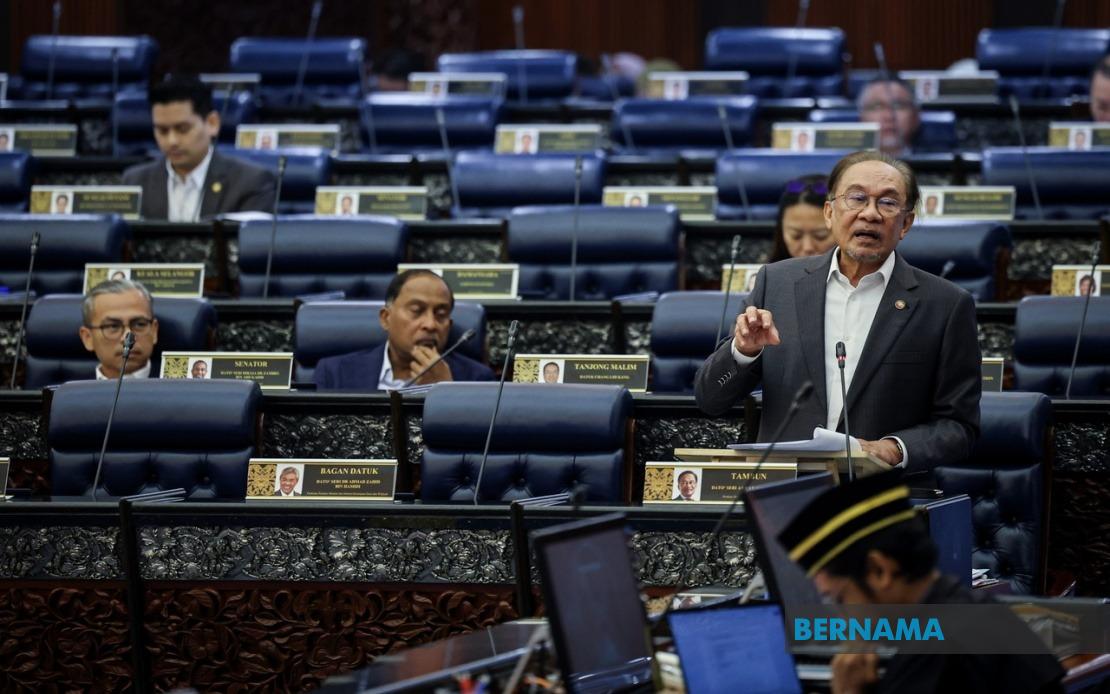
Prime Minister Datuk Seri Anwar Ibrahim moved to defuse potential controversy surrounding his recent statements on the Johor state election scheduling, emphasizing during parliamentary proceedings on July 7 that his observations reflected personal reasoning rather than any effort to direct the Election Commission's operational choices. Speaking in the Dewan Rakyat during Minister's Question Time, Anwar sought to distinguish between offering an opinion grounded in practical considerations and attempting to influence an institution explicitly mandated to function independently.
The clarification emerged after opposition lawmakers questioned the scope and intent behind Anwar's earlier commentary during the campaign trail, when he had suggested that conducting the election on a Sunday rather than the scheduled Saturday would better accommodate Malaysian voters employed across the border in Singapore. Ahmad Fadhli Shaari from Pasir Mas pressed the Prime Minister to explain whether his public statements had crossed the threshold from casual remark into improper political pressure on the electoral body. Such scrutiny reflects wider sensitivities in Malaysia concerning the preservation of institutional independence, particularly around bodies tasked with safeguarding democratic processes.
Anwar's reasoning centred on the practical realities facing a significant segment of the Malaysian workforce. He acknowledged that many Malaysians work in Singapore and frequently operate on compressed Saturday schedules, meaning a Sunday polling date would grant them easier passage across the causeway to fulfil their civic obligation. The arithmetic of cross-border employment in the Klang Valley and Johor regions has long posed logistical challenges during election cycles, as workers must arrange leave or time-off to return home and queue at polling stations. By framing his preference around voter convenience rather than partisan advantage, Anwar attempted to position his intervention as merely suggesting a common-sense adjustment rather than overreaching into the Election Commission's preserve.
Crucially, the Prime Minister reinforced that the Election Commission stands as a constitutionally protected independent authority bearing sole responsibility for determining all aspects of the electoral calendar. He stated unambiguously that regardless of his personal inclination toward Sunday voting, the Commission's decision to proceed on Saturday carried full legitimacy and finality. This rhetorical move sought to rebuild trust in the separation between the executive branch and electoral administration—a distinction that carries particular weight in Malaysia's political context, where questions about institutional autonomy periodically surface. The emphasis on the Commission's unfettered discretion may also serve to preempt suggestions that the government had subtly pressured officials toward any particular outcome.
A second line of questioning from Mohd Sany Hamzan of Hulu Langat ventured into whether Malaysia might formally approach Singapore to coordinate arrangements enabling Malaysian voters to participate more readily. This query touched on sensitive diplomatic ground, as any government-to-government engagement regarding electoral processes could theoretically be perceived as seeking foreign assistance in managing domestic affairs. Anwar rejected this approach definitively, reaffirming Malaysia's commitment to the principle of electoral sovereignty and non-interference in another nation's internal processes. He emphasized that Malaysia holds this standard dear and applies it reciprocally, thus cannot reasonably ask Singapore to intervene in Malaysian electoral administration.
However, Anwar indicated that business organizations operating in Singapore with significant Malaysian workforces had been furnished information about upcoming elections and encouraged to grant employees time to return and cast ballots. This distinction between informal corporate accommodation and formal governmental diplomacy allowed Anwar to acknowledge the legitimate interests of cross-border workers while maintaining that no official channels had been activated. The approach reflects a pragmatic middle ground: government does not directly approach foreign counterparts about elections, yet private employers remain free to manage their personnel scheduling compassionately during electoral periods.
The Prime Minister referenced his personal relationship with Singapore's Lawrence Wong, underscoring that even cordial bilateral ties and personal rapport between leaders do not justify or necessitate collaboration on electoral matters. This point carries significance in Southeast Asia, where close relationships between premiers sometimes blur the lines of formal state relations. By explicitly stating he harbored no intention of contacting Wong regarding Johor's polls, Anwar signalled respect for institutional boundaries that transcend personal friendship or strategic partnership. Such clarity becomes particularly important given Malaysia and Singapore's historical tendency toward minor diplomatic friction, where perceptions of undue influence can become flashpoints for public concern.
The broader context involves growing scrutiny worldwide regarding electoral integrity and the independence of election-managing institutions. Malaysia's Election Commission, despite occasional criticism from civil society groups, generally maintains credibility as an impartial arbiter. Anwar's careful language—distinguishing personal opinion from institutional direction—reflects awareness that any appearance of governmental pressure could erode public confidence in the Commission's autonomous judgment. Opposition lawmakers seized on his remarks partly to test whether the executive might be testing the boundaries of appropriate engagement with electoral authorities. The parliamentary exchange therefore served as a minor stress-test of Malaysia's democratic conventions and the practical lines separating legitimate political discourse from undue influence.
For Malaysian voters working across the causeway, the resolution of this exchange carries practical implications. While the election proceeded on Saturday as originally scheduled, the discussion illuminated how cross-border employment patterns complicate electoral logistics in a region characterized by significant labor mobility. The Johor situation exemplifies challenges facing democracies with considerable transnational workforces, where voter participation intersects with international business arrangements. Future electoral planning may need to grapple more systematically with accommodating this demographic, though any such adjustments would properly remain the Election Commission's prerogative to assess and implement.

