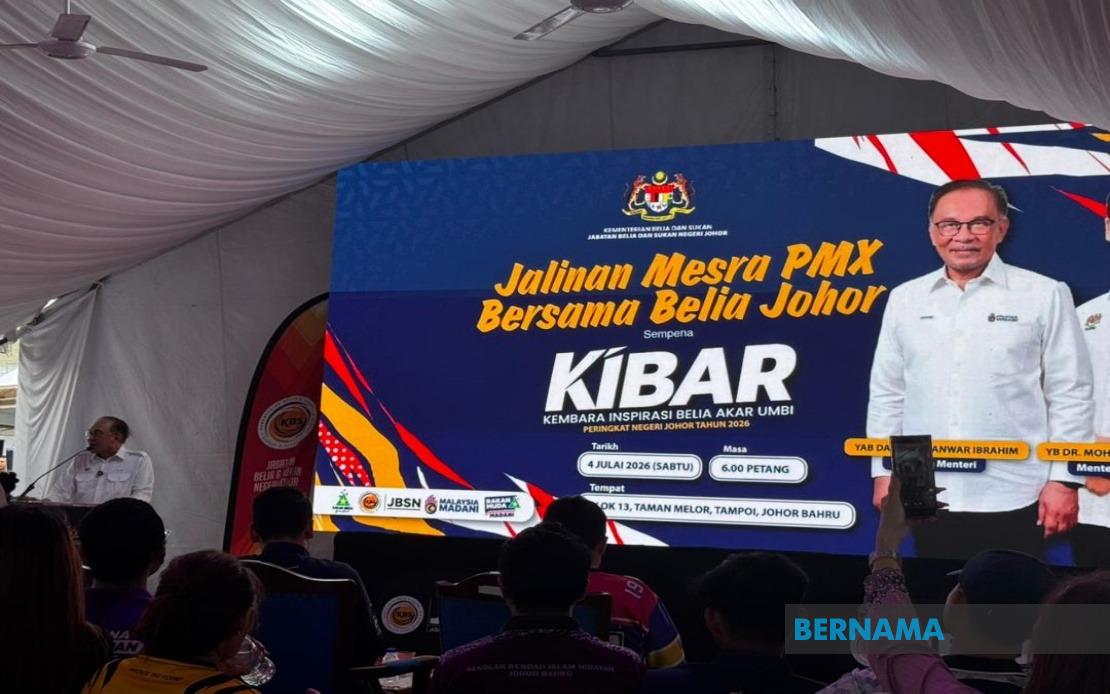
Prime Minister Datuk Seri Anwar Ibrahim has launched a pointed critique at political factions that routinely invoke Malay supremacy and indigenous rights during campaign seasons, yet demonstrate little commitment to preserving and advancing Malay interests when wielding governmental authority. Speaking in Johor Bahru on July 4, Anwar articulated frustration with what he characterised as a disconnect between electoral rhetoric and post-election governance, a pattern that has become increasingly visible in Malaysian politics.
The Prime Minister's remarks, delivered during an engagement with Johor youth as part of the 2026 Kembara Inspirasi Belia Akar Umbi (KIBAR) initiative at Taman Melor, Tampoi, centred on the erosion of Malay reserve land—a constitutionally protected asset that sits at the heart of Malaysia's social contract. Anwar pointedly questioned when these rhetorically zealous parties had last undertaken meaningful action to create or expand Malay reserve land holdings, implying that the answer was never or rarely. Instead, he noted with evident concern that substantial quantities of such protected land have transferred to non-Malay ownership, a phenomenon that contradicts the stated commitments of political parties claiming stewardship of Malay and Bumiputera rights.
Anwar's intervention addresses a persistent tension within Malaysian electoral politics. Political parties, particularly those on the conservative spectrum, have historically mobilised support by emphasising threats to Malay-Muslim dominance and indigenous privileges enshrined in the Federal Constitution. These narratives prove electorally potent, especially during periods of heightened competition for votes in rural and semi-urban constituencies. However, Anwar's assertion suggests that once these parties transition from opposition to governance, the urgency and authenticity of their commitment to Malay interests evaporate, replaced by pragmatism and competing fiscal priorities.
The Prime Minister's challenge carries particular weight given his position within Pakatan Harapan, a coalition that has historically attracted cross-community support and emphasised multiethnic governance. By criticising what he frames as opportunistic Malay-centric messaging, Anwar is implicitly positioning his government as more principled and results-oriented. His emphasis on transparent actions and policies over sloganeering represents an attempt to reframe the political discourse around measurable outcomes: actual Malay reserve land preservation, documented Bumiputera contract allocation, and verifiable asset protection for Malay business interests.
The timing of these remarks merits consideration within the broader context of Malaysia's political evolution. The nation's electorate has become increasingly sophisticated, with younger voters—the ostensible audience for the KIBAR programme—less susceptible to purely rhetorical appeals and more concerned with governance competence and tangible policy delivery. Anwar's critique effectively challenges opposition parties to defend their record or acknowledge the gap between campaign promises and administrative reality, potentially repositioning public expectations around what constitutes genuine advocacy for Malay rights.
The hypocrisy Anwar identifies extends beyond land issues. He pointed to the broader pattern wherein parties claiming Malay supremacy simultaneously court business interests and contracts that benefit their connected networks rather than wider Malay entrepreneurship. This suggests a distinction between rhetorical commitment to Malay collective advancement and actual willingness to distribute resources equitably within that community. Crony capitalism, dressed in the language of Bumiputera protectionism, appears to be Anwar's implicit target—a practice that benefits political insiders while doing little for ordinary Malay citizens.
Such critiques, however, also invite scrutiny of the Pakatan Harapan government's own record on Malay reserve land protection and Bumiputera economic advancement. Opposition figures would likely counter that every Malaysian government, regardless of coalition, has presided over erosion of indigenous land protections, sometimes through deliberate policy choices and sometimes through bureaucratic negligence. The difference in degree and intent may matter less to constituencies affected by loss of ancestral land rights than the fact of loss itself.
Anwar's framing also reflects evolving demographics and economic anxieties within the Malay community. Younger Malays face significant socioeconomic pressures—housing affordability, graduate employment, entrepreneurial opportunity—that existing Bumiputera mechanisms have not adequately addressed. For this constituency, empty nationalist rhetoric rings hollow against lived economic precarity. Anwar's emphasis on substantive policy represents an implicit acknowledgment that traditional ethnic solidarity messaging no longer suffices, and that effective governance demands genuine focus on shared material interests.
The presence at this event of Selangor Menteri Besar Datuk Seri Amirudin Shari and Youth and Sports Minister Dr Mohammed Taufiq Johari underscores the Pakatan Harapan's attempt to present a unified front on this issue. By having senior figures from both federal and state levels articulate consistent messaging around Malay rights advocacy rooted in demonstrable action, the coalition seeks to consolidate political credibility on matters of indigenous interest.
Moving forward, Anwar's challenge will rest not merely on rhetorical contrasts with opposition parties but on his government's capacity to document and highlight specific achievements in Malay reserve land preservation, Bumiputera business development, and equitable resource distribution. The KIBAR programme itself, targeting grassroots youth engagement, represents one mechanism through which the government might build political capital among younger Malays by demonstrating tangible commitments. Ultimately, the distinction Anwar is drawing—between political slogans and substantive action—may define electoral competition in coming years, with voters increasingly demanding evidence of delivery rather than promises of future advocacy.

