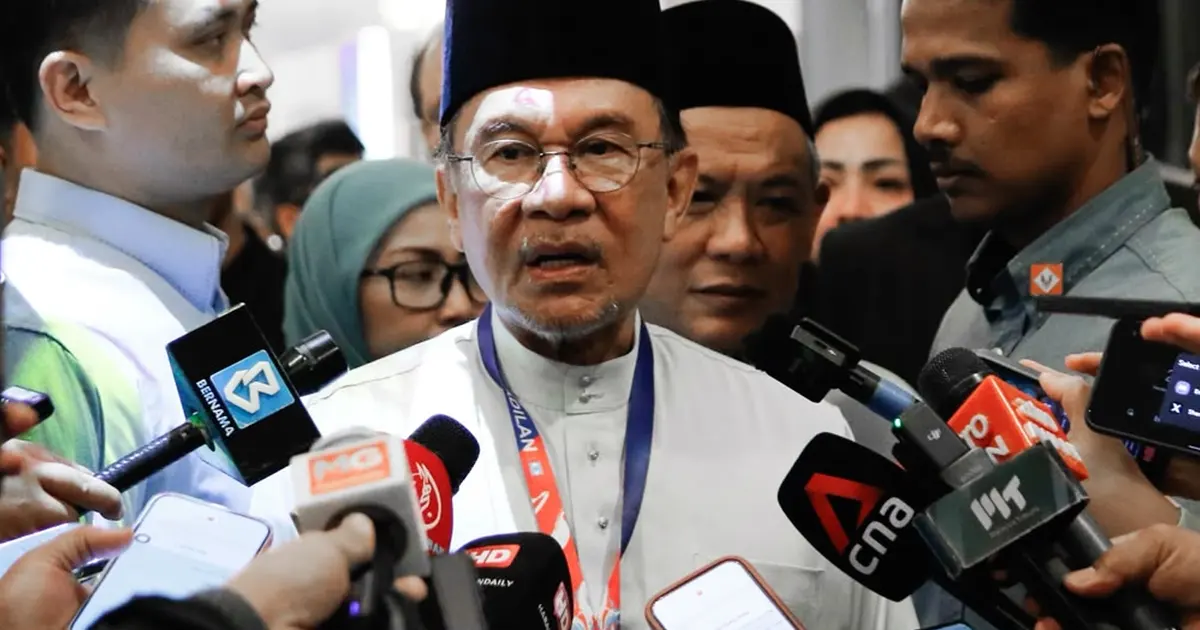
Prime Minister Anwar Ibrahim moved swiftly to contain potential coalition tensions on Tuesday, denying fresh speculation about strained relations with Deputy Prime Minister Zahid Hamidi and reframing critical remarks by former Umno Youth chief Khairy Jamaluddin as merely one individual's viewpoint rather than a reflection of broader governmental concerns.
The clarification came in response to Khairy's observations shared during a podcast appearance, where the ex-Umno Youth leader had raised questions about trust dynamics within Malaysia's governing alliance. Rather than engaging substantively with those specific critiques, Anwar positioned the disagreement as rooted in different interpretive frameworks, suggesting that both he and Zahid fundamentally view the coalition's functioning in harmonious terms that diverge from Khairy's assessment.
The incident underscores persistent undercurrents within the Pakatan Harapan-Barisan Nasional coalition arrangement, where senior figures occasionally surface concerns about cohesion and personal relations at the top levels of government. For Malaysian political observers, these periodic statements—whether dismissive denials or expressed reservations—have become a familiar rhythm in coalition governance. Each public comment, even when quickly walked back or reframed, offers a window into deeper questions about whether the unprecedented alignment of traditionally opposed blocs can genuinely function without friction.
Anwar's response strategy demonstrates a well-established political instinct: publicly downplay intra-coalition disputes while maintaining sufficient ambiguity to preserve relationships across different party factions. By attributing Khairy's observations to personal interpretation rather than factual assessment, the prime minister avoided either validating concerns about his working relationship with Zahid or attacking the former youth leader for raising them. This calculated restraint reflects the delicate mathematics of coalition management, where every public statement risks reverberating through multiple party structures with different sensitivities and priorities.
The timing of Khairy's podcast remarks carries particular significance given the coalition's ongoing efforts to present unified governance amid persistent economic challenges and public scrutiny. Trust between senior ministerial figures forms the backbone of effective cabinet function, particularly when coalition partners must coordinate across significantly different ideological traditions. Questions about whether such trust exists, even when carefully framed as individual opinions, can feed broader narratives about governmental stability that ripple through markets, investor confidence, and public perception.
Zahid's position as deputy premier has itself generated considerable discussion since his appointment, reflecting Umno's bargaining power within the broader coalition arithmetic. His criminal trial proceedings, which continue in parallel with his senior ministerial duties, add an additional layer of complexity to the trust question. Any perception that the prime minister harbours doubts about his deputy's reliability could theoretically undermine the deputy's authority or complicate policy coordination, making Anwar's decisive denial strategically important regardless of its underlying accuracy.
Khairy's recent political trajectory—having lost his Umno Youth leadership position and subsequently faded from prominent ministerial office—may also inflect how his commentary is received within governmental and party circles. Former political figures sometimes use media platforms to maintain relevance and influence factional debates within their home parties, potentially explaining why his observations resonated enough to warrant prime ministerial response. Alternatively, the fact that Anwar felt compelled to address them publicly suggests that Khairy still commands sufficient standing or that his remarks connected with existing anxieties within coalition ranks.
For Southeast Asian governments operating within coalition frameworks—a structural reality for many regional nations—the Malaysian experience offers instructive lessons about managing public discourse around internal relationships. Singapore's political system maintains tight message discipline partly by preventing precisely these kinds of open discussions, while Thailand's coalition governments have frequently collapsed over similar unresolved trust questions. Malaysia's approach, by contrast, appears to tolerate periodic airing of concerns followed by managerial reassurance, a pattern that has thus far preserved coalition cohesion despite multiple opportunities for breakdown.
The substantive policy implications of whether Anwar and Zahid genuinely trust each other extend across multiple portfolios and strategic decisions. Their respective spheres of influence—the prime minister's control over PKR and overall coalition direction versus the deputy premier's Umno base and infrastructure ministry responsibilities—remain sufficiently distinct to permit functional governance even amid interpersonal tensions. Yet coordinated initiatives requiring buy-in from both figures' political networks could theoretically suffer if underlying confidence proves shallow.
Looking forward, whether this denial proves sufficient to suppress further speculation depends substantially on whether additional coalition figures weigh in with their own observations. Political silence from other senior ministers could suggest acceptance of Anwar's framing, while further comments—even in measured terms—would signal that trust questions genuinely preoccupy significant portions of the government. The coming weeks will likely reveal whether this exchange represents a genuine misunderstanding quickly clarified or symptomatic of deeper collaborative friction that periodic denials cannot indefinitely obscure.
The Malaysian political establishment has grown accustomed to managing coalition governance through such cyclical confrontations with potential fractures. What remains unresolved, however, is whether the current alignment of traditionally antagonistic forces can eventually crystallise into a genuinely integrated political bloc or whether it will forever depend on careful public management of private doubts and divergent interests.

