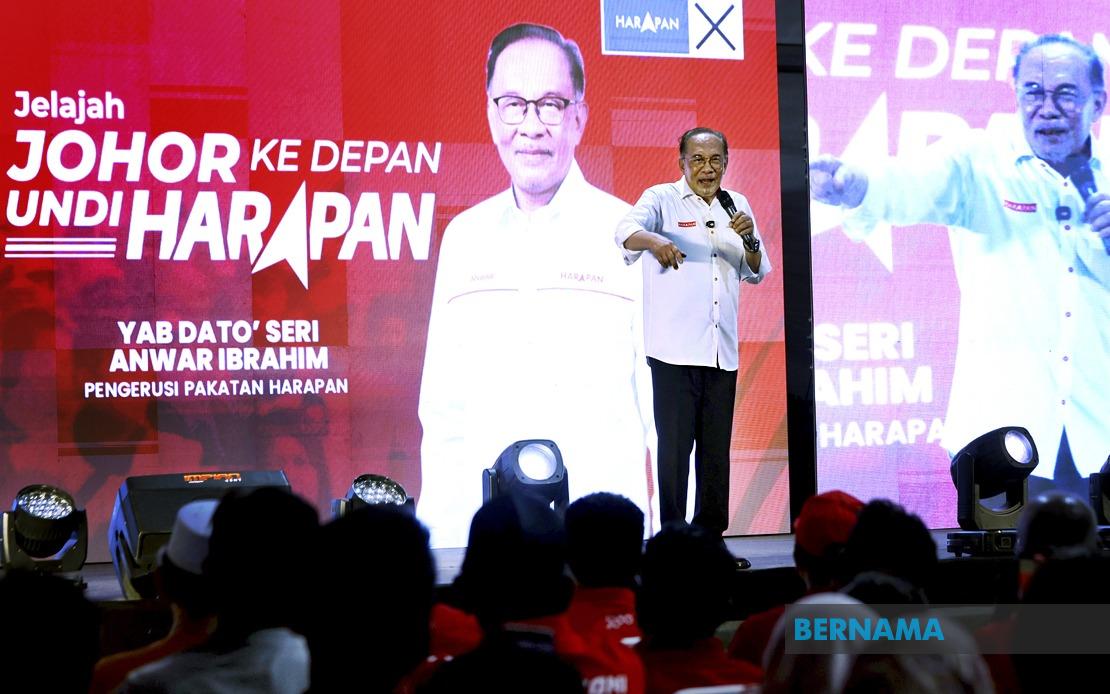
Prime Minister Datuk Seri Anwar Ibrahim has issued an unequivocal pledge to extinguish what he terms the "culture of plunder" that long characterised Malaysian politics, vowing that his administration will extend zero tolerance toward corruption at every level of government. Speaking at a campaign rally in Sungai Mati, Muar, the Premier underscored the MADANI Government's core mission: to systematically purge the nation's bureaucratic infrastructure of entrenched illicit practices and restore public wealth to its rightful owners. His remarks strike at the heart of a governance challenge that has haunted Malaysia for decades and remains central to public concerns about institutional integrity and the equitable distribution of resources.
The Prime Minister's language deliberately transcended ethnic and religious boundaries, insisting that leadership quality should hinge entirely on moral character rather than communal identity. He articulated this principle with striking clarity, declaring his preference for honest Malays, Chinese, and leaders of all backgrounds over dishonest figures regardless of their demographic profile. This rhetorical approach attempts to reframe the anti-corruption agenda away from narrow factional disputes and toward universal principles of accountability—a critical distinction in Malaysia's fractious political landscape where many governance failures have been historically attributed to identity-based patronage networks. By centering integrity as a non-negotiable criterion, Anwar positioned his government as fundamentally opposed to the zero-sum ethnic politics that previous administrations weaponised to shield wrongdoing.
Central to Anwar's message was a pointed condemnation of institutional mechanisms that permitted the conversion of state power into personal and familial enrichment. He singled out the practice of awarding government contracts to relatives and close associates as a defining feature of the discredited system he seeks to dismantle. Such arrangements, he argued, represented not merely individual moral failures but structural distortions that drained national resources and undermined Malaysia's competitive standing internationally. The specificity of his critique—naming family enrichment, nepotistic contracting, and self-dealing—suggested a deliberate pivot toward concrete governance reforms rather than abstract anti-corruption rhetoric. For observers tracking institutional change, this framing indicates recognition that corruption in Malaysia functions through systematic pathways rather than isolated incidents.
Anwar's unambiguous assurance that no individual would receive protection from his government if implicated in corruption constitutes a direct challenge to historical patterns where political rank often conferred immunity from investigation or prosecution. This pledge assumes particular weight given Malaysia's recent history of high-profile corruption cases and the public perception that accountability remains selectively enforced. By explicitly foreclosing the possibility of political protection, the Prime Minister signalled intent to subordinate political calculation to institutional principle—though the distinction between rhetorical commitment and actual implementation remains a legitimate subject of scrutiny. The statement carries significance both domestically and regionally, as Southeast Asian governance standards increasingly incorporate transparency metrics that directly influence international investment decisions and institutional credibility.
During the same campaign appearance, Anwar characterised opposition attempts to destabilise his government as fundamentally motivated by desire to recover lost federal power rather than concern for public interest. This framing served multiple purposes: it delegitimised dissent by attributing it to self-interest rather than substantive policy disagreement, while simultaneously reinforcing the government's self-image as protector of systemic integrity against those willing to exploit divisions for factional advantage. The rhetorical maneuver reflects wider tensions within Malaysian politics between narratives of institutional reform and perceptions of continuity beneath surface-level personnel changes. For voters evaluating competing claims about governance quality, distinguishing between genuine institutional transformation and performative anti-corruption messaging constitutes an ongoing analytical challenge.
The timing of these remarks proved strategically significant, delivered during intensive campaigning for the Johor State Election scheduled for July 11, with early voting designated for July 7. Anwar's participation across multiple campaign venues within a compressed timeframe underscored the stakes the federal government attributed to the state contest. Election results in Johor carry proportionate weight in Malaysian politics given the state's demographic scale and historical significance as a political bellwether. By centering anti-corruption messaging in his state campaign, Anwar sought to mobilise voters around governance quality as a primary electoral consideration, potentially reorienting campaign discourse from identity-based appeals toward institutional performance metrics.
The Johor contest itself presented a complex political picture, with 172 candidates contesting 56 state legislative seats in what analysts widely viewed as a critical test of Pakatan Harapan's electoral viability and public confidence in the current federal administration's reform agenda. The breadth of Anwar's campaign engagement—completing 15 separate commitments across two days in the state—reflected the government's determination to establish direct communication with voters rather than rely exclusively on traditional media channels. This intensive retail politicking strategy suggests recognition that anti-corruption claims require reinforcement through consistent public messaging and direct accountability to constituencies. Notable attendees at the Sungai Mati event included Penang Chief Minister Chow Kon Yeow and Ledang MP Syed Ibrahim Syed Noh, whose participation signalled coalition cohesion around the anti-corruption platform.
For Malaysian observers evaluating the government's institutional trajectory, Anwar's statements merit consideration alongside actual enforcement actions and legislative initiatives designed to fortify accountability mechanisms. The credibility of anti-corruption pledges ultimately depends on demonstrable institutional capacity and political will to investigate, prosecute, and convict powerful figures implicated in malfeasance. Malaysia's previous experience with anti-corruption campaigns suggests that initial rhetorical commitment frequently encounters resistance when applied to politically influential individuals or established networks benefiting from systemic opacity. The gap between aspirational governance language and operational capacity remains a defining feature of anti-corruption efforts across Southeast Asia, where institutional constraints, resource limitations, and political leverage frequently obstruct accountability.
Anwar's invocation of regional and global standing provided additional context for his anti-corruption emphasis, suggesting recognition that international perceptions of Malaysia's governance quality directly influence capital flows, foreign direct investment decisions, and the nation's broader geopolitical positioning. Nations perceived as institutionally fragile or tolerant of elite corruption face increasing sanctions from international financial institutions, development partners, and institutional investors increasingly incorporating environmental, social, and governance criteria into capital allocation decisions. By positioning anti-corruption reform as essential to Malaysia's economic competitiveness and international respect, Anwar linked domestic institutional change to tangible national interests rather than presenting it as merely ethical imperative.
The Prime Minister's specific appeal to Johor voters to judge leaders by integrity and honesty rather than rhetorical appeals represented an attempt to elevate public discourse toward substantive governance evaluation. This framing implicitly acknowledged the challenge posed by political actors who weaponise emotional appeals and sectarian messaging to deflect scrutiny regarding institutional performance. By urging voters toward differentiated assessment based on demonstrated character rather than partisan affiliation, Anwar advocated for a voting calculus that theoretically transcends the traditional coalitional divisions that have structured Malaysian electoral competition. Whether such appeals successfully reshape voter behaviour remains an open empirical question, as research on electoral psychology across democracies suggests that affective and identity-based considerations frequently supersede rational policy evaluation.
Looking forward, the sustainability of Anwar's anti-corruption commitment requires translation into concrete institutional reforms, including strengthened investigative capacity within enforcement agencies, legislative amendments closing corruption loopholes, and transparent mechanisms for monitoring compliance among government officials. The test of governmental sincerity extends beyond campaign rhetoric toward observable actions including investigation outcomes, prosecution of high-profile cases, and structural reforms addressing systemic vulnerabilities that historically enabled corrupt practices. For Malaysia's development trajectory and regional positioning, the difference between performative and substantive anti-corruption reform carries profound implications for institutional trust, investment climate, and the nation's ability to address pressing development challenges requiring functional state capacity.

