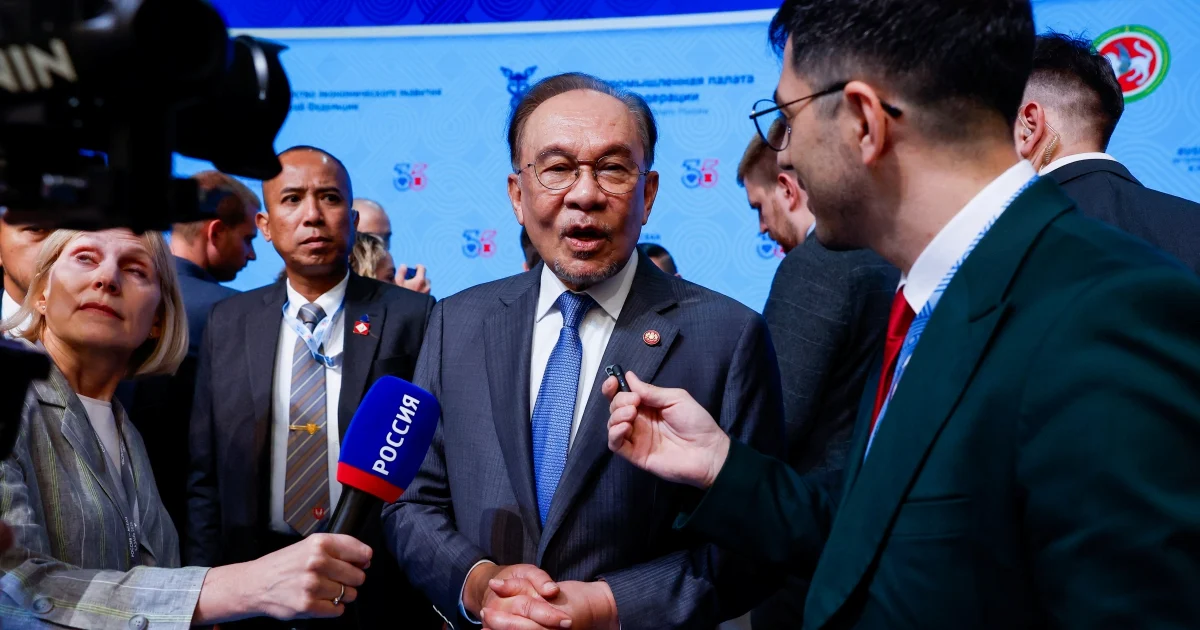
Prime Minister Datuk Seri Anwar Ibrahim has underscored the significance of cultural diplomacy in international relations, drawing on his personal fondness for Russian music and literature to illustrate how artistic connections transcend formal government interactions. Speaking in Kazan, Anwar highlighted that meaningful engagements between nations extend far beyond commercial transactions and political agreements, encompassing the shared appreciation of creative expression that binds societies together. His remarks reflect a sophisticated understanding of soft power—the ability to shape international perceptions and strengthen relationships through cultural influence rather than coercion.
The Prime Minister's willingness to publicly discuss his appreciation for Russian cultural works signals Malaysia's commitment to broadening its engagement with Russia beyond the conventional framework of trade and investment. By citing his enjoyment of Russian songs and literature, Anwar was essentially demonstrating that points of connection exist at the societal level, where citizens from different nations can find common ground through music, poetry, and storytelling. This approach resonates particularly well in Southeast Asia, where Malaysia itself positions itself as a cultural bridge between diverse communities, and where artistic traditions have historically served as vehicles for regional understanding.
The emphasis on cultural exchanges carries particular relevance for Malaysia, a nation deeply invested in cultural diplomacy across the Muslim world, Asia-Pacific, and beyond. Anwar's comments suggest that Kuala Lumpur views its relationship with Russia not merely as a transactional partnership focused on energy, commodities, or strategic interests, but as a multifaceted relationship rooted in mutual respect for intellectual and creative traditions. This perspective aligns with Malaysia's broader foreign policy philosophy of fostering people-to-people connections alongside government-to-government relations.
Russia's rich literary heritage, encompassing the works of Dostoevsky, Tolstoy, and Chekhov, represents a profound intellectual tradition that has influenced thinkers worldwide. Anwar's explicit acknowledgement of this legacy suggests a familiarity with Russian cultural contributions that extends beyond superficial diplomatic courtesy. For Malaysian readers and policymakers, such statements underscore the importance of cultivating knowledge of partners' cultural contexts—a practice that can deepen mutual understanding and create more resilient diplomatic relationships. Literature, in particular, offers insights into a nation's values, historical experiences, and worldview.
The reference to Russian music further emphasizes how artistic expression creates emotional and psychological bridges between peoples. Russian classical music, folk traditions, and contemporary works have universal appeal that transcends language barriers and geopolitical divisions. By publicly appreciating this dimension of Russian culture, Anwar was acknowledging that relationships built on appreciation for the other party's achievements and contributions tend to be more durable and meaningful than relationships based purely on strategic calculation. This observation holds value for all nations seeking to strengthen international partnerships.
The distinction Anwar drew between cultural cooperation and economic cooperation is analytically important. While trade, investment, and commercial partnerships form the backbone of international relations, they can be subject to market fluctuations, changing global supply chains, and shifting economic priorities. Cultural connections, by contrast, often prove more stable and resistant to the vicissitudes of economic cycles. A Malaysian businessperson who has read Tolstoy or appreciated Russian music may maintain positive sentiments toward Russia even during periods of economic downturn or political tension. This resilience makes cultural diplomacy a valuable complement to conventional statecraft.
For Southeast Asia more broadly, Anwar's comments carry implications regarding how the region engages with major powers. As Malaysia and other ASEAN nations navigate complex relationships with various global actors, the cultivation of cultural understanding can serve as a stabilizing factor. Russia's own interest in cultural diplomacy—demonstrated through the Pushkin Institute, cultural centres, and artistic exchanges in various countries—suggests receptivity to such initiatives. Malaysian and regional efforts to deepen cultural ties with Russia could enhance mutual understanding and create constituencies within both societies favorable to constructive bilateral relations.
The setting in Kazan, a historically and culturally significant Russian city, provided an appropriate backdrop for Anwar's remarks. Kazan represents the intersection of European and Asian influences within Russia itself, embodying the multicultural heritage that Russia presents to the world. The choice of venue may have been intentional, reflecting the notion that cross-cultural understanding can flourish when both parties acknowledge and appreciate the complexity and diversity within the other's civilization. This symbolism aligns well with Malaysia's own identity as a multicultural nation that values harmony across religious and ethnic lines.
Moving forward, Anwar's statement suggests potential avenues for deepening Malaysia-Russia ties beyond traditional cooperation frameworks. Enhanced cultural exchanges could include literary festivals featuring Russian and Malaysian authors, music collaborations, academic partnerships focused on comparative literature and arts, and youth exchange programmes. Such initiatives would complement existing cooperation in areas such as trade, energy, and education, creating a more comprehensive and resilient relationship. They would also provide platforms for Malaysian and Russian citizens to engage directly, fostering understanding at the grassroots level.
The Prime Minister's emphasis on cultural diplomacy also reflects evolving trends in international relations, where nations increasingly recognize that soft power and public diplomacy are integral components of statecraft. In an era of information overload and rapid communication, creating positive associations between nations through cultural mechanisms has become more important than ever. Anwar's willingness to speak personally about his cultural interests humanizes Malaysia's diplomatic approach and suggests that the nation values engagement on multiple levels—not just through formal government channels, but through the shared human appreciation of beauty, creativity, and intellectual achievement.
For Malaysian media, academic institutions, and cultural organizations, Anwar's remarks offer an invitation to explore Russian culture more deeply and to facilitate broader societal engagement with Russia's artistic traditions. Whether through translation projects, film screenings, literary events, or musical performances, Malaysia has opportunities to introduce Russian cultural works to wider audiences. Such efforts would honour Anwar's implicit endorsement of cultural exchange while simultaneously enriching Malaysian cultural life and demonstrating the nation's commitment to cosmopolitan values.