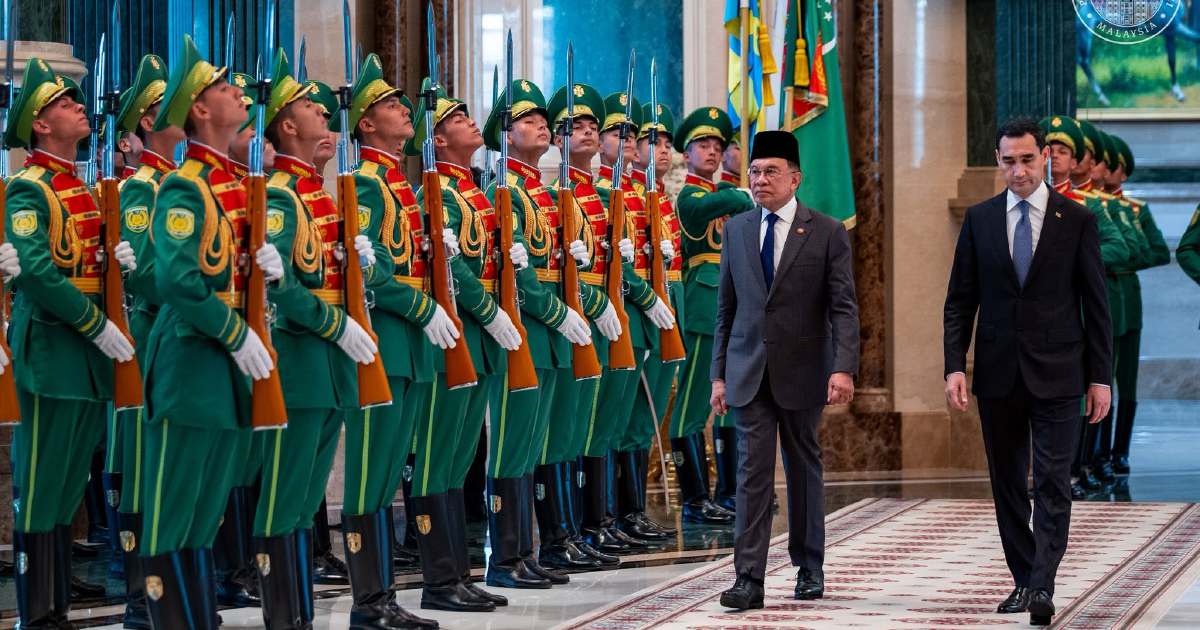
Prime Minister Datuk Seri Anwar Ibrahim received full ceremonial honours at Turkmenistan's Presidential Palace in Ashgabat, underscoring the significance attached to his first official visit to the country as head of government. The formal reception, complete with state protocol, signals both nations' commitment to expanding bilateral relations at the highest level following Anwar's appointment to office.
This landmark visit represents a deliberate effort by Malaysia's leadership to strengthen engagement across Central Asia, a region historically less prioritised compared to Southeast Asia despite its strategic importance to global trade and energy security. Turkmenistan's geographic position along ancient Silk Road corridors and its vast hydrocarbon reserves make it a potentially valuable partner for Malaysian commercial and diplomatic interests. The Presidential Palace reception demonstrates Turkmenistan's willingness to elevate ties with Malaysia, suggesting both countries see merit in deepening cooperation beyond ceremonial courtesy.
The visit comes at a time when Malaysia is actively repositioning itself on the international stage through enhanced multilateral engagement. Anwar has consistently advocated for greater Malaysian involvement in regional and global affairs, making Central Asian nations logical additions to the government's diplomatic portfolio. Turkmenistan, which has maintained a policy of permanent neutrality recognised by the United Nations, presents a stable and neutral platform for Malaysian engagement without the geopolitical complications that sometimes characterise relations with other major powers.
Energy cooperation represents one obvious avenue for bilateral collaboration. Turkmenistan possesses world-class natural gas reserves and maintains significant oil production capacity. While Malaysia is not energy-dependent, the country's position as a significant petrochemical producer and exporter means securing diversified energy partnerships and supply chain relationships across different regions enhances economic resilience. Malaysian companies operating in petrochemicals, downstream industries, and energy services could potentially benefit from expanded access to Central Asian markets and resources.
Beyond hydrocarbons, the visit opens possibilities for Malaysian investment in Turkmenistan's infrastructure development sector. The country has been modernising its economy and upgrading transportation networks, port facilities, and telecommunications systems. Malaysian expertise in construction, engineering, and project management could find profitable applications in supporting these initiatives while strengthening Malaysia's foothold in Central Asia. Such ventures would require both formal agreements at state level and supportive business environment frameworks.
Cultural and educational exchanges merit consideration as lasting foundations for any bilateral relationship. Establishing academic partnerships between Malaysian and Turkmen universities, facilitating student mobility programmes, and promoting cultural festivals create people-to-people bonds that outlast purely transactional government interactions. These soft diplomacy initiatives also position Malaysia more favourably within Central Asian intellectual and cultural circles, potentially influencing long-term perceptions of Malaysia across the region.
Turkmenistan's strategic location also offers Malaysia indirect benefits through improved connectivity to European markets and Western Asia. As Malaysian companies expand internationally, having established diplomatic and commercial relationships across Central Asia creates natural gateways for market entry and supply chain optimisation. The country's membership in various international and regional organisations provides additional platforms for Malaysian participation and influence in shaping regional policies affecting trade and security.
Diplomatically, Anwar's visit reflects Malaysia's broader ambition to engage with nations across diverse geographies and political systems. This inclusive approach differentiates Malaysia's foreign policy from more restrictive or ideologically narrow positions adopted by some regional peers. By maintaining active diplomatic channels with countries like Turkmenistan—regardless of their internal governance systems—Malaysia preserves its autonomy and maximises its influence across multiple international forums including the United Nations, where such relationships translate into political goodwill and voting support on matters of Malaysian interest.
The Presidential Palace reception also carries symbolic weight domestically. It demonstrates that Anwar's leadership has secured international recognition and respect from other nations' heads of state. This validation of Malaysia's current government strengthens Anwar's domestic political position and projects confidence in Malaysia's stability and leadership capability to international observers. Successful high-profile state visits generate positive media coverage that resonates both abroad and at home.
Looking forward, this inaugural official visit likely paves the way for follow-up missions and deeper institutional engagement. Bilateral trade offices might be expanded, joint commissions established to oversee cooperative initiatives, and regular ministerial exchanges scheduled to maintain momentum. The Presidential Palace reception thus represents not merely a diplomatic courtesy but potentially the foundation for sustained, mutually beneficial engagement between Malaysia and Turkmenistan spanning trade, investment, culture, and security cooperation.

