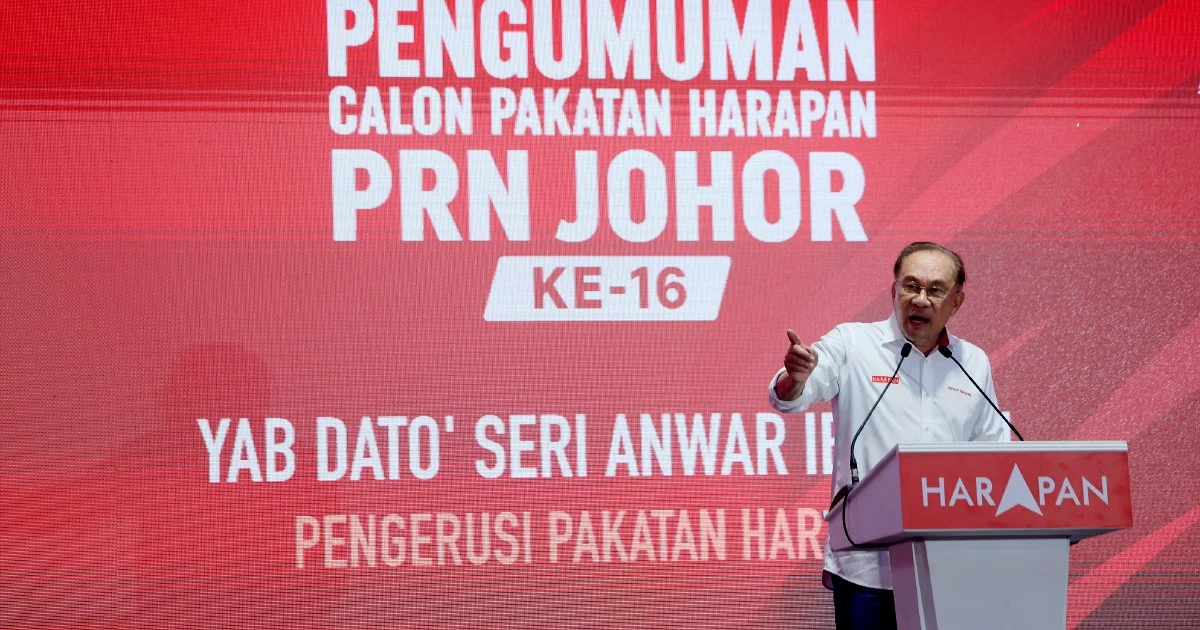
Prime Minister Datuk Seri Anwar Ibrahim has called upon Johor's executive councillors to rigorously examine longstanding grievances regarding the state's allocation of federal revenue, directing them to hold previous administrations accountable for what state officials characterise as an inequitable distribution of resources. Speaking during a visit to Tangkak, Anwar emphasised the importance of transparency and proper documentation in resolving disputes over financial arrangements between Putrajaya and Johor, signalling the unity government's commitment to addressing regional concerns that have festered during successive administrations.
The directive represents a notable shift in how Kuala Lumpur is engaging with Johor's administrative concerns, particularly given the state's strategic importance both as an economic powerhouse and as a politically competitive arena. Johor, Malaysia's southern economic anchor, has long harboured complaints about revenue allocation formulas that state leaders across party lines have argued disadvantage their jurisdiction relative to its economic output and population. The state's gross domestic product contributions have periodically sparked debates about whether the federal revenue-sharing mechanism adequately compensates Johor for its fiscal contributions.
Anwar's instruction carries implicit acknowledgment that the Barisan Nasional government under Datuk Seri Najib Razak and the subsequent Perikatan Nasional administration led by Tan Sri Muhyiddin Yassin may have mishandled state revenue disputes or failed to establish transparent criteria for fund distribution. By encouraging state officials to press for clarification and documentation, the Prime Minister is essentially reopening files that previous governments may have preferred to leave closed, creating a mechanism for Johor to demand concrete answers about historical financial arrangements.
The revenue-sharing framework between federal and state governments in Malaysia operates through constitutionally mandated mechanisms, though implementation and interpretation have frequently become sources of tension. States argue that formulas established decades ago no longer reflect current economic realities, while federal governments contend that centralised fiscal management requires flexibility. Johor's position is particularly acute because the state generates substantial excise revenue from fuel and other commodities, yet receives allocations that some analysts suggest do not proportionately reflect these contributions.
For Malaysian federalism and centre-state relations, Anwar's intervention signals that the current administration is willing to revisit grievances that may have accumulated under previous leadership. This approach could establish a precedent for other states to articulate their own revenue concerns, potentially triggering a broader recalibration of federal-state financial relationships. The Prime Minister's emphasis on documentation and questioning suggests he recognises that legitimacy in governance often depends on demonstrating responsiveness to regional economic anxieties.
The timing of Anwar's remarks is noteworthy given Johor's political dynamics. The state has remained a Barisan Nasional stronghold despite the unity government's presence at the federal level, creating a complex political environment where state leadership maintains autonomy while the federal administration pursues national priorities. By validating Johor's complaints about revenue, Anwar appears to be building bridges with the state administration while simultaneously delegitimising previous federal governments' handling of the issue.
State revenue allocation has become increasingly contentious across Southeast Asia as regional administrations demand greater fiscal autonomy. Thailand's provinces and Indonesia's districts have similarly contested revenue-sharing formulas, reflecting a broader tension between centralised and decentralised governance models. Malaysia's constitutional framework theoretically provides states with certain revenue sources, yet the relationship between enumerated rights and practical resource availability remains contested. Johor's case exemplifies how federal-state revenue disputes can accumulate into significant political grievances if unresolved.
For Johor's executive council, the instruction provides formal justification to demand comprehensive audits and documentation of revenue transactions spanning years of BN and PN governance. Such investigations could prove administratively complex and politically sensitive, potentially exposing financial arrangements that either administration preferred to keep opaque. The council now has political cover from the Prime Minister to pursue aggressive questioning of federal revenue allocations without appearing to be merely oppositional.
The economic implications of resolving revenue disputes could be substantial. Should investigations demonstrate that Johor received materially less funding than warranted by its contributions and population, adjustment mechanisms might generate additional state resources for development projects. However, quantifying historical underpayments involves contentious calculations about baseline formulas, inflation adjustments, and alternative methodologies—issues unlikely to be resolved quickly.
Anwar's instruction reflects a calculation that validating state grievances strengthens federal legitimacy by demonstrating responsiveness to regional concerns while simultaneously undermining his predecessors' credibility. This approach balances federation-building with political advantage, suggesting the current administration sees opportunity in reopening closed disputes rather than allowing them to fester as sources of lingering resentment. For Johor officials, the directive provides both opportunity and obligation to pursue substantive answers about historical revenue treatment, potentially reshaping federal-state financial relations in ways that extend beyond the immediate dispute to influence how future administrations approach revenue allocation.

