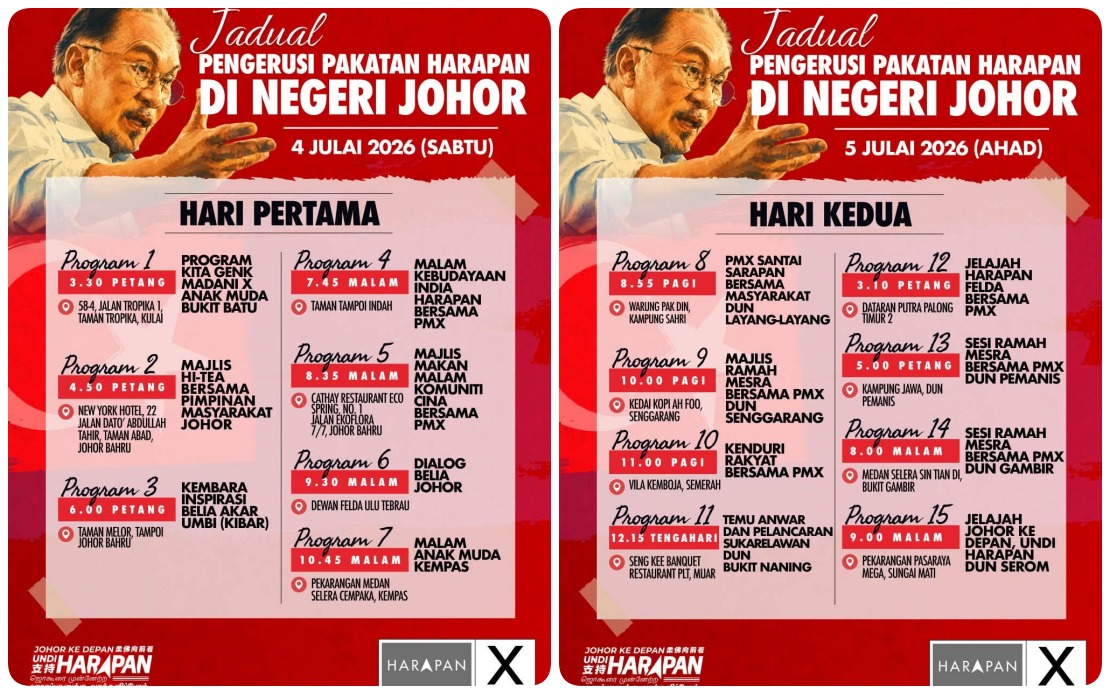
Prime Minister Datuk Seri Anwar Ibrahim is throwing his considerable political weight behind Pakatan Harapan's campaign for the 16th Johor state election, embarking on a gruelling seven-stop programme across the state on July 4 as the coalition races towards polling day on July 11. The itinerary, publicised through Anwar's official Facebook page, underscores the high stakes the national leadership has placed on retaining control of Malaysia's southern powerhouse, a state that has proven pivotal in recent electoral contests and remains strategically important to PH's political fortunes.
The Prime Minister's schedule reflects a deliberate strategy to court multiple voter segments across the demographic spectrum. His first engagement targets ordinary constituents in grassroots settings, establishing direct contact with voters before the campaign day progresses. This opening move is characteristic of Malaysian political strategy, where leaders seek to project accessibility and demonstrate that they remain connected to the concerns of ordinary citizens rather than remaining cloistered in elite political circles.
The afternoon session takes a more formal turn with a high tea reception at a Johor Bahru hotel at 4.50 pm, where Anwar will engage with community leaders representing diverse occupational and social backgrounds. These networking sessions serve multiple purposes: they allow business owners, professionals, and civil society figures to air grievances directly to the nation's chief executive, while simultaneously signalling to these influential constituencies that their voices matter in the political process. For PH, securing the support of these community anchors can prove decisive in swaying fence-sitters and those undecided voters who look to respected local figures for guidance.
Youth engagement represents another pillar of this campaign architecture. The Youth Dialogue session scheduled for 9.30 pm at Felda Ulu Tebrau Hall targets younger voters, a demographic that has shown increasing political dynamism across Southeast Asia. Capturing youth support remains crucial for any coalition seeking sustained political relevance, particularly in Johor where younger populations in urban areas have demonstrated growing political consciousness. By personally attending this evening session rather than delegating to subordinates, Anwar signals that youth concerns rank among PH's priorities.
The intensity of the campaign is set to escalate further on July 5, when Anwar has scheduled eight additional programmes. This relentless pace reflects the competitive pressure PH faces in Johor, where rival coalitions continue to mobilise their own resources aggressively. The decision to conduct back-to-back campaign days with substantial programme counts indicates that PH leadership perceives the election outcome as genuinely competitive rather than predetermined.
Pakatan Harapan is fielding candidates across all 56 state assembly constituencies, demonstrating its confidence in contesting every available seat rather than ceding any ground. The coalition's candidate distribution reveals internal negotiations: PKR is running 20 candidates, Amanah 19, and DAP 17. This allocation reflects the relative bargaining power of each partner within the coalition structure and highlights the delicate balance PH must maintain to hold its multi-ethnic, multi-party alliance together through electoral contests.
The broader context involves 172 candidates competing for the 56 seats, indicating substantial three-way contests in many constituencies. This fragmented field creates both opportunities and risks for PH. Opposition fragmentation could benefit the ruling coalition if votes split inefficiently among rivals, yet it also creates unpredictability and heightens the possibility of surprise results in individual constituencies. Early voting is scheduled for July 7, a format increasingly common in Malaysian elections that expands participation opportunities while introducing an element of campaign strategy around when to deploy resources most effectively.
For Malaysian politics observers and regional analysts, the Johor contest carries significance extending beyond state-level governance. Johor represents a bellwether for national political sentiment, and electoral performance here often signals broader trends affecting federal politics. Poor results for PH would embolden opposition parties and potentially weaken Anwar's political standing heading toward the next federal election cycle. Conversely, a decisive PH victory would consolidate the coalition's control over critical state machinery and resources, reinforcing its claim to represent the electoral mainstream.
The campaign intensity also reflects calculations about voter mobilisation and turnout. Campaign teams across Malaysian politics understand that elections are won not merely by persuading undecided voters but by maximising turnout among core supporters. Anwar's personal involvement in multiple events serves the dual purpose of energising party machinery and core voters while providing nationally televised and social media moments that project dynamism and leadership.
For regional observers watching Malaysian politics, this Johor campaign demonstrates the continued importance of personalised, grassroots political engagement even in an era of digital campaigning. While online platforms play roles in modern Malaysian elections, the decision by Anwar to undertake extensive physical campaigning suggests that traditional person-to-person contact remains irreplaceable, particularly in a multicultural society where building trust and demonstrating genuine commitment to communities requires physical presence and direct dialogue.

