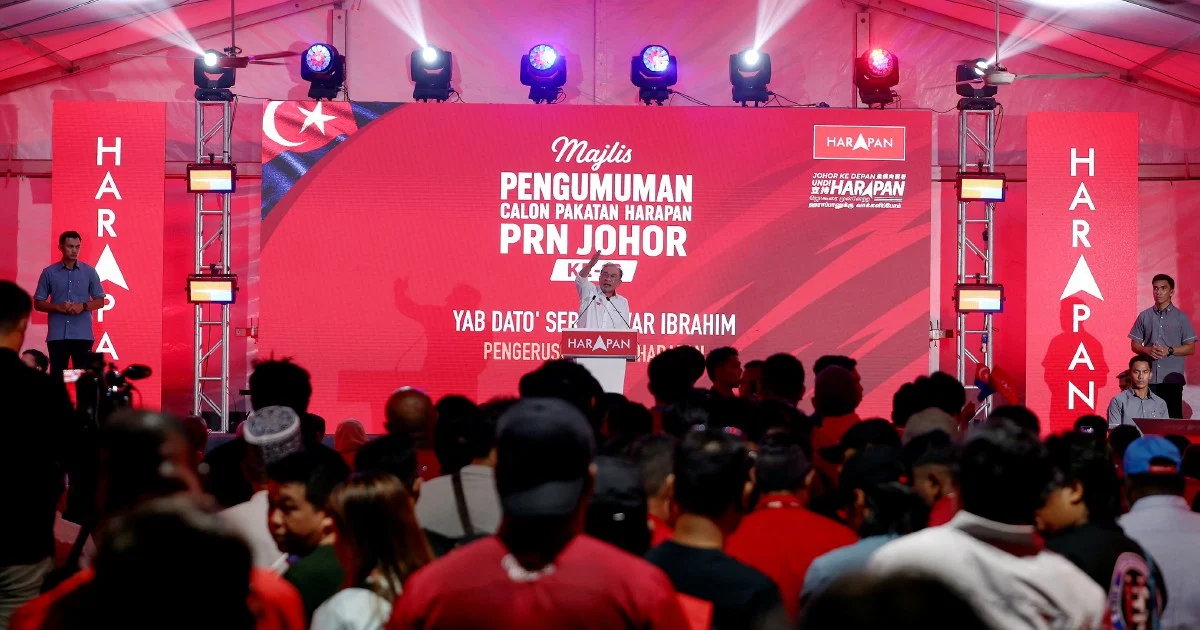
Prime Minister Anwar Ibrahim has drawn a firm line in the electoral sand ahead of the Johor state polls, insisting that the campaign must remain strictly within the realm of political competition and should not draw in the state's traditional institutions. Speaking in Tangkak, the Pakatan Harapan chairman made clear that the Malay Rulers' institutions have no place in what should be a straightforward contest between competing political parties, reflecting broader concerns about keeping constitutional monarchies separate from electoral battles across Malaysia.
The statement carries significant weight given Anwar's position as both head of the ruling coalition and Prime Minister, suggesting that the federal government expects all competing parties to respect this boundary. This demarcation between politics and institutions is particularly important in Johor, where the Sultan commands deep traditional respect and where historical patterns of royal involvement in state politics have sometimes blurred these lines. By making his position explicit now, Anwar appears to be setting expectations before the campaign begins in earnest.
The timing of Anwar's remarks is noteworthy, coming as various political factions prepare their strategies for Johor. The state has long been a BN stronghold, and any electoral contest there carries implications for the broader political landscape in Malaysia. By establishing clear parameters around what is acceptable in campaign conduct, the PM is effectively trying to shape the nature of the contest from the outset, signalling that personal attacks, institutional pressure, or attempts to leverage royal authority will not be tolerated.
In the Malaysian context, where constitutional monarchy plays a crucial role in checks and balances, maintaining clear separation between electoral politics and royal institutions is essential for preserving the integrity of both. The palace serves as a neutral arbiter and symbol of state continuity, roles that can be compromised if drawn into partisan electoral disputes. Anwar's intervention suggests awareness that this boundary might be vulnerable to pressure during a competitive campaign.
The statement also reflects evolving norms around electoral conduct in Malaysia, where increasing scrutiny is being placed on how campaigns are waged and what lines should not be crossed. Political scientists and observers have noted growing concern about maintaining democratic standards while respecting constitutional institutions, a balancing act that becomes more delicate during high-stakes state elections. Johor, as one of Malaysia's largest and most politically consequential states, inevitably attracts intense competition and scrutiny.
Anwar's message appears directed at multiple audiences simultaneously. To coalition partners within Pakatan Harapan, it emphasises that they must compete on policy and performance grounds. To opposition parties, it signals that any attempt to mobilise institutional authority will be viewed as beyond the pale. To the Johor palace itself, it provides a diplomatic statement that political forces will respect the appropriate boundaries of royal involvement.
The Johor state election framework itself reflects constitutional arrangements where the Sultan holds significant ceremonial and constitutional roles, including in the formation of government. However, there is a clear distinction between these constitutional functions and active involvement in electoral campaigning or support for specific parties. Anwar's comments underline this distinction, suggesting that while the Sultan's constitutional position remains unchanged, his institutions should not become tools of partisan advantage.
For Malaysian voters, particularly those in Johor, such statements help establish what might be called the rules of engagement for the coming campaign. They signal that leaders at the national level expect political competition to be conducted within bounds that respect Malaysia's institutional arrangements. This has practical implications for how campaigns will be resourced, what rhetoric will be deployed, and how competing parties will seek to gain advantage.
The broader regional context matters here as well. Southeast Asian democracies are grappling with questions about how to maintain strong institutions while fostering genuine electoral competition. Malaysia's experience, with its constitutional monarchy coexisting alongside democratic contestation, offers lessons about separating these spheres. Anwar's statement can be read as an attempt to reinforce these lessons at a critical moment.
Historically, Johor has seen periods where state leadership and royal institution interests aligned closely, sometimes creating ambiguity about where political authority ended and institutional prerogative began. Modern Malaysian politics increasingly requires clarity on this point. As states become more competitive and power transfers become more frequent, maintaining institutional neutrality becomes correspondingly more important.
The immediate practical question becomes how effectively this boundary will be maintained once campaigning begins. Opposition parties will need to mount credible challenges without invoking royal support or attempting to position themselves as preferred by the palace. Government and ruling coalition parties must similarly resist the temptation to claim royal backing for their candidates or policies. Both sides face pressure to win, which creates incentive to cross lines that Anwar has now publicly identified as unacceptable.
Anwar's intervention also positions him as an advocate for institutional integrity, a position that carries political benefits. It allows him to appear statesmanlike and protective of constitutional arrangements while simultaneously making a practical appeal for clean campaigning. Should anyone violate this principle, his statement provides grounds for criticism and potential sanctions.
Ultimately, the Johor election will serve as a test case for whether Malaysian political actors can maintain this institutional separation even under electoral pressure. Success in this regard would strengthen confidence in both democratic processes and traditional institutions. For observers across Southeast Asia watching how Malaysia manages this balance, the Johor campaign will offer important evidence about the sustainability of this particular model of political organisation.

