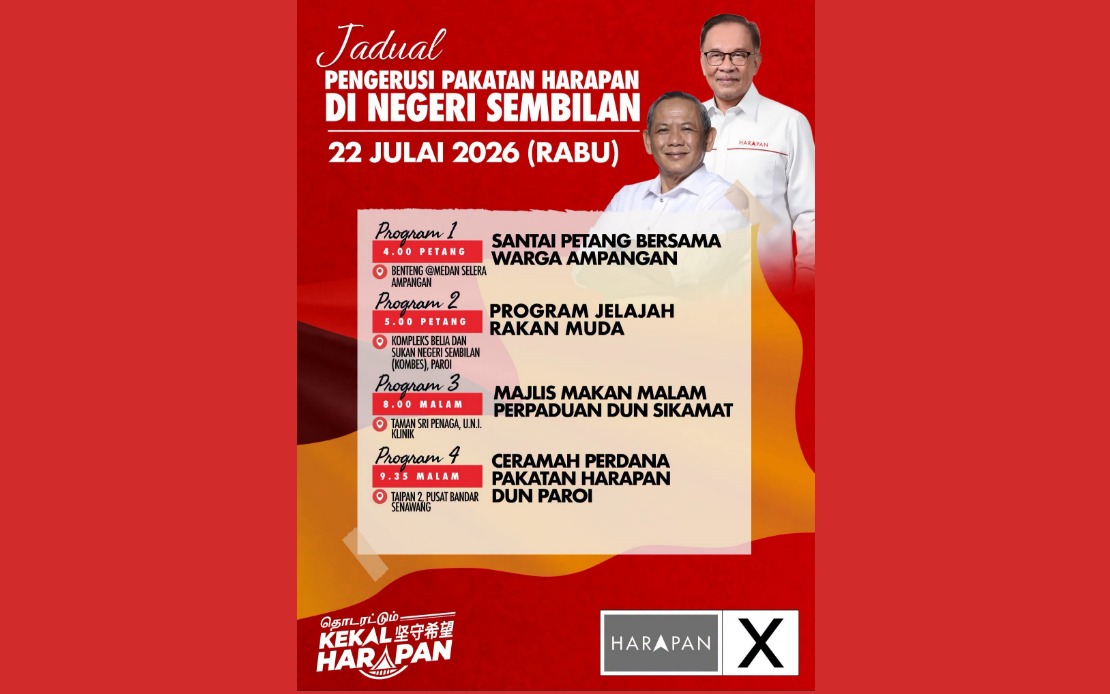
Prime Minister Datuk Seri Anwar Ibrahim will undertake a full day of campaign activities across Negeri Sembilan today, marking a strategic push by Pakatan Harapan to consolidate its position as the incumbent coalition fighting to maintain control of the state government. The visit comes on the fifth day of the official campaign period, with Anwar's presence intended to energize supporters and demonstrate the coalition's commitment to defending its administration led by Menteri Besar Datuk Seri Aminuddin Harun ahead of polling on August 1.
The Prime Minister's itinerary encompasses four constituencies spanning the Ampangan, Paroi, Sikamat and Senawang areas, combining community engagement, youth outreach and a major public rally. Beginning at 4 pm with a grassroots gathering called 'Santai Petang Bersama Warga Ampangan' at Benteng @ Medan Selera Ampangan, Anwar will then proceed to the Negeri Sembilan Youth and Sports Complex in Paroi for the 'Jelajah Rakan Muda' youth programme. This sequencing reflects PH's dual focus on both established community networks and younger voters, a demographic that has proven crucial in recent Malaysian elections.
Later in the evening, the Prime Minister will attend a unity dinner in Sikamat constituency before headlining a major coalition ceramah at Pusat Bandar Senawang. These high-profile engagements serve multiple strategic purposes: they signal central party leadership's engagement with local contests, provide media opportunities to amplify the coalition's campaign messaging, and create visible symbols of organizational strength that can influence wavering supporters.
Anwar's direct involvement underscores the significance of the Negeri Sembilan election within the broader national political landscape. As PKR president and Prime Minister, his personal campaigning carries symbolic weight beyond typical ministerial support, suggesting that PH views the state contest as competitive enough to warrant top-tier attention. The decision to schedule four separate programmes within a single afternoon and evening reflects the intensity with which the coalition is approaching this contest.
Packatan Harapan's campaign narrative centers on the ten-point manifesto unveiled on Monday, which emphasizes developmental initiatives and inclusive governance that the coalition argues will elevate Negeri Sembilan's status and quality of life. Anwar's campaign appearances will serve to contextualize these pledges within the coalition's broader national agenda, attempting to link state-level promises to federal government capacity and credibility. This messaging strategy positions the election as a referendum on PH's competence rather than purely on local issues.
The coalition is contesting all 36 state seats in the 16th Negeri Sembilan state election, deploying 16 candidates from PKR, 11 from the Democratic Action Party and nine from Amanah. This distribution reflects internal coalition negotiations and electoral calculations regarding which party can most effectively mobilize support in particular constituencies. The breadth of the contest—fielding candidates across all seats—represents a confidence-building exercise, signaling that PH believes it can compete competitively throughout the state rather than ceding ground to opposition parties.
The electoral timeline sees early voting scheduled for July 28, with the main polling day on August 1. This compressed calendar means that the current campaign week represents a critical window for both the ruling coalition and opposition forces to shape voter perceptions. Anwar's concentrated schedule reflects the urgency of reaching maximum audiences before early voting commences, as those who cast ballots early will be unavailable to persuade thereafter.
The strategic targeting of Ampangan, Paroi, Sikamat and Senawang suggests that PH's campaign strategists have identified these constituencies as either particularly competitive or as areas where enthusiastic primary support requires reinforcement. By concentrating presidential-level attention on specific constituencies, the coalition aims to generate localized momentum that can influence voting patterns. The inclusion of youth-focused programming acknowledges the importance of energizing younger voters who may be less habitually engaged with electoral politics.
For Malaysian observers and the broader Southeast Asian political community, the Negeri Sembilan election represents an important test of PH's electoral sustainability following its 2022 return to federal power. State elections function as mid-term report cards on ruling coalitions, providing opposition movements with opportunities to demonstrate electoral resurgence and suggesting whether national government formations can translate into durable local support. The Prime Minister's personal campaigning reflects the stakes involved, positioning the contest as consequential for both state-level governance and coalition morale.
The intensity of the campaign schedule also reflects competitive dynamics that extend beyond typical state election considerations. Opposition parties are mounting serious challenges across multiple constituencies, making systematic coalition-wide mobilization necessary rather than optional. Anwar's presence across four constituencies in a single day demonstrates the premium that PH leadership places on visible organizational activity and personal accessibility to voters, factors that can prove decisive in close contests.

