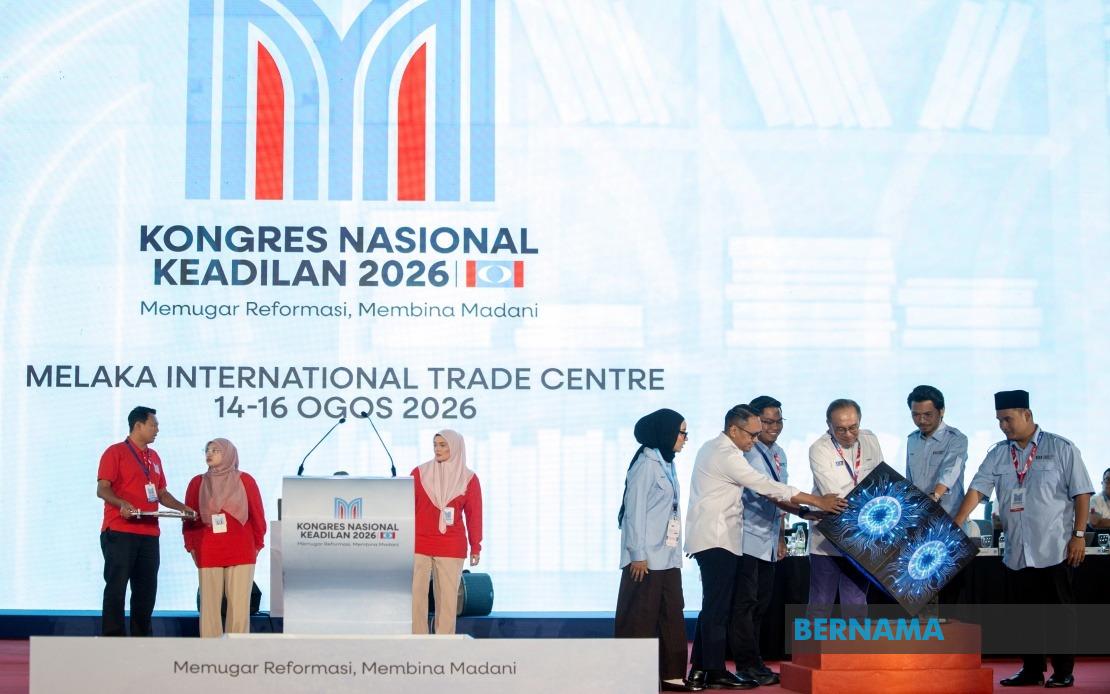
Prime Minister Datuk Seri Anwar Ibrahim, who also leads Parti Keadilan Rakyat, formally introduced a 113-page publication in Melaka on August 16 that represents the party's youth wing's strategic vision for contemporary governance and societal transformation. The manifesto, authored by AMK chief Muhammad Kamil Ahmad Munim and executive committee member Ashraf Ahmad Hadi, sets out the Angkatan Muda Keadilan's conceptual framework for engaging with pressing national issues through a lens of moral and intellectual renewal.
Anwar positioned the publication's timing as particularly significant, noting that it arrives at a critical juncture for Malaysia's developmental agenda. Rather than dismissing it as routine bureaucratic documentation or fleeting campaign material, he characterised the work as a substantive articulation of civilisational purpose—one that seeks to fundamentally reorient how the nation approaches progress by prioritising human dignity over purely technical considerations. This framing reflects growing intellectual currents within PKR that question whether conventional development metrics adequately capture societal wellbeing.
Central to Anwar's messaging was an unsparing assessment of the responsibilities borne by the younger generation, particularly those engaged in party politics and youth activism. Rather than portraying youth involvement as a celebratory opportunity or status symbol, he underscored that contemporary positions of influence constitute a profound moral test and a measure of individual spiritual fortitude. This rhetoric moves beyond conventional appeals to youthful idealism, instead emphasising accountability and the weight of historical consequence that accompanies political participation.
The Prime Minister explicitly acknowledged Malaysia's fractured historical trajectory, referring to the legacies of injustice and institutional leakages that continue shaping governance structures. His argument centres on the proposition that reversing these entrenched patterns demands more than incremental reform—it requires what he termed extraordinary creativity, meaning novel institutional arrangements and policy approaches that depart from established orthodoxies. He equally emphasised the necessity of intellectual courage, suggesting that Malaysia's intellectual class must be willing to challenge inherited assumptions about development, state capacity, and social organisation.
Spiritual resilience emerged as a third pillar of Anwar's framework, representing a deliberate incorporation of ethical and philosophical dimensions into discussions of governance and nation-building. This rhetorical positioning reflects PKR's broader effort to distinguish its development philosophy from purely technocratic or market-oriented paradigms that have dominated policy discussions across much of Asia. For Malaysian readers navigating competing visions of progress, this emphasis on moral foundations offers an alternative analytical lens to conventional economic growth narratives.
Within the party's strategic architecture, the publication serves a dual function that reflects evolving approaches to political education and cadre development. On one level, it functions as institutional memory—a deliberate attempt to ensure that younger party members understand the historical struggles that preceded their entry into politics, grasp the foundational principles animating PKR's existence, and internalise the meaning and practical implications of "Reformasi" as both historical rupture and ongoing commitment. This investment in historical consciousness differentiates PKR's approach from parties whose political education remains more episodic or event-driven.
Simultaneously, the document aspires to shape character and political practice among emerging leaders. By establishing intellectual and moral benchmarks for party membership, the publication implicitly critiques forms of political participation driven primarily by ambition, material reward, or factional loyalty. It attempts to inculcate a particular conception of principled activism that remains grounded in foundational party values while adapting to contemporary challenges—a balance that many political movements struggle to maintain across generational transitions.
For Malaysian observers of political development, this initiative warrants attention as a case study in how mainstream political parties attempt to transmit values and ensure ideological coherence amid rapid institutional growth. PKR's evolution from reform movement to governing party has inevitably created tensions between revolutionary origins and bureaucratic necessities. The publication represents an effort to resolve these tensions by positioning institutional discipline and moral clarity as complementary rather than contradictory objectives.
The regional dimensions merit consideration as well. Across Southeast Asia, political parties face common challenges in maintaining organisational integrity and principled leadership as they navigate between democratic competition and state power. Whether through formal publications or alternative mechanisms, parties throughout the region grapple with questions about how to preserve founding missions while acquiring governing capability. Malaysia's experience therefore offers comparative insights for understanding broader regional patterns in political evolution.
For the youth activists and party cadres who constitute the primary audience, the publication's emphasis on moral seriousness and intellectual rigour carries implications for their own career trajectories and political formation. It signals that within PKR's framework, advancement and influence ought to correlate with demonstrated commitment to foundational principles and capacity for independent thought rather than mere factional positioning or accumulated tenure. This normative claim, whether realised in practice or not, establishes expectations about the character of political leadership that the party seeks to cultivate.
The broader context of Malaysian governance also renders this initiative significant. As the country navigates post-pandemic recovery, economic restructuring, and evolving social expectations, political parties face pressure to articulate coherent long-term visions rather than managing immediate electoral cycles. PKR's effort to equip its younger generation with both historical understanding and philosophical frameworks for addressing contemporary challenges reflects one strategic response to these pressures—an attempt to build political capacity grounded in principled thinking rather than reactive crisis management.
Moving forward, the practical impact of this publication will depend substantially on whether party structures translate its normative prescriptions into actual institutional practices and personnel decisions. Publications alone rarely transform political culture; their significance derives from whether they catalyse genuine shifts in how parties identify, recruit, develop, and promote their membership. For PKR, the test will be whether this manifesto becomes a genuine reference point for internal debates and leadership selection, or whether it remains a symbolic gesture toward ideological seriousness that fails to penetrate party operations.

