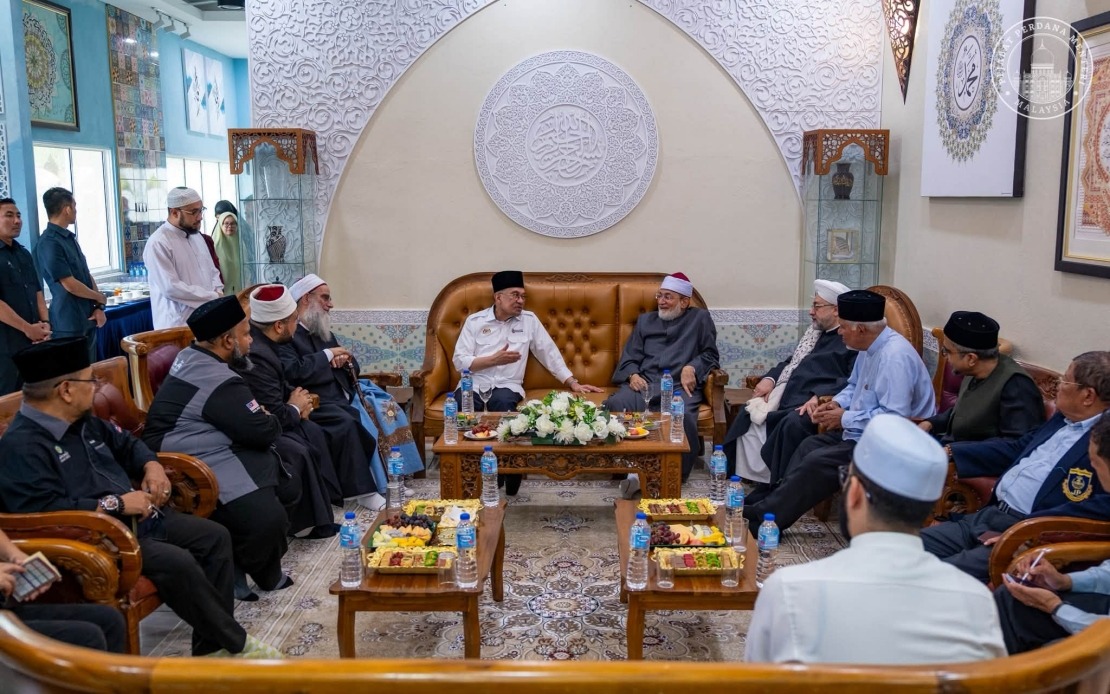
Prime Minister Datuk Seri Anwar Ibrahim carved out time from his demanding schedule to meet with three internationally respected Islamic scholars who are presently in the country. The encounters underscore the government's continued engagement with prominent religious figures and its commitment to deepening Islamic scholarship and theological discourse within Malaysia's multicultural context.
The three scholars represent significant academic and spiritual authorities within the Islamic world. Al-Fadhil Al-Allamah Al-Muhaddith Syeikh Dr Mustafa al-Nadwi Al-Hasani brings extensive expertise in hadith scholarship, a foundational discipline in Islamic jurisprudence that examines the authenticated sayings and practices of Prophet Muhammad. His credentials as a leading Egyptian scholar position him as an influential voice in contemporary Islamic education across the Arab world and beyond. The second scholar, Al-Fadhil Al-Allamah Al-Muqri' Syeikh Dr Ahmad Isa Al-Ma'sarawy, has earned international recognition for his mastery of Quranic recitation, a field requiring decades of dedicated study and spiritual preparation. The third, Al-Fadhil Al-Syeikh Maulana Al-Sayyid Afeefuddin Al-Jailani, serves as custodian of significant Islamic heritage sites and institutions associated with the revered historical figure Syeikh Abdul Qadir Al-Jailani, indicating his guardianship role over important waqf endowments and sacred spaces.
Through his visit, Anwar conveyed several interconnected messages about his administration's priorities. The Prime Minister indicated his interest in consulting these scholars on matters of religious interpretation and guidance, positioning himself as a leader receptive to expert theological counsel. By publicly acknowledging their presence and expressing appreciation for their willingness to share knowledge within Malaysia, he signalled governmental support for international Islamic intellectual exchange and the elevation of Quranic and hadith scholarship as significant cultural pursuits.
The meetings occurred at Nasyrul Quran, an institution dedicated to Quranic studies and education. This venue choice reflects the alignment between governmental interests and Islamic educational initiatives focused on textual scholarship and proper religious understanding. For Malaysia, which maintains Islam as the official faith of the federation and navigates questions about Islamic governance and pluralism, the engagement with such scholars carries symbolic weight. It demonstrates that discussions about Islamic teachings and their application in contemporary society involve not merely domestic religious leaders but also authoritative international figures.
Anwar's Facebook commentary highlighted his perspective on the visit's broader significance. He framed the scholars' presence as contributing to a multifaceted agenda encompassing increased religious knowledge, spiritual blessings, and affective attachments to Islamic principles. Importantly, he explicitly connected Islamic scholarship to social outcomes, articulating a vision of a society characterised by virtue, erudition, and harmonious coexistence. This formulation suggests that the government views engagement with rigorous Islamic learning as instrumental to nation-building and community cohesion rather than as a purely devotional or academic matter.
The emphasis on harmony within Anwar's statement reflects ongoing Malaysian concerns about managing religious and ethnic relationships in a diverse nation. By presenting Islamic scholarship as a foundation for virtuous social practice and peaceful coexistence, he attempted to reframe theological education as contributing to rather than conflicting with pluralistic governance. This rhetorical move acknowledges that Malaysia's Islamic identity coexists with significant non-Muslim populations and that interpretations of Islam's public role remain contested domestically.
The visit also reflects practical diplomatic dimensions. Hosting prominent international scholars enhances Malaysia's standing within Islamic intellectual circles and positions the country as a venue for advanced religious education and dialogue. For Southeast Asia more broadly, which contains the world's largest Muslim population by region, the presence of such scholars and governmental engagement with them underscores the region's continuing relevance to global Islamic discourse. Malaysia, as a majority-Muslim nation with established Islamic institutions, naturally positions itself as a hub for such scholarly exchange.
Anwar's explicit request for the scholars' prayers and advice indicates a personal spiritual dimension alongside the political and social aspects of the meeting. By publicly positioning himself as seeking religious counsel, he reinforces an identity as a Muslim leader concerned with both material governance and spiritual guidance. This approach reflects a leadership model that integrates religious authority and legitimacy into executive function, a pattern established across multiple Muslim-majority contexts.
The timing and visibility of these encounters merit consideration. Senior Malaysian political figures periodically engage with international Islamic personalities, a practice that carries domestic implications. For constituencies within Malaysia that prioritise Islamic governance and scholarship, such meetings signal responsiveness to religiously-grounded concerns. Simultaneously, for audiences focused on secular governance principles, the explicitly theological framing of the visits requires careful interpretation regarding the government's stance on the relationship between Islamic scholarship and public policy.
Moving forward, the substantive outcomes of such scholarly encounters often materialise through longer-term initiatives. These might include collaborative academic programmes, educational partnerships, or advisory relationships that influence how Islamic knowledge and teachings circulate within Malaysian institutions. The Foundation or other bodies may subsequently benefit from the scholars' involvement in curriculum development, lecture series, or theological training programmes.
The visit encapsulates broader patterns in contemporary Islamic governance, where leaders seek to draw legitimacy from connection with renowned scholarly authorities while simultaneously promoting visions of Islam compatible with their broader developmental and social agendas. For Malaysia specifically, such engagement reflects the government's confidence in its Islamic credentials and its desire to position Islam as a progressive force capable of contributing to modern nation-building, scholarly advancement, and social stability.

