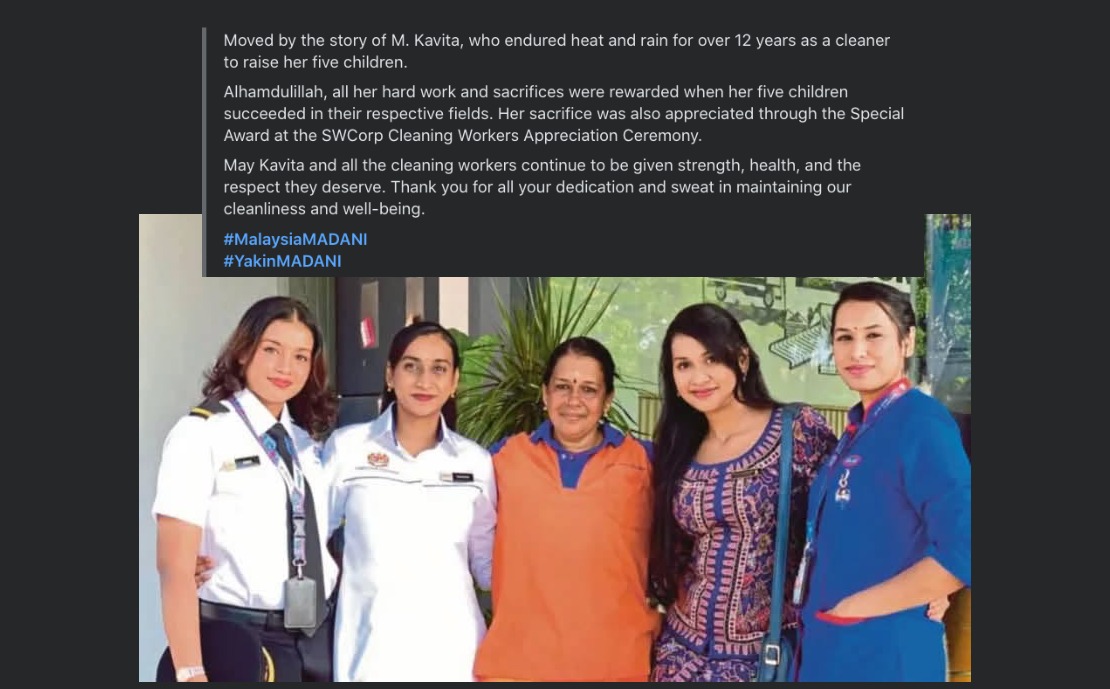
Prime Minister Datuk Seri Anwar Ibrahim has publicly celebrated the remarkable journey of street sweeper M. Kavita, whose unwavering commitment to her work and family has inspired countless Malaysians. Through a Facebook post, Anwar acknowledged how Kavita's more than 12 years of labour in challenging weather conditions touched his heart, describing her sacrifice as a testament to the strength and determination of Malaysia's essential workers.
Kavita's story embodies a powerful narrative about resilience and parental dedication. Working as an SWM Environment employee in Seremban, she balanced gruelling shifts maintaining public spaces with the profound responsibility of nurturing and supporting five children. The prime minister's recognition underscores an often-overlooked truth in Malaysia: that those who keep our cities clean and our communities healthy frequently labour under considerable personal strain, yet remain committed to building better futures for their families.
What transformed Kavita's quiet sacrifice into a moment of national recognition was a surprise that occurred during her birthday celebration last month, which subsequently went viral on social media. Her four daughters orchestrated a touching gesture by visiting her workplace in their professional uniforms to mark her 50th birthday. The moment captured the essence of her life's work—each daughter's appearance in pilot, cabin crew, and staff nurse uniforms represented the tangible fruits of Kavita's labour and determination.
The emotional weight of that encounter proved significant precisely because it visualised the connection between a parent's sacrifice and a child's achievement. Kavita's tears of joy reflected not merely the surprise itself, but the full realisation that her decades of physical labour in all weather conditions had created pathways for her children to pursue meaningful careers. Each uniform represented a milestone she had helped make possible through countless early mornings and difficult shifts.
Beyond the personal narrative, Anwar's public tribute carries broader implications for how Malaysia recognises and values its workforce across all socioeconomic strata. The prime minister explicitly called for continued blessings upon street sweepers and cleaning workers, wishing them strength, health, and the respect they deserve. This acknowledgment addresses a systemic gap in how society often treats those in essential service roles, frequently rendering them invisible despite their fundamental contribution to public health and urban cleanliness.
Kavita's achievement has also received formal institutional recognition. During SWCorp's Cleaning Workers' Day Appreciation ceremony, she was awarded a Special Award, marking an official acknowledgment from the cleaning sector itself. This dual recognition—both from Malaysia's highest political office and from industry bodies—signals an important shift toward elevating the status and dignity of cleaning workers within the national consciousness.
The timing of Anwar's tribute arrives as Malaysia continues grappling with questions about labour equity, worker dignity, and the often-invisible contributions of lower-income service sectors. Cleaning workers represent a substantial portion of Malaysia's workforce yet frequently experience wage constraints and limited career development opportunities. Kavita's example—where persistence within these constraints still permitted her to provide her children with opportunities for social mobility—offers a counter-narrative to narratives of entrapment.
Yet Kavita's story also highlights the fragility inherent in such achievements. The success of her children, while remarkable, came despite rather than because of structural support for cleaning workers. Her ability to raise five successful professionals depended not on exceptional institutional assistance but on her personal determination and likely significant sacrifice across health, time, and wellbeing. This reality suggests that while individual stories of overcoming adversity merit celebration, structural changes remain necessary to prevent exceptional cases from remaining exceptional.
For Malaysian society broadly, Kavita's narrative invites reflection on intergenerational mobility and the often-hidden costs of advancement. The pride her daughters displayed in visiting her wearing their professional uniforms reflected pride in their own achievements, but equally, it acknowledged the foundation their mother had laid. This reciprocal recognition—of parent honouring child and child honouring parent—encapsulates values deeply embedded in Malaysian culture yet frequently obscured by economic stratification.
Anwar's explicit messaging about respecting cleaning workers and thanking them for safeguarding public wellbeing challenges Malaysians to reconsider their relationship with those who perform essential maintenance work. The prime minister positioned cleaning workers not as peripheral to society but as active guardians of community health and cleanliness, deserving acknowledgment and gratitude. This framing potentially influences how the broader public interacts with and regards these workers in everyday contexts.
The broader economic context also merits consideration. Malaysia's development trajectory has created expanding professional opportunities for younger generations, yet entry-level positions in cleaning and sanitation remain largely concentrated among workers from economically marginalised communities. Kavita's children accessing professional roles in aviation and healthcare represents upward mobility that many Malaysian families aspire toward but few achieve, particularly when starting from service sector backgrounds.
Moving forward, Kavita's story suggests several pathways for institutional action. Structured support programmes for children of essential workers, enhanced compensation for cleaning sector employees, and career development opportunities could transform exceptional cases into more common outcomes. The challenge lies in translating public celebration into systemic change that recognises and rewards the dignity of work across all sectors.
Ultimately, Anwar's tribute to Kavita represents more than acknowledgment of one woman's sacrifice. It signals an important moment in Malaysia's national discourse about work, worth, and the fundamental interdependence between all occupational categories. As the nation continues evolving economically, maintaining visibility of stories like Kavita's ensures that progress benefits all Malaysians rather than concentrating opportunity within already-advantaged segments of society.

