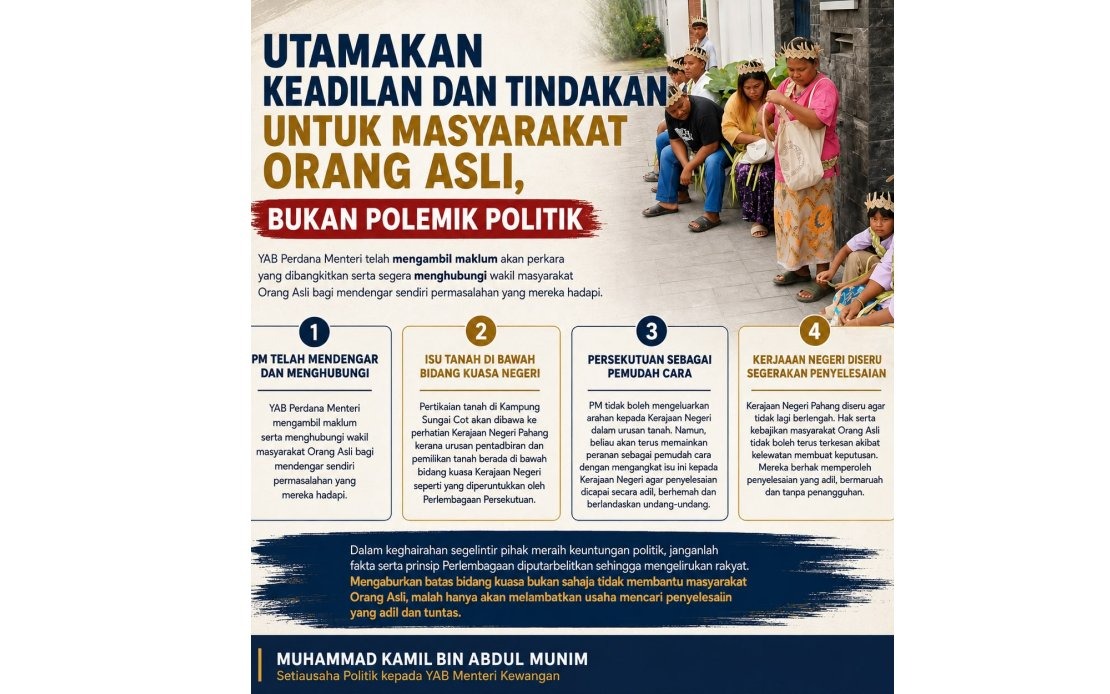
Prime Minister Datuk Seri Anwar Ibrahim has committed to maintaining an active facilitation role in resolving the contentious land dispute affecting the Orang Asli community in Kampung Sungai Cot, located in Maran, Pahang. According to Muhammad Kamil Abdul Munim, political secretary to the Finance Minister, the Premier intends to escalate the matter with the Pahang State Government to expedite a resolution that is both legally compliant and equitable to the affected indigenous community.
The Prime Minister's direct engagement with representatives from Kampung Sungai Cot underscores the significance of the issue at the highest levels of governance. Muhammad Kamil revealed that Anwar has personally reached out to community leaders to gain substantive understanding of the circumstances and barriers they confront. This hands-on approach represents an effort to move beyond bureaucratic distance and engage meaningfully with the indigenous population's concerns regarding their ancestral lands.
A fundamental constitutional constraint shapes the boundaries of federal intervention in this matter. Land administration and ownership remain the exclusive domain of state governments, as enshrined in the Federal Constitution. Muhammad Kamil emphasized that while the Prime Minister lacks the constitutional authority to mandate state government decisions on land matters, this does not translate into governmental indifference or abandonment of the affected community. Rather, his role centres on advocacy and facilitation—using federal influence to encourage expedited state-level action.
The political secretary issued an implicit rebuke to parties instrumentalizing the Orang Asli community's plight for electoral advantage. He cautioned against distorting constitutional principles or manipulating facts to mislead public opinion, arguing that such tactics ultimately undermine rather than support efforts to secure genuine resolutions. This framing reflects broader tensions surrounding indigenous land rights in Malaysia, where constitutional federalism sometimes becomes a convenient shield for inaction at the state level.
The indigenous population of Kampung Sungai Cot represents a particularly vulnerable demographic within Malaysia's landscape. Orang Asli communities have historically faced systemic marginalization regarding land tenure and resource rights, compounded by bureaucratic fragmentation between federal and state authorities. The Pahang State Government's jurisdiction over this matter places primary responsibility on state-level institutions, yet also creates potential for delays if state priorities diverge from federal emphasis on swift resolution.
Muhammad Kamil's statement carries an implicit urgency directed at state authorities, urging them to discharge their obligations without further postponement. He stressed that the continued welfare and rights of the Orang Asli population should not suffer from prolonged governmental deliberation. This language suggests frustration within federal circles regarding the pace of state action or the complexity of the matter, and reflects a broader push to accelerate resolution processes that have apparently stalled.
The matter entered public discourse following a Facebook post by Anwar on Friday, wherein he reiterated his intention to engage the Pahang State Government given the jurisdictional parameters governing land administration. This digital platform communication signals the Premier's awareness that the issue carries public resonance and merits transparent acknowledgment. For a community struggling with land security, such high-level political visibility can either catalyze meaningful action or remain symbolic gesture depending on implementation dynamics.
The Orang Asli struggle for land rights in Maran reflects broader Southeast Asian patterns of indigenous marginalization amid state consolidation and economic development pressures. Malaysia's federal system theoretically protects state autonomy over natural resources and land tenure, yet this same structure can become a barrier to protecting minority communities when state governments prioritize alternative interests. The Kampung Sungai Cot dispute illustrates these institutional tensions at ground level.
For Malaysian civil society and indigenous advocacy organizations, the Prime Minister's positioning as facilitator rather than direct arbiter carries significant implications. While federal leverage can incentivize state action, it cannot substitute for structural reforms ensuring indigenous land rights protection. The statement implicitly acknowledges these limitations while simultaneously declaring commitment to maximize available federal tools for community benefit.
Moving forward, the efficacy of this approach depends substantially on Pahang State Government responsiveness to federal facilitation efforts. Muhammad Kamil's emphasis on expedited, fair resolution signals that federal leadership expects tangible progress rather than indefinite postponement. The challenge now centres on translating political commitment into concrete administrative outcomes that genuinely address Orang Asli land security in Kampung Sungai Cot without perpetuating cycles of consultation followed by inaction.

