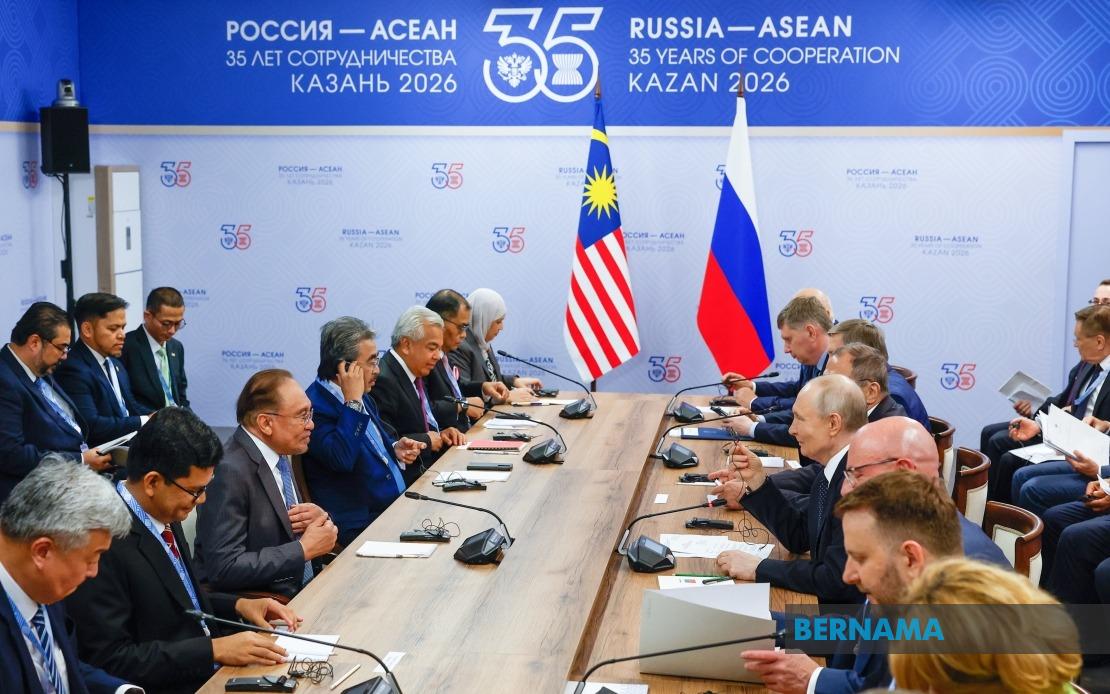
Prime Minister Datuk Seri Anwar Ibrahim has publicly recognised the efforts of Russian President Vladimir Putin and Chinese President Xi Jinping in promoting peace across West Asia and condemning the human rights abuses directed at civilians in Gaza, Iran and Lebanon. Speaking during an exclusive interview with Russian state broadcaster RT in Kazan, Anwar underscored Malaysia's unwavering commitment to maintaining an independent foreign policy stance that remains unaligned to any particular superpower interest, whilst simultaneously refusing to remain silent on matters of humanitarian concern and international justice.
Anwar's remarks came while he was in Kazan for the Commemorative Summit celebrating 35 years of diplomatic ties between ASEAN and Russia, providing a significant platform for the Malaysian leader to articulate his nation's perspective on one of the most contentious geopolitical issues of our time. The timing of his comments reflects Malaysia's broader diplomatic engagement with multiple stakeholders across the region, including leaders from the Gulf states, Pakistan, Türkiye and Iran, all part of a coordinated effort to facilitate a just and lasting resolution to the ongoing Middle Eastern tensions.
A critical distinction that Anwar emphasised throughout the interview centres on Malaysia's deliberate rejection of the term "neutrality" in favour of "centrality" when describing its approach to international affairs. This conceptual shift carries substantial implications for how Malaysia navigates the complex web of global power dynamics. Centrality, as Anwar explained, means that Malaysia refuses to be bound by ideological commitments to any particular bloc, whether Western or otherwise, while simultaneously maintaining the moral authority and international standing to take principled positions on human rights violations, minority rights abuses and atrocities committed against civilian populations.
The Prime Minister's framework distinguishes Malaysia's approach from traditional non-alignment doctrine, which often implied a passive stance during international crises. Instead, centrality positions Malaysia as an active participant in global affairs, capable of exercising moral judgment and diplomatic influence without surrendering its independence. This distinction becomes particularly relevant in Southeast Asia, where nations increasingly find themselves caught between competing interests of major powers, and where maintaining principled positions without triggering backlash requires sophisticated diplomatic navigation.
Anwar's government has consistently demonstrated this commitment through parliamentary action, securing bipartisan support for positions critical of Israeli military operations while maintaining diplomatic channels with various international actors. This parliamentary dimension is significant because it grounds Malaysia's foreign policy in domestic democratic legitimacy rather than executive whim alone, lending weight to the nation's international pronouncements and making them less susceptible to accusations of capricious or purely strategic posturing.
The Prime Minister directed sharp criticism toward what he characterised as Western hypocrisy in its treatment of Middle Eastern conflicts. His argument centres on an apparent contradiction wherein Western nations, particularly the United States, have provided military and diplomatic backing for Israeli military actions while simultaneously criticising other regional actors for their responses. Anwar's framing of this as hypocrisy rather than legitimate geopolitical preference carries weight precisely because Malaysia has no ideological investment in either camp, allowing it to observe the inconsistency from a position of genuine independence.
Anwar specifically highlighted the disparity in international responses to aggression against Iran compared to actions against other regional actors. His observation that the international community has maintained silence regarding what he terms aggression against Iran while vocally condemning other military actions underscores a fundamental inconsistency in how international norms are applied. This selective application of moral standards, whether intentional or structural, undermines the credibility of international humanitarian frameworks and makes smaller nations like Malaysia justifiably wary of relying on Western-dominated institutions for protection.
The broader context for Anwar's remarks includes Malaysia's significant economic and strategic interests in maintaining stability across West Asia. As a trading nation dependent on secure maritime routes and stable energy supplies, Malaysia has genuine strategic reasons to advocate for peace in the region beyond purely humanitarian or ideological concerns. However, the Prime Minister's framing suggests that economic interests and moral principles need not be in conflict; indeed, genuine and lasting peace requires that international conduct be grounded in consistent application of humanitarian principles rather than shifting calculations of strategic advantage.
For Southeast Asian audiences specifically, Anwar's approach offers a model for how regional nations can engage with global power struggles while maintaining their interests and principles. Malaysia's deliberate cultivation of relationships across multiple regional and global blocs—evidenced by its engagement with the Gulf, Pakistan, Türkiye, Iran, Russia and China—demonstrates that non-alignment need not mean isolation or irrelevance. Instead, it can be a source of diplomatic leverage and moral authority, particularly when paired with consistent principled positions.
The Russia visit itself carries symbolic significance in this context. Malaysia's engagement with Russia, a nation facing Western sanctions and diplomatic isolation, demonstrates the nation's commitment to maintaining its own foreign policy course regardless of Western preferences. This independence becomes increasingly important as geopolitical tensions rise and pressure grows for nations to choose sides in emerging great power competition between the United States and China.
Anwar's emphasis on ASEAN centrality rather than neutrality also suggests an evolution in how the regional bloc might position itself in future international deliberations. Rather than retreating into silence or abstention when major powers clash, ASEAN nations, through Malaysia's articulation, are suggesting they will continue to speak out on matters of principle even when doing so creates diplomatic friction with powerful actors. This represents a potentially significant shift in regional diplomatic posture with implications for how ASEAN engages with the rules-based international order.
The challenge ahead for Malaysia lies in sustaining this principled position while managing the inevitable complications that arise from attempting to maintain good relations across deeply divided camps. Anwar's diplomatic engagement across these various stakeholders suggests confidence that this balance is achievable, though maintaining it will require continued political will and sophisticated execution. For a nation of Malaysia's size and resources, projecting this kind of independent moral voice on global affairs represents significant diplomatic ambition, one that carries both opportunities and risks in an increasingly polarised international environment.

