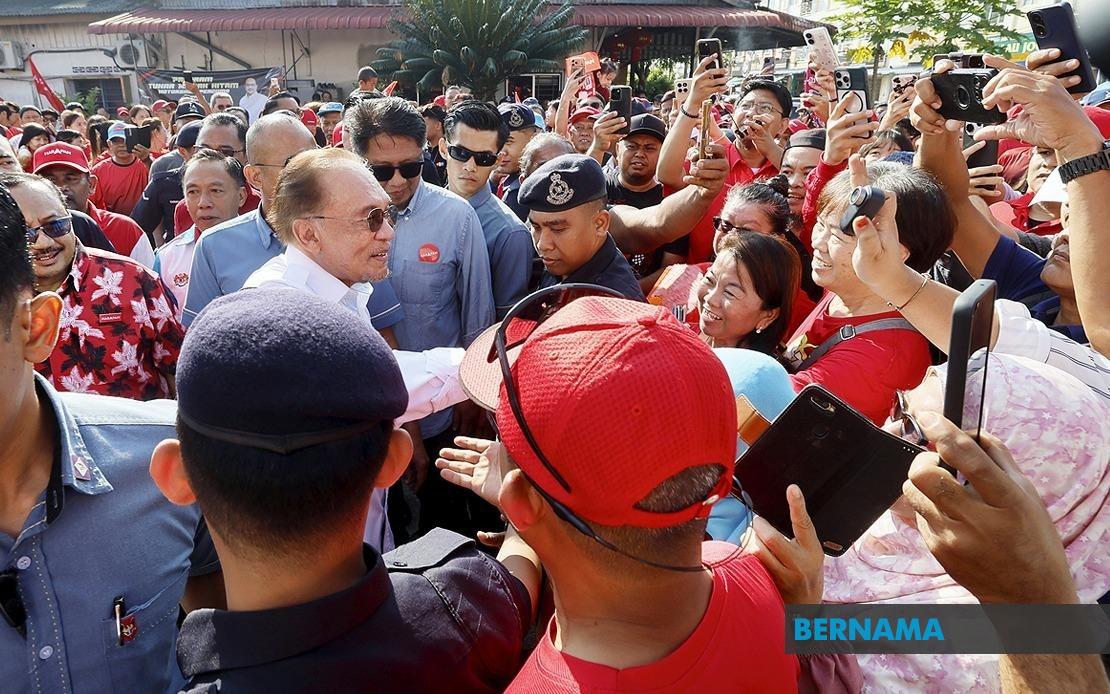
Prime Minister Datuk Seri Anwar Ibrahim moved to counter perceptions of political bias in federal resource allocation on July 9, asserting that his administration distributes development benefits equitably across Malaysia irrespective of which coalition controls state governments. Speaking at a campaign event in Senggarang, Batu Pahat during the run-up to the 16th Johor state election, Anwar emphasised that the Federal Government's commitment to inclusive development transcends partisan considerations and extends to all communities nationwide.
The Prime Minister's remarks arrive at a politically sensitive moment as Pakatan Harapan campaigns in Johor, a state historically dominated by opposition parties. His statement directly addresses longstanding accusations from rival political camps that the federal government channels disproportionate resources toward states governed by its coalition partners. By explicitly naming states led by different political groupings—including Kelantan and Kedah, both held by PAS—Anwar sought to demonstrate that development allocation decisions operate independently of partisan calculations.
As chairman of Pakatan Harapan in addition to his role as Prime Minister, Anwar occupies a dual position that inevitably invites scrutiny regarding potential conflicts between governing the nation and advancing coalition interests. His emphasis on impartiality reflects an attempt to separate these roles in the public mind, though the practical reality of simultaneous responsibilities as both chief executive and party leader remains a persistent point of political contention in Malaysian governance discourse.
The Federal Government has indeed pursued substantial infrastructure initiatives in Johor, with Anwar highlighting the Johor-Singapore Special Economic Zone as a flagship development. This cross-border initiative represents a strategic economic undertaking extending beyond ordinary state-level politics, designed to position the region as a major commercial and industrial hub. The project's significance transcends immediate electoral considerations, though its prominent mention during campaigning underscores how major infrastructure serves dual purposes as both genuine policy implementation and electoral messaging.
Beyond the flagship JS-SEZ project, Anwar pointed to flood mitigation investments as evidence of federal commitment to Johor's welfare. The government has greenlit billions of ringgit for flood management programmes in Segamat and Muar, constituencies vulnerable to seasonal inundation. These water management projects carry particular weight in Malaysia's political context, where natural disasters directly impact electoral sentiment and public satisfaction with governmental competence. Investment in flood resilience, therefore, functions simultaneously as practical governance and political necessity.
The broader pattern of development initiatives across multiple states reflects a deliberate strategy to construct a national narrative of inclusive governance. By distributing visible infrastructure projects—economic zones, flood defences, and related undertakings—across geographically and politically diverse regions, the federal administration attempts to present itself as transcending factional interests. For Malaysian voters accustomed to regional resource disparities and concerns about political discrimination in allocation, such demonstrations hold considerable persuasive power.
Kelantan and Kedah, specifically mentioned by Anwar, merit closer examination in this context. Both states operate under PAS governance, making them administratively controlled by a party outside Pakatan Harapan's coalition structure. Federal support for development in these regions gains particular political significance precisely because it contradicts the hypothesis that ruling coalitions systematically deprioritise opposition-governed areas. Whether such support materialises consistently and at comparable levels to coalition-controlled territories remains subject to empirical verification and political dispute.
The campaign event itself demonstrates how development rhetoric becomes intertwined with electoral strategy in Malaysian politics. Communications Minister Datuk Fahmi Fadzil's presence, alongside PH candidates for three Johor constituencies, underscores the calculated nature of the Prime Minister's appearance and messaging. Campaign rallies function as platforms for establishing policy narratives intended to resonate with voters whilst simultaneously mobilising party supporters and candidates.
For Malaysian audiences beyond Johor, Anwar's statements carry implications regarding the anticipated tenure of his administration. They signal a commitment to maintaining federal development as a politically neutral function, at least in rhetorical terms. This positioning becomes increasingly important as Malaysia navigates periods of divided governance, where single coalitions no longer control all state assemblies. In such a configuration, credible assertions of impartial resource distribution become essential to national cohesion and interstate relations.
The challenge facing any federal administration attempting to demonstrate genuine impartiality lies in the asymmetry between rhetorical claims and measurable outcomes. Development spending, infrastructure placement, and resource allocation are inherently visible and subject to quantitative analysis. Communities and political observers can track whether promised projects materialise, compare investment levels across states, and evaluate whether timing aligns with electoral cycles. Such scrutiny means Anwar's assertions will face empirical testing throughout his administration's tenure.
Looking beyond the immediate electoral context of the Johor state election, the Prime Minister's emphasis on inclusive development reflects deeper imperatives within Malaysia's contemporary political system. With no single coalition commanding overwhelming dominance across all state governments, federal authorities cannot function effectively by systematically marginalising opposition-controlled territories. Practical governance requires cooperation, negotiation, and at minimum, the appearance of fairness in resource distribution. Anwar's articulation of these principles, whatever the underlying reality, acknowledges this structural reality.
The involvement of candidates from constituencies across Johor—Onn Abu Bakar, Mohd Khuzzan Abu Bakar, and Felicia Poh Rui Ling representing Senggarang, Semerah, and Penggaram respectively—personalises the broader development narrative. Individual candidates become embodiments of the promised development agenda, their local credentials and campaign messaging reinforcing the federal government's claims of commitment to specific constituencies. This localisation of national policy statements strengthens the emotional resonance of political messaging.
Ultimately, Anwar's reaffirmation of impartial governance standards establishes a benchmark against which his administration will be judged. Whether the Federal Government subsequently demonstrates consistency between these stated principles and concrete resource allocation will significantly influence voter confidence, interstate relations, and the broader narrative surrounding Pakatan Harapan's fitness to govern. The campaign trail assertions made in Senggarang provide a foundation upon which Malaysian political debate will build in coming months.

