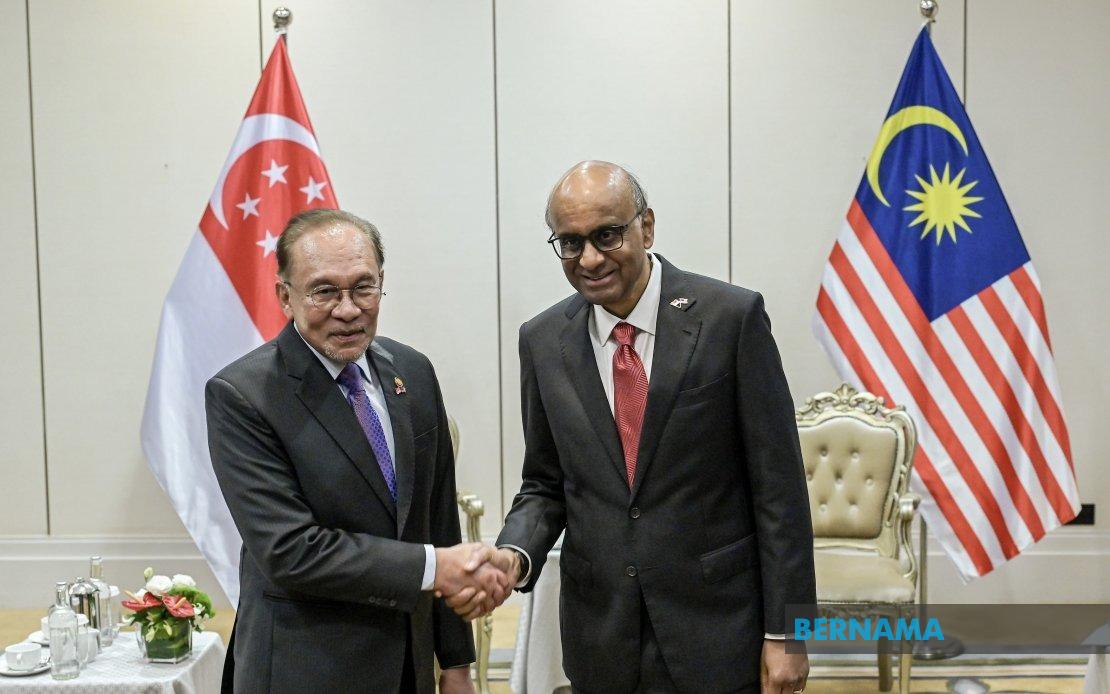
Prime Minister Datuk Seri Anwar Ibrahim received Singapore President Tharman Shanmugaratnam on Monday during an official state visit that underscores the deepening ties between Malaysia and its closest economic partner in Southeast Asia. The 40-minute bilateral meeting, held in Kuala Lumpur, brought together senior government figures from both nations in a show of diplomatic solidarity and shared commitment to strengthening cross-border relations.
The delegation attending the session reflected the breadth of bilateral engagement, with Malaysia represented by Foreign Minister Datuk Seri Mohamad Hasan, Investment, Trade and Industry Minister Datuk Seri Johari Abdul Ghani, and Entrepreneur and Cooperatives Development Minister Steven Sim Chee Keong, alongside senior officials. The presence of trade-focused ministers signalled that economic cooperation would likely feature prominently in their discussions, particularly given the robust trading relationship between the two neighbours.
The three-day visit, scheduled from July 13 to 15 at the invitation of the Yang di-Pertuan Agong Sultan Ibrahim, carries significant ceremonial weight. Earlier on Monday, President Tharman was extended a formal state welcoming ceremony at Istana Negara by the King himself, marking the visit's importance in Malaysia's diplomatic calendar. This hospitality represents the reciprocal nature of bilateral relations, with the visit mirroring Sultan Ibrahim's official trip to Singapore in May 2024.
The timing and protocol of such exchanges illustrate how Malaysia and Singapore, despite occasional political tensions, maintain institutionalised high-level engagement that transcends day-to-day policy disagreements. State visits provide both nations with opportunities to reset narratives around cooperation and to demonstrate shared interests in regional stability and economic prosperity to their respective publics and the international community.
Singapore's centrality to Malaysia's economic architecture cannot be overstated. The city-state remains Malaysia's second-largest trading partner globally and its single largest trading partner within ASEAN, a distinction that shapes everything from supply chain management to investment flows and technological collaboration. This dominant position reflects decades of economic integration driven by geographic proximity, complementary economies, and institutional frameworks that have facilitated seamless commerce across the Johor Strait.
Bilateral commerce between the two countries demonstrated resilience in the first half of 2025, with trade figures suggesting an accelerating recovery trajectory. From January to May, bilateral trade surged 14.5 per cent year-on-year to RM189.90 billion, compared with RM165.93 billion during the same period in 2024. This robust growth trajectory, if sustained through the remainder of the year, could position 2025 as a banner year for Malaysia-Singapore trade after more modest gains in previous periods.
The annual trade figures paint a comprehensive picture of the relationship's economic dimensions. In 2025, total bilateral commerce reached RM402.35 billion, representing a 1.5 per cent increase from the previous year. While this growth rate appears modest in percentage terms, the absolute value reflects the sheer scale of economic integration—nearly 400 billion ringgit in annual commerce speaks to thousands of businesses, millions of workers, and complex supply chains that depend on smooth Malaysia-Singapore relations.
For Malaysian manufacturers, retailers, and service providers, Singapore serves as both a market and a gateway to global commerce. Conversely, Singapore's industries depend on Malaysian resources, labour, and market access. This mutual economic interdependence creates natural incentives for both governments to maintain stable diplomatic relations and to resolve disputes through negotiation rather than confrontation. During a state visit, these economic fundamentals invariably influence discussions at the highest levels.
The growth acceleration evident in the first five months of 2025 suggests that the bilateral relationship is responding positively to improved regional sentiment and potentially to new trade initiatives or regulatory adjustments. Malaysian policymakers and business leaders will be monitoring whether this growth momentum can be sustained, particularly given uncertainties surrounding global trade patterns and regional geopolitical developments that could affect investment flows and commercial confidence.
For Malaysian stakeholders, including investors, exporters, and workers with connections to Singapore, state visits like this serve as barometers of government-to-government relations. Strong ceremonial observance and high-level participation suggest that bilateral institutions remain robust and that both sides view the relationship as sufficiently important to invest time and diplomatic capital. The presence of Malaysia's trade minister and investment minister in the meeting with President Tharman indicates that practical economic matters likely featured in their conversation.
Looking forward, the consistency of high-level bilateral engagement through state visits and reciprocal diplomatic visits helps to institutionalise Malaysia-Singapore relations in ways that transcend electoral cycles or temporary political disagreements. Both nations recognise that their fates are intertwined in ways that demand sustained cooperation on trade, infrastructure, security, and environmental issues. Presidential and prime ministerial visits, whatever their formal agenda, serve the deeper purpose of maintaining the diplomatic relationships that make everyday commerce and cooperation possible.
The three-day visit provides an extended opportunity for discussions that extend beyond the formal meeting captured in official statements. Behind-the-scenes conversations typically cover outstanding bilateral issues, regional developments, and forward-looking initiatives. For Malaysia, hosting a state visit from Singapore's head of state represents both an opportunity and an obligation—an opportunity to advance mutual interests and an obligation to maintain the standards of diplomatic protocol that keep relations functioning smoothly despite occasional strains.

