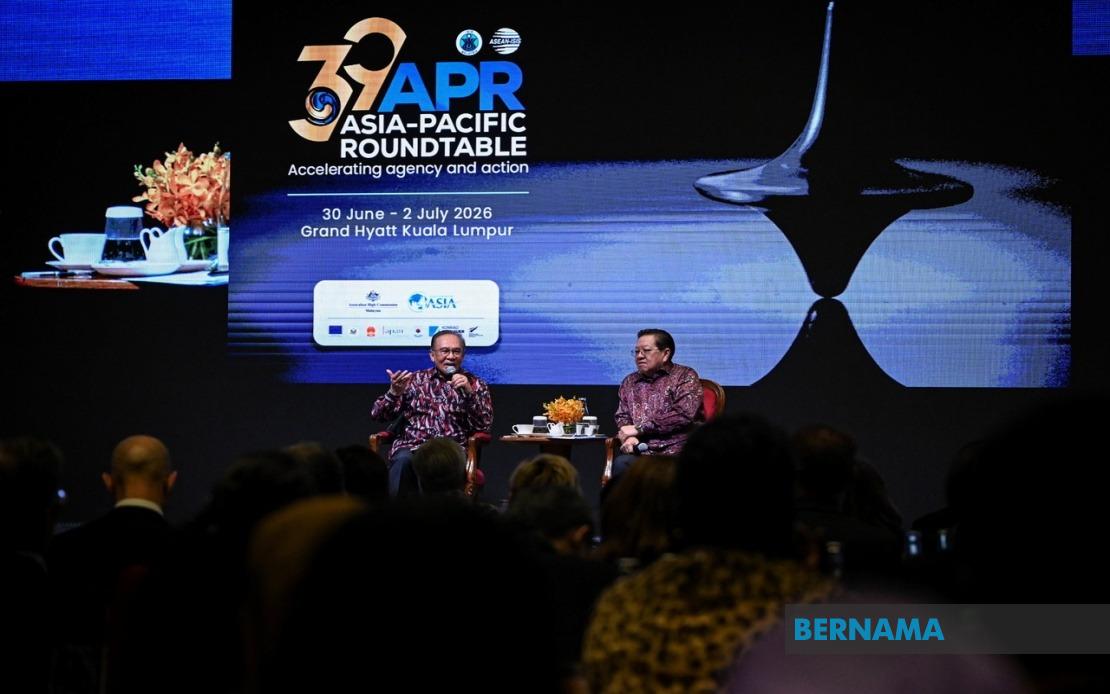
Prime Minister Datuk Seri Anwar Ibrahim has categorically rejected the prevailing narrative that confrontation in the South China Sea is an unavoidable outcome, instead championing dialogue, mutual confidence and respect for international legal frameworks as the cornerstones of regional stability. Speaking at the 39th Asia-Pacific Roundtable in Kuala Lumpur this week, Anwar articulated a vision of the waterway—contested by multiple claimants including Malaysia, China, Vietnam, the Philippines, and others—as fundamentally manageable through sustained diplomatic engagement rather than military posturing or worst-case scenario thinking.
The Prime Minister's remarks come at a time when geopolitical tensions in Southeast Asia have periodically flared, driven by territorial disagreements, resource competition, and broader strategic rivalries between major powers. By publicly distancing Malaysia from apocalyptic framings of the dispute, Anwar signals that Kuala Lumpur intends to navigate the delicate balance between asserting its own maritime rights and maintaining pragmatic economic and political relationships with Beijing, a crucial trading partner and investor. His comments underscore a Malaysian strategy that seeks to decouple sovereignty concerns from wholesale adversarial positioning.
Anwar highlighted the substance of Malaysia's direct bilateral experience with China, noting productive conversations with President Xi Jinping and Premier Li Qiang that have not, in his assessment, generated the kinds of flashpoints or inflammatory incidents that might justify alarmist rhetoric. This framing is particularly significant for Malaysian audiences and policymakers, as it suggests that the maritime disagreements—while real and requiring patient resolution—need not poison the broader relationship or become a driving force behind regional militarization. The Prime Minister's confidence in ongoing bilateral communication reflects a deliberate choice to privilege functional diplomacy over confrontational posturing.
Central to Anwar's position is Malaysia's commitment to the United Nations Convention on the Law of the Sea (UNCLOS), which provides the legal scaffolding for resolving maritime disputes. The Prime Minister emphasized that China has publicly endorsed UNCLOS principles and remains engaged in negotiations on the ASEAN-China Code of Conduct, a multilateral framework intended to establish rules of engagement and reduce the risk of accidents or miscalculation spiralling into larger incidents. The ongoing negotiation process itself represents an achievement; it demonstrates that claimant states and China recognize the utility of codified protocols, suggesting that the region has moved beyond zero-sum thinking.
Anwar cautioned against what he termed excessive focus on scenarios of armed conflict, arguing that such narratives can become self-fulfilling by hardening positions, inflaming public opinion, and constraining political leaders' room for manoeuvre. This warning resonates particularly in Southeast Asia, where social media amplification and nationalist sentiment can rapidly mobilize opinion around sovereignty questions. By encouraging restraint in public discourse, the Prime Minister is advocating for a mature approach to foreign policy that distinguishes between legitimate assertion of rights and unnecessary escalation through inflammatory messaging.
The Prime Minister's confidence in ASEAN's stabilizing role derives from the organization's track record of managing intra-regional tensions through consensus-building and quiet diplomacy among member leaders. He pointed to the frequency and quality of direct communication between ASEAN heads of government as instrumental in preventing disagreements from metastasizing into serious confrontations. This institutional and interpersonal dimension of ASEAN statecraft—often overlooked in analyses focused on formal mechanisms—has indeed proven more durable than many external observers anticipated. For Malaysian readers, this underscores the value of ASEAN solidarity, even when individual members pursue distinct bilateral relationships with major powers.
Beyond the South China Sea, Anwar demonstrated consistent application of these diplomatic principles by welcoming Cambodia and Thailand's commitment to sustained negotiations on their longstanding border dispute. By framing many regional boundary disagreements as historical legacies stemming from colonial-era administrative decisions, rather than intractable ethnic or religious conflicts, Anwar offered a subtle reframing that emphasizes their potential manageability. This comparative perspective—noting that other regions have resolved inherited border disputes through patience and mutual trust—subtly argues that Southeast Asian states possess the institutional maturity and political will to do likewise.
The Prime Minister's vision also encompasses reform of global multilateral institutions, particularly the United Nations and World Trade Organisation. Anwar's linkage of South China Sea stability to broader questions of international institutional legitimacy reflects recognition that regional peace ultimately depends on whether major powers, especially China and the United States, perceive the international system as reasonably fair and responsive to their interests. For Malaysia and other Southeast Asian nations, this suggests that sustainable regional arrangements require not just bilateral accommodation but also structural reforms that enhance the relevance and perceived legitimacy of global governance frameworks.
Anwar's pronouncements carry weight in Malaysian discourse, as they establish the government's official position against more hawkish or nationalist rhetoric that might circulate in political opposition or media commentary. By explicitly rejecting conflict fatalism, the Prime Minister is making a political choice to keep open the space for economic cooperation, cultural exchange, and diplomatic negotiation with all parties, including China. This positioning allows Malaysia to maintain its own maritime claims while avoiding the binary choice between total capitulation and perpetual confrontation.
The implications extend beyond Malaysia's bilateral relationships to the broader regional architecture. If Anwar's framing gains traction—particularly among other ASEAN members and the international business community—it could reinforce incentives for sustained dialogue over military buildups. Conversely, if geopolitical pressures intensify or if specific incidents occur, this optimistic narrative could be tested and potentially undermined. For now, however, the Prime Minister has staked out a measured middle ground that prioritizes pragmatism and institutional frameworks over zero-sum competition, reflecting a Malaysian approach that has historically sought to maximize autonomy and benefit from engagement with multiple powers rather than alignment with any single bloc.

