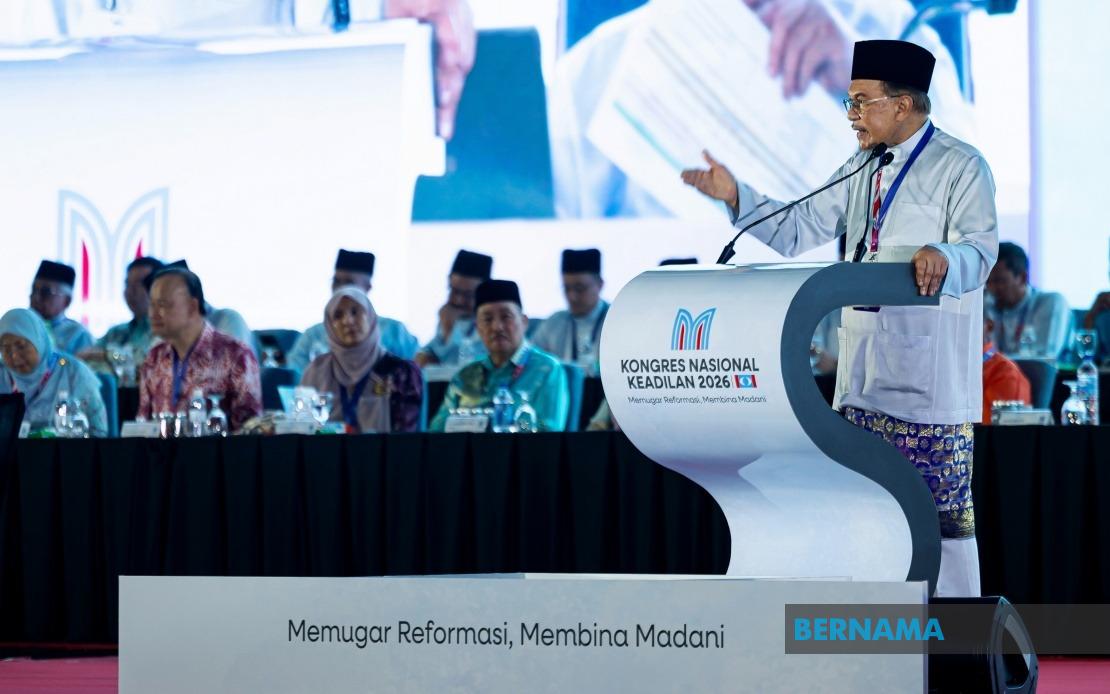
Prime Minister Datuk Seri Anwar Ibrahim moved to quash speculation about interpersonal tensions within Malaysia's Unity Government during his address at the 2026 PKR National Congress in Melaka, insisting that his working relationship with Deputy Prime Minister Datuk Seri Dr Ahmad Zahid Hamidi remains intact and functional. Speaking to journalists at the Melaka International Trade Centre on August 15, the PKR president flatly rejected recent allegations that trust between the two leaders had eroded, characterizing the criticism as merely one individual's subjective interpretation rather than a reflection of actual circumstances.
The Prime Minister's remarks came in direct response to claims made a day earlier by Khairy Jamaluddin, the former UMNO Youth chief and Rembau MP, who had suggested that the relationship between Anwar and Ahmad Zahid had significantly weakened since the Unity Government's formation in 2022. Khairy attributed this apparent deterioration to escalating tensions between Barisan Nasional and Pakatan Harapan, particularly following BN's strategic decision to align with Perikatan Nasional in the Negeri Sembilan state election. However, Anwar framed such interpretations as emerging from a worldview fundamentally at odds with his own governance philosophy.
In explaining the divergence between his assessment and Khairy's, Anwar articulated a philosophical distinction regarding how different leaders process political developments. He suggested that Khairy habitually examines situations through a lens of conflict and competition, whereas his own approach prioritizes consensus-building and non-confrontational dialogue. This characterization offered insight into broader differences in leadership temperament within the coalition, with Anwar positioning his method as the path toward sustainable governance while implicitly criticizing alternative approaches as inherently divisive or destabilizing.
The Prime Minister's public affirmation of Ahmad Zahid's contributions to Malaysia's political architecture carried particular significance given the scrutiny surrounding the Unity Government's stability. During his presidential address at the congress, Anwar took the opportunity to formally acknowledge BN's and Ahmad Zahid's instrumental role in facilitating the coalition's establishment following the 15th General Election. This public recognition functioned both as diplomatic courtesy and strategic reaffirmation of the government's foundational partnership, designed to project unity to party members and the broader public at a moment when cracks appeared to be showing.
The Unity Government, which unified rival parties following the contentious 2022 election outcome, has faced repeated tests of its cohesion throughout its tenure. The structure brought together historically antagonistic political forces—PKR, Barisan Nasional, and later Perikatan Nasional—creating an arrangement that observers have described as inherently fragile. Tensions between BN and PH have periodically surfaced over policy direction, ministerial appointments, and electoral strategy, with state-level elections proving particularly revealing of underlying strains.
Anwar's response to Khairy's allegations highlighted a deliberate strategy of compartmentalizing disagreement within the coalition from declarations of fundamental rupture. Rather than dismissing concerns entirely or engaging in defensive rhetoric, he acknowledged that differing perspectives naturally emerge both within individual parties and across the coalition's various components. However, he insisted that such differences remained manageable through established mechanisms of dialogue and dispute resolution, provided all parties approached discussions with commitment to peaceful resolution rather than confrontational posturing.
The timing of Anwar's remarks carried broader implications for the government's political trajectory. With the Negeri Sembilan election having demonstrated BN's willingness to pursue alternative alliances outside the Unity framework, questions naturally arose regarding the coalition's future durability. By publicly restating his confidence in Ahmad Zahid and the partnership, Anwar sought to prevent speculation about potential coalition breakdown from acquiring momentum among rank-and-file members or influencing their interpretation of recent political developments.
Khairy's decision to publicly articulate concerns about eroding trust between the coalition's leadership figures represented an unusual intervention by a backbench MP in matters of high-level diplomatic significance. His comments suggested that anxieties about the Unity Government's stability extended beyond formal party channels and had begun circulating among senior figures who, while no longer in executive positions, retained considerable influence over party narratives. This public airing of concerns potentially reflected broader unease within UMNO regarding the partnership's direction or its electoral prospects.
The contrast between the two leaders' characterizations of coalition health underscored competing interpretations of normal political friction versus genuine relationship breakdown. Where Khairy saw deteriorating trust, Anwar perceived inevitable disagreement between coalition partners whose interests did not perfectly align but whose commitment to the broader governing project remained firm. These divergent assessments reflected fundamentally different expectations about what the Unity Government could realistically achieve and at what cost to the participating parties' individual identities and policy agendas.
Anwar's emphasis on pursuing peaceful resolution mechanisms rather than confrontational approaches appeared aimed at establishing a template for managing future coalition tensions. By framing his leadership style as inherently committed to dialogue and consensus-seeking, he positioned himself as the stabilizing force within an arrangement predisposed toward instability. This rhetorical strategy served to reinforce his authority while subtly delegitimizing critics who questioned coalition sustainability as unnecessarily destructive or excessively pessimistic about collaborative governance possibilities.
For Malaysian observers monitoring the Unity Government's trajectory, Anwar's statements provided reassurance that the coalition's primary architects retained commitment to their arrangement despite observable strains. Whether such public affirmations reflected genuine confidence in the partnership's durability or represented necessary damage control following Khairy's comments would likely become clearer as the government navigated upcoming electoral challenges and policy disagreements. The fundamental question of whether diverse political interests could be sustainably managed within a single governing structure remained unresolved, with both leaders offering competing visions of the coalition's current health and future prospects.

