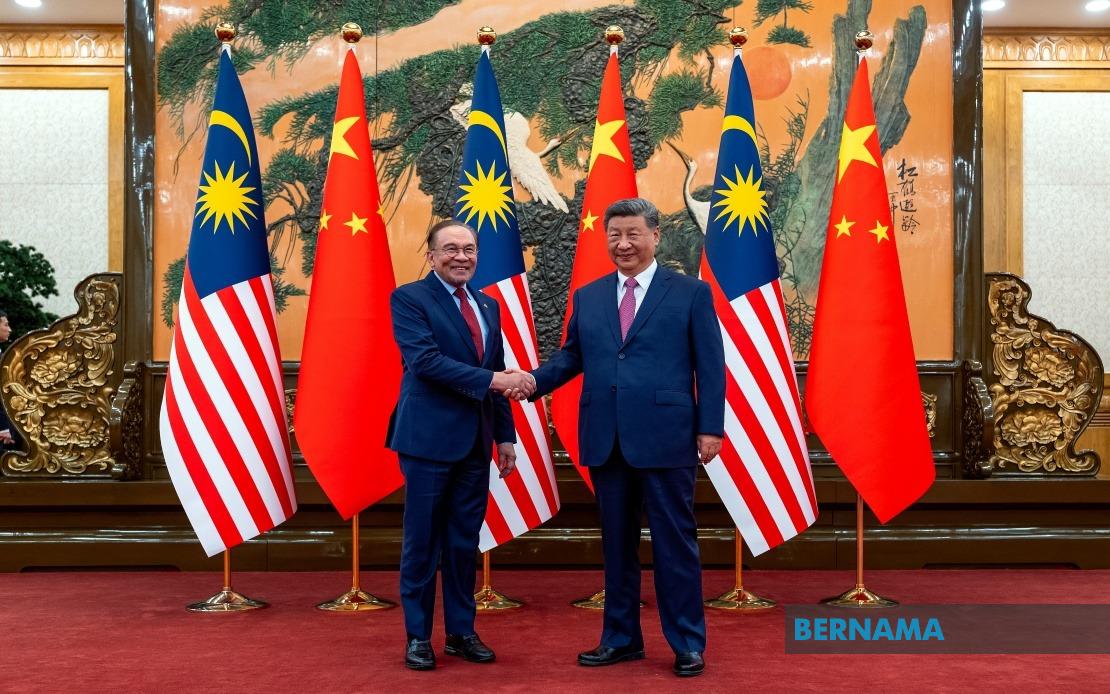
Prime Minister Datuk Seri Anwar Ibrahim has extended formal congratulations to the Chinese government marking the 105th anniversary of the Chinese Communist Party, underscoring the continued importance Malaysia places on its relationship with Beijing. In a statement posted on social media, Anwar revealed that he had dispatched a letter directly to Chinese President Xi Jinping conveying warm wishes from both the Malaysian government and its people on this significant occasion for the ruling party.
The message carries particular diplomatic weight given Malaysia's strategic positioning in Southeast Asia and the evolving dynamics of regional geopolitics. By personally reaching out to the Chinese leadership, Anwar is reinforcing the bilateral relationship at the highest levels, demonstrating Malaysia's willingness to maintain cordial ties despite the complex multipolar environment characterizing contemporary Asia-Pacific relations.
In his correspondence, Anwar emphasised Malaysia's admiration for the Chinese Communist Party's lengthy historical trajectory and its pivotal role in shaping modern China's development. The Prime Minister specifically highlighted his appreciation for how the party's evolution has been grounded in the country's ancient civilisation, enduring historical narratives, and the cultural values that have accumulated across countless generations. This framing positions China's political development as emerging organically from its civilisational heritage rather than as an imported system, a characterisation that resonates with Beijing's own self-presentation.
Crucially, Anwar drew attention to a watershed moment in Malaysian-Chinese bilateral relations: May 31, 1974, when Malaysia became the first Southeast Asian nation without socialist governance to formally recognise the People's Republic of China. This decision represented a bold diplomatic gambit during the height of Cold War divisions, when many Western-aligned countries maintained formal ties exclusively with the Republic of China on Taiwan. By invoking this historical precedent, Anwar underscored Malaysia's record of pragmatic engagement with China and its willingness to prioritise mutually beneficial relations over ideological considerations.
The 1974 recognition decision reflected considered statecraft rather than mere expedience. Malaysian policymakers at the time calculated that engaging with mainland China, despite its socialist government, would serve the nation's economic and security interests while also positioning Malaysia as a bridge between the communist and non-communist worlds in Southeast Asia. More than five decades have elapsed since that diplomatic watershed, and Anwar's invocation of it suggests that Malaysian leadership continues to view that original decision as validating Malaysia's broader foreign policy orientation toward pragmatism and strategic flexibility.
Anwar emphasised that the foundation laid in 1974 has only solidified over the intervening decades, becoming an increasingly robust platform for deepening substantive cooperation. The relationship has expanded far beyond symbolic diplomatic recognition to encompass extensive economic interdependence, investment flows, infrastructure projects, and cultural exchanges. Malaysia's positioning as a gateway between China and Southeast Asia, combined with shared interests in regional stability, has made the relationship mutually valuable for both capitals.
The Prime Minister reiterated Malaysia's forward-looking commitment to expanding strategic partnerships with China across multiple domains, grounding this pledge in three fundamental principles: mutual respect, reciprocal trust, and benefits that accrue equitably to both nations. This tripartite formulation reflects Malaysia's desire to present the relationship as balanced and reciprocal rather than hierarchical, addressing concerns that occasionally emerge about asymmetrical dependencies or undue Chinese influence in regional affairs.
Moreover, Anwar linked Malaysia-China cooperation to broader regional imperatives, explicitly tying bilateral engagement to the achievement of regional peace, stability, and economic prosperity. This broader framing situates Malaysia's relationship with Beijing not as a bilateral arrangement conducted in isolation but as integral to the maintenance of the regional order that benefits all Southeast Asian nations. It implicitly acknowledges that without China's constructive engagement and cooperation, the regional stability that underpins ASEAN prosperity becomes more difficult to sustain.
The timing of Anwar's message merits consideration within Malaysia's current foreign policy context. The Prime Minister has positioned himself as an advocate for balanced engagement with major powers, including China, the United States, and others. This measured approach reflects Malaysia's historical tradition of non-alignment and its contemporary interest in avoiding forced choices between competing power blocs. By maintaining warm relations with Beijing while simultaneously engaging Washington and other partners, Malaysia seeks to preserve its strategic autonomy and maximise the benefits flowing from multiple great-power relationships.
From a Southeast Asian perspective, Malaysia's relationship with China carries significance extending beyond bilateral dynamics. As one of the region's more economically developed nations and a key player in ASEAN, Malaysia's approach to China influences the broader regional calculus. Malaysia's demonstrated ability to maintain constructive relations with Beijing while preserving its strategic independence and regional commitments provides a model of pragmatic engagement that other Southeast Asian nations observe closely.
The letter exchange also occurs against the backdrop of intensifying great-power competition in Asia, where multiple nations compete for influence and alignment. Malaysia's reaffirmation of commitment to deepening cooperation with China, coupled with its emphasis on mutual respect and shared benefits, signals that Kuala Lumpur intends to remain an active participant in its relationship with Beijing rather than a passive recipient of Chinese initiatives. This active posture reflects Malaysia's aspiration to shape the bilateral agenda and ensure that cooperation serves Malaysian national interests effectively.

